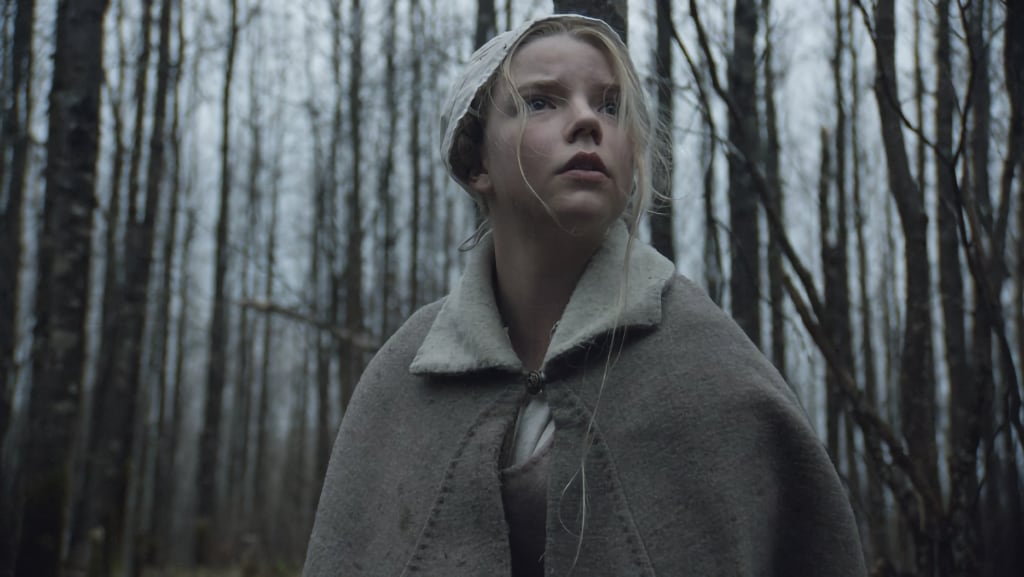
Thomasin is a teenage girl just like any other: too many chores, a bratty younger brother and sister, parents that just don’t understand, and burdened with the inescapable taint of original sin. And if that weren’t bad enough, her family’s just moved to a new place, far away from everybody she knows! But when she meets her new neighbor Philip, that’s when things get really crazy for Thomasin and the whole family!
Wouldst thou like to live hilariously? Catch The Witch this summer on The Disney Channel.
This is another one of those movies that I waited far too long to see, so I saw all of its influences on popular culture long before I saw the movie itself. And I’m not sure it was the best choice for Halloween night, since although it’s excellent, it’s not in the “fun and spooky” category of horror movie. Unless you really hate Puritans I guess?
I was surprised to be reminded that this was Robert Eggers’s first feature, since it’s so masterful right out of the gate. And on top of the beautiful cinematography and excellent performances, it’s so good at completely enshrouding you with mood. It feels a little like sucking on highly-concentrated bullion cubes of dread, and cold, and cold (the emotional variety), and guilt, and anxiety, and self-loathing, and injustice.
I had been spoiled on the very last scene, but very little of what came before it. And I’d read that it was left ambiguous as to whether the events in the movie are supernatural, or a figment of the characters’ imaginations. I didn’t get that ambiguity at all. I’d expected it to be even slower than it actually is, but it shows you its first horrific event pretty quickly. And there were too many logistical problems for me to think it’s all in Thomasin’s mind, or even an ergot-induced mass hallucination, things that no one in the family would’ve been around to witness.
And I think The Witch is entirely better for it. The horror doesn’t have to be metaphorical for it still to have resonance with its themes of hypocrisy, false or stubborn piety, shame, and persecution. There’s an implicit assertion that the problem with witch trials wasn’t that witches don’t exist.
One of the things that the movie does so well is plant an idea in your head and letting it take hold — not completely unlike hearing the whispers of a goat, now that I think of it. We’re only ever shown just enough of the horrific to let it linger in our minds, before the camera mercifully cuts to black. It even has the mercy of cutting around scenes that would just show the immediate reactions to something horrible, skipping forward to let us witness the aftermath. That makes it feel dreadful instead of torturous. As if the movie is letting an idea expand in our minds, instead of rubbing our nose in it.
Showing the father chopping wood over and over, from ominously high or low camera angles. Showing the brother opening up a steel trap with his tiny fingers. It all had me on edge, waiting for the thing that would turn things from bad to even worse.
The devotion to authenticity is evident throughout, and it doesn’t feel like unnecessary perfectionism but essential for making the movie’s themes felt as much as understood intellectually. It’s easier to appreciate the appeal of dogmatic faith when you see people surrounded by the hostile and the inexplicable.
The Witch is the perfect example of a movie that speaks for itself, in defiance of the urges of people like me to over-analyze or interpret it. At this point, I’ve seen and really enjoyed Nosferatu and The Witch, and they’ve both left me with the feeling that I’d absorbed the movie as much as I’d watched it. It may not be spooky fun, but it did remind me of the utter lack of certainty or security we have, adrift on a rock in the far edges of an uncaring cosmos, and really, isn’t that what Halloween is all about?