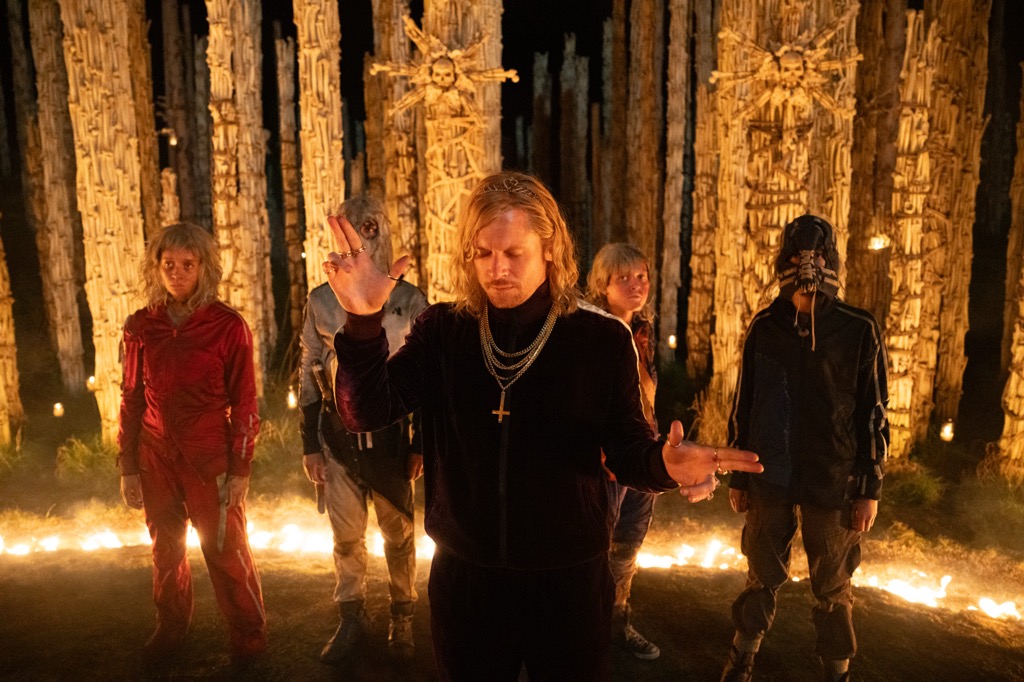
Early in 28 Years Later: The Bone Temple, Ralph Fiennes’s character Dr. Kelson is walking through a meadow, reciting poetry or maybe half-singing? I didn’t recognize a melody, but the cadence and certain phrases jumped out as something I should recognize. I struggled to remember where I’d heard it before: was it a traditional folk song? A poem I’d read in high school English class?
Suddenly, it hit me. Half-remembered lyrics from some of the British Isles’ finest poets: Duran Duran, with “Girls on Film.” And if I hadn’t remembered it, the movie would’ve made it explicit a few minutes later, when Kelson cranks up his record player and starts the song playing.
A later sequence — set in the tranquil meadow surrounding the Bone Temple, in contrast to extended scenes of horrific torture happening elsewhere — transitions to “Ordinary World” by Duran Duran. It’s a wonderfully succinct way to establish Kelson as a survivor from the old world, before the virus, showing us that this is the music he hears when he’s experiencing joy and beauty.
It’s also an excellent contrast to the recordings used in 28 Years Later. In particular, the recitation of “Boots” by Rudyard Kipling. That was the “theme” of the community of survivors on the island in that story: driving, regimented, emphasizing duty and relentless perseverance, clinging to an older vision of England that valued tradition, glory, and victory over joy and beauty.
And the relevance seemed even more obvious later in the movie, when one of the characters goes through a similar experience to the one I did: having fleeting memories from years ago, not quite able to identify where they came from, or to piece them together into anything coherent. Until suddenly, it all falls into place.
I’m not sure how much of that comparison was directly intentional, because I doubt most of the audience spent their formative years listening to Duran Duran. But it’s a brilliant way of establishing the language of this trilogy, a trilogy about people surviving in a new world with fractured or unreliable memories of the old. The audio — and frequently, flashes of non-diegetic imagery — are moments of intense POV from a character without actually switching the viewpoint to first-person. They represent not only what the character is feeling in that moment, but also what memories they value.
I was initially disappointed with The Bone Temple, since it seemed to lack all of the flourishes that made 28 Years Later so interesting. In particular, those flashes of non-diegetic imagery. I didn’t fully appreciate all of the shots of Errol Flynn and longbowmen and tanks and soldiers until weeks after seeing the movie, when I realized that they were specific to the residents of the island: locked in a never-ending war, clinging to a romanticized version of England and the war effort during WWII. They were contrasted with the visions of Spike and his mother, which were more child-like, either calling back to a fantastic and adventurous version of ancient England, or nostalgic memories of childhood before the outbreak.
The Bone Temple, by contrast, feels straightforward almost to a fault. In the first half hour or so, there are flashes of a consistent visual language for this series — shaky cameras and hyper-active editing, with footage that seems almost performatively digital — but there’s a vague sense that they’re there out of obligation more than anything else.
The exception is a jarring, brief shot that seems out of place, a soon-to-be victim of an attack from the infected, who seems to transform before they’re supposed to. It suggests an idea that isn’t confirmed until much later, and it’s one of the rare examples of living up to the “movies are a visual medium that can show just about anything, so why not use it?” philosophy of 28 Years Later. I wish there were more of it in The Bone Temple.
Without it, it almost feels like a documentary about a gang of sadistic, psychopathic, Satanists terrorizing the survivors of a zombie apocalypse. So much that I was tempted to walk out — not to give up entirely, because the movie’s too good for that, but to watch the rest of it later, at home, when I could pause to give myself a break from the extended torture. The Bone Temple is actually surprisingly merciful in cutting away from the gore instead of relishing in it, at least in terms of a series of movies where characters are torn apart and devoured by zombies. But it’s still intense and violent, leaving no ambiguity about what’s happening and what might happen next.
I’m very glad I didn’t walk out, though, because the entire movie builds to a climactic sequence that is just spectacular. Not just a satisfying conclusion to this movie’s story, but the feeling that the movie has finally broken free of its obligation to verisimilitude, and it can show us something terrifically weird. Plus it has the sense that even in a world where the zombie apocalypse has a scientific origin that isn’t at all supernatural, there’s still room for a kind of magic.
It makes the second installment of this trilogy not just essential, but retroactively improves the movies that came before it. It snaps the pieces into place that make it easier to see the themes that have been playing out on top of and around the largely plot-heavy movies that have preceded it. We’ve seen a bunch of stylishly innovative and well-executed movies about how different parts of the UK respond to the collapse of society; now we’re getting a clear picture of why the filmmakers believe these are stories worth telling.
But to go into that in more detail requires spoilers, so I recommend avoiding the rest until after you’ve seen both 28 Years Later and 28 Years Later: The Bone Temple.
Part of the reason that I’ve never been a huge fan of the 28 Days Later franchise is that I’m not interested in post-apocalyptic stories in general, and zombie stories even less so. More than any other type of “monster movie,” they’re interesting only for what they have to say that’s not about the monsters themselves.
And it feels like it’s a genre that’s been picked clean, thematically. This one is a satire about brain-dead commercialism! Or, what if the real monsters are the humans?! Did you ever think of that?
The only thing that 28 Days Later seemed to add was what if they’re really fast? and what if they’re all British?1And, I guess, what if we made mainstream horror movies that weren’t so hung up about casual male nudity? Apart from that, every installment has seemed like a really well-executed exercise in style, which evaporates as soon as the movie is over.
So I appreciated how The Bone Temple, five movies into the franchise, finally made it so clear that even I could understand it: these aren’t contemporary zombie movies that happen to be set in the United Kingdom; they’re specifically about the UK.2If not intentionally from the start with 28 Days Later, then at least retroactively with the new trilogy. They’re full of symbols specific to the UK, and that specificity adds depth to the more vague, generalized anxiety about the fall of civilization that’s inherent to zombie movies.
The added idea that the rest of the world has more or less gone to normal, while the UK has been left quarantined, emphasizes that specificity. I don’t think it’s just a commentary on British society, though; I think it’s more the case that England and Scotland have such a long history, full of symbols and images with vivid connotations, that it makes the concepts easy to read without necessarily needing to make them explicit.
I read a friend’s review of The Bone Temple on Letterboxd, and he said that it didn’t explore the Jimmy gang in the way that he expected, or deliver on their story in the way he would’ve liked. I was tempted to agree. It was such a bizarre coda to the end of 28 Years Later, seeming like such a bonkers non-sequitur, that it implied not only that the next movie would pick up immediately afterwards (which it does) but that it would focus on how this gang formed and what were the ideas behind it (which it doesn’t at more than a surface level).
But the other thing the teaser did was allow those of us outside the UK to read up on Jimmy Savile and find out the full significance of his story to UK audiences, and why he specifically was chosen as a symbol. And when you consider the two movies as a set, it becomes clearer that the symbol is more meaningful than its purpose in the plot.
According to the plot, it is just a stylistic flourish, something to make the gang more visually interesting than garden-variety sadistic Satanists. To a character of Sir Jimmy Crystal’s age, the Teletubbies and Savile would reasonably be the two things he remembered most from the old world. So we get the Teletubby dance, and the track suits, and the wigs, and “how’s that?” as the gang’s version of “amen.”
But these two movies3And possibly 28 Days Later as well? It’s been forever since I watched it. use images, sounds, music, and symbols to convey themes on a separate channel from the plot. To the degree that it can be interpreted as purely stylistic choices by people like me, who might not be familiar with all of the connotations. I initially took 28 Years Later‘s images of England Of Old to be the viewpoint of the movie, instead of the viewpoint of specific characters.
For the community on the island, the images are nostalgia for a heavily-romanticized version of England in wartime.
For Spike after he takes off with his mother, they’re images of a medieval church, with a vague suggestion of magic: not only does he still have a child’s impression of the world as a fantastic adventure story, but also everything he knows about “contemporary” society is so old and alien to him that it might as well be talking about the days of King Arthur.
For his mother, she’s simply struggling to remember her childhood and the last time she knew peace. Places aren’t unfamiliar simply because of age but because she has fractured memories of what they were like before society fell.
For Dr Kelson, we see photographs of his life in the old world (taken of Ralph Fiennes around the time of Strange Days, from the looks of it), and we hear Duran Duran songs to place him in a very specific time period: not necessarily perpetually stuck in the 1980s, but someone whose “comfort music” is from the 80s. Like most of the characters we see in these movies, he doesn’t have specific memories of the world before the outbreak, but more of an overall feeling for the time that appeals to him the most.
And all of these shattered or imperfect memories call back to specific times in England’s history, times with strongly identifiable connotations: tradition and perseverance, magic and adventure, home and family, prosperity and youth.
Which makes the choice of Savile as a symbol especially potent for a post-apocalyptic monster movie. This person was a cultural institution for decades, before being revealed as a monster concealing his crimes behind recognizable eccentricity and philanthropy, before being revealed as a monster who was protected and enabled by trusted institutions deliberately ignoring or belittling his crimes.
It’s familiar for post-apocalyptic stories, and zombie stories in particular, to focus on the horrors that humans are capable of, and to ask questions about what civilization and society look like after we rebuild it. Having the Jimmy gang take on the half-remembered appearance and mannerisms of Savile has the immediate connotation of psychopathic monsters trying to pass themselves off as members of polite society. But it also forces the audience to reconsider our baseline for polite society.
Everyone is trying to establish a new normal based on what they remember of society before the outbreak. There’s always an implication in these stories that there’ll be a point sometime in the future when the crisis is over and the survivors can rebuild. This trilogy is raising the question of whether the society we have now is worth rebuilding. Or whether our perception of the present is like the characters’ memories of it: not just imperfect, but sometimes outright false.
This all culminates in the best sequence of the movie, the part that took it from “I might walk out of this and catch the ending later” to “they’re doing something genuinely great with this new trilogy.” It’s when Dr Kelson turns it up to 11, obviously, but also in the way that that fantastic scene is intercut with Samson regaining his memories.
It’s significant that Kelson understands the rituals and knows exactly how to pull them off spectacularly, even though he doesn’t actually believe in any of it. We see that Jimmy Crystal doesn’t actually believe in it, either, even within the cloud of his genuine psychosis; at its heart, it’s self-serving manipulation to keep himself in power.
And I thought it was especially interesting and surprising that Jimmy Ink (played by Erin Kellyman, who elevates everything that she’s in) did believe in Satan, even while she could see through Jimmy Crystal’s bullshit. And that after finding out, instead of doubling down on her faith, she simply acknowledged that Kelson put on a good show and moved on. It’s a great way to establish that people born after the outbreak, with no ties to the old world, and living in an impossibly hostile universe, would value pragmatic survival over faith.
The commentary on organized religion, and the role of ritual, is clear and effective without being made too explicit. And intercutting it with Samson regaining his memories and fighting his way out of the train car not only makes it metal as hell, but emphasizes that idea of people waking up and coming to their senses. It suggests a glimmer of real hope that the franchise hasn’t really seen before — even the theme of kindness in the face of death that uplifted 28 Years Later was still rooted in the idea of how humanity can survive. The Bone Temple‘s climax suggests something more than just survival, a way out of bleak subsistence and towards building something even better and more “true” than what was destroyed.
The whole idea of “One Thing I Like” was to prevent myself from doing exactly what I’m doing here: offering a literal explanation of everything the movie says implicitly. But I was so struck by how everything fell into place at the climax of The Bone Temple, and it felt like a story and a set of ideas that had been running parallel in multiple channels suddenly converged into something profound.