(Apologies for the pretentious title, but I get the impression that’s what you’re supposed to do for think-pieces, and I can’t think of a better way to put it).
Catherine O’Hara passed away, and initially, I didn’t think I had much to comment on apart from joining in the universal sadness to lose someone who was such a master of comedy, who was enjoying a career resurgence and people finally appreciating how brilliant she was, and possibly most important, was by all accounts unfailingly kind and loyal to her many friends.
O’Hara seemed to be beloved by literally everyone, and today has seen a lot of people posting clips of their favorite performances by her. What’s remarkable is that so many people have different ones.
Everybody loves her standout performance in Beetlejuice, and even if you weren’t a huge fan of Schitt’s Creek, you had to acknowledge that the performances were brilliant, O’Hara’s in particular.
What surprised me was that I immediately had a phrase running through my head: “Can you… direct me… to the hotel?” Her sketch “English for Beginners” from SCTV with Andrea Martin has been swirling around for decades as one of my formative memories of this is what comedy is. The gag itself is so old-school that it’s practically vaudevillian, but what makes it work is O’Hara and Martin playing off of each other and being so completely committed to being goofy.
And it seems trite to point it out, but at the time — even on SCTV, which had geniuses like O’Hara and Martin in the cast — it was rare to have a sketch focused exclusively on two women, which relied on their being funny more than on their being women.
I only learned recently that O’Hara did the voice of Sally in Nightmare Before Christmas. In retrospect, it shouldn’t have been that surprising, since the role is essential to the heart of that movie, even if it doesn’t depend on the kind of over-the-top barely-keeping-it-together histrionics that O’Hara is probably most known for. It feels like the part was cast purely not on “type,” but just for getting a master who could nail it.
Most surprising of all is that I was literally just now reminded of her performance in After Hours. The scene in which she’s calling out random digits while a panicked Griffin Dunne is trying to remember a phone number is the only scene I remember from that movie. And it’s stuck with me even after I forgot where it was from. (I even “borrowed” the gag for a one-off in the first Sam & Max episode I wrote for). I probably didn’t make the connection because she’s slightly more grounded than the characters I’d seen on SCTV, while still having that same manic and unpredictable energy. There’s something simultaneously sinister and joyful about it, and I doubt anyone else would’ve been able to pull it off.
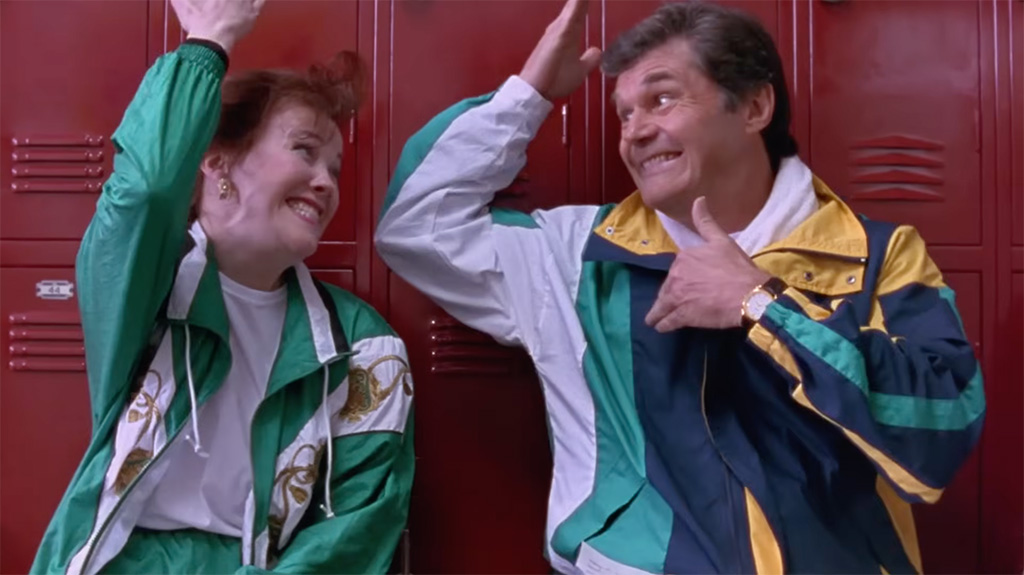
My favorite of her performances is probably in Waiting for Guffman, in particular her audition with Fred Willard’s character doing Midnight at the Oasis. There are just so many brilliant choices there — silently mouthing along with her partner’s lines, launching into the song at full volume (anyone in theater knows you’ve got to project!) and slightly off-key, the hesitant half-step when she tries to get in sync with the dance. It’s the perfect case of someone who makes it look easy playing someone who makes it look difficult.
And the part that makes it unique to O’Hara, and I don’t think anyone else could pull it off as well, is that she does it with a broad, practiced smile that has a hint of desperation to it, but at the same time feels like it comes from a place of genuine joy.
I’ve never known exactly what to make of Waiting For Guffman, and it’s always made me slightly uncomfortable, no matter how funny it is. More than any of the other Christopher Guest improv movies, there’s an ambiguity about whether the sadness at the heart of it makes it mean spirited. There’s a tension between laughing at and laughing with, which is probably fully intentional.
Looking at it again today, in the context of all of O’Hara’s other work, makes it feel clearer: I’ve been overthinking it. The comedy is the most important thing, and the comedy comes from the characters.
And I think O’Hara is the anchor that makes it work. If you concentrate too much on the comedy, it just becomes silly and forgettable. But if you concentrate too much on the character, it becomes sad, and it feels like a bunch of successful actors mocking people in community theater for being too ambitious. A huge part of O’Hara’s genius is that her facial expressions, line delivery, and mannerisms were so dead-on perfect that you could sense the soul underneath, even if it wasn’t a character that you were “supposed” to feel sympathy for or identify with.
I realized that I’ve gotten hung up on the idea of what I’m “supposed to think” or how I’m “supposed to feel.” Concentrating too hard on the idea that they’re successful actors forgets that they all went through a period of being struggling actors, and they can deeply relate to the characters they’re playing. Sometimes O’Hara’s characters were broad and over-the-top and just meant for laughs, but often they were just flawed human beings, barely keeping it all together. And you can sense an affection for them, even when they’re deeply unlikeable.
Which is a lot nicer than getting caught up in ideas about “punching up vs punching down,” or getting fixated on separating characters into categories of likeable vs unlikeable, sympathetic vs deplorable. They’re human beings, and should be sympathetic by default. And when they’re too over-the-top to be grounded human beings, they should at least be very funny, which is possible when you have an actor so masterful that she can turn the slightest facial expression or vocal mannerism into a punchline. And seems to be having so much fun working with her friends that she makes it look easy and joyful.