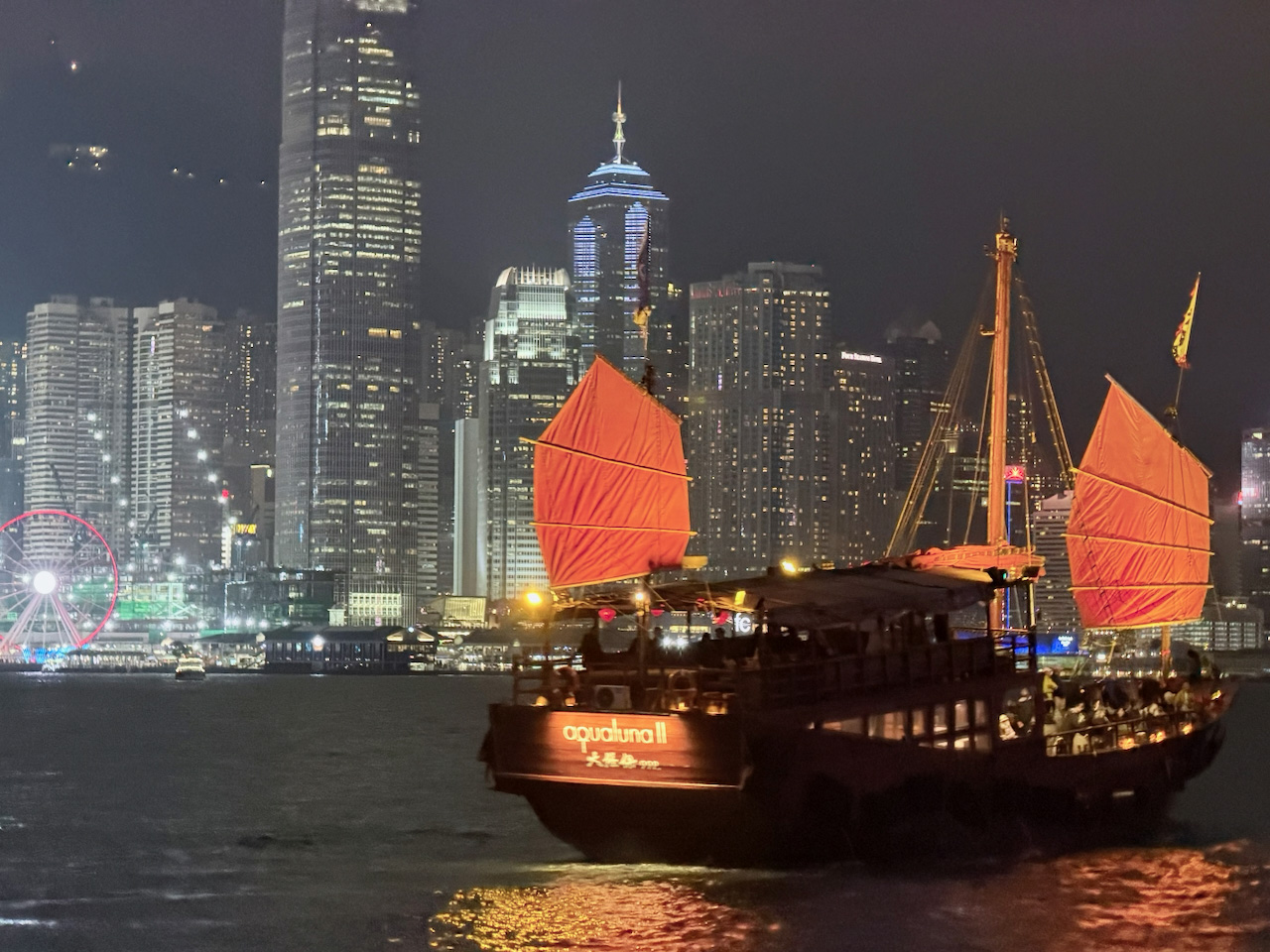
We recently returned from a week-long trip to Hong Kong, my first time to the city and in fact, first time to anywhere in Asia outside of Japan.
It had been on our list of places to visit someday, but circumstances made it so that the best time to go was in January, on fairly short notice.1I’m no longer a young man, so scheduling a 15-hour flight only a month in advance qualifies as “short notice.” That means I didn’t do a ton of research on the place, and only had a short list of the most well-known tourist sites to visit.
So this isn’t intended to be an in-depth take on the city from an experienced traveler, but more targeted at people who might be interested in visiting for the first time. Or, I guess, people who are interested in where I go on vacation for some reason.
Starting Out in Wan Chai
Our first hotel was in Wan Chai, which quickly became my favorite neighborhood. We were centrally located2Although not in Central and close to both the subway and the tram, and the streets right next to the hotel had a street market every morning.
The thing that will probably be most immediately apparent to travelers in Hong Kong will be the sheer number of impossibly tall buildings with impossibly small footprints. Our first hotel is 29 stories high and occupies a single small block off of Queen’s Road East. I’m not used to seeing buildings with the ground-floor footprint of a Walgreen’s towering more than 20 stories.
The thing that might be most immediately apparent to American travelers in Hong Kong is just how superior the public transit system is to anything I’ve seen in the US, including New York City. Not just the convenience of having an express train connecting the airport and the center of the city in under 30 minutes, but in having multiple transit options all within a short walk away. There’s nothing like a well-functioning metro transit system to convince you that all of the hype you’ve been hearing about American exceptionalism your whole life is just bullshit propaganda.
Also, the transit system uses something called the Octopus card, which is similar to Tokyo’s Suica card system, but is used much more widely. Every single mode of transportation we took — subways, express trains, trams, ferries — accepted it, as did most bodegas and vending machines. Travelers from outside Hong Kong can get the Octopus for Tourists app for their phone and tap through without needing to open the app.


Besides wandering through the street market, my personal highlights in Wan Chai were:
- A historic post office across the street from the hotel, holding steadfast against the surrounding skyscrapers. So much of the city that we saw seemed to be turned over entirely to modernity, so it was nice to see anything acknowledging the city’s history.
- Huge murals in the subway station in Wan Chai had photographs of graceful ballet dancers interacting with people going about their day-to-day in the neighborhood. Funny, beautiful, and just fantastic.
- We were near a somewhat upscale mall area that seemed to be setting up for the upcoming New Year’s celebration, including a small grove of shocking pink trees that I’m still not sure were real or not.
The Harbor and Peak Tram
The most impressive sight in Hong Kong is the city itself. There are plenty of opportunities to take in the amazing skyline, from either the Hong Kong Island or Kowloon Peninsula sides of the harbor, and from the top of Victoria Peak.


On our first sightseeing day, we took the Star Ferry from the island over to the Tsim Sha Tsui (TST) side. It’s extremely affordable and relatively fast, taking around 15-20 minutes. You’ll spend longer waiting to board, and on crowded days, you can bypass a lot of the line by using the dedicated queue for Octopus cards, which don’t require a separate ticket.
People in the tourist-heavy areas were aggressively pushing boat tours, which we didn’t try. The most distinctive tour boats are run by Aqualuna, but I was more interested in taking pictures of them than actually riding one. They’re so frequently seen in tourist photos and video that I started to get the impression that they’re practical instead of just photogenic; I guess the equivalent would be seeing video of Fisherman’s Wharf in San Francisco and believing that people still use tall ships for day-to-day sea traffic.
The best views of the city were from the top of Victoria Peak on Hong Kong Island, and even though it’s likely the most touristy of any of the things we did, I still would say that the Peak Tram is a must-do. It’s a funicular that goes up an extremely steep incline; much of the ride feels almost as if you’re completely vertical, and the effect of seeing the land outside the window at such a severe tilt is disorienting.
At the top is a four-story tower filled with what’s essentially a mall full of shops, restaurants, and tourist photo spots. There’s a separate mid-range, multi-story mall also at the top, a short distance from the tower. The tower’s topmost viewing platform is an extra charge, but I thought it was completely worth it, giving spectacular views of the city as well as some interesting views of the less populated side of the island.
One of the things that hadn’t occurred to me, even though it’s obvious in retrospect, is that the peak tram isn’t just for tourists. In addition to being necessary transportation for everyone who works at the peak, there are stops for people who live or work on the side of the mountain.3Or is it a hill? It’s always hard for me to tell when it’s at that scale and steepness.
The Tram Tour and the Ding Dings
I’m a total sucker for open-air tour buses, and I’ll try to ride them in any city that has them.4Someday I need to go back and ride the ones in San Francisco, now that I’d be going as a tourist. There are regular bus tours like you’d see in other cities, but we took the “Tramoramic” tour. I’d recommend it.


Hong Kong has a line of double-decker trams called “ding dings” (for the bell they use to warn pedestrians) that run east to west across Hong Kong Island. The pre-recorded tour dialogue gave some history of the tram line itself as well as the different neighborhoods we passed through. I kind of wish we’d done it earlier, because it’s a pretty good orientation to the city and how everything on the island is laid out.
The front of our car had been commandeered by some models and a couple of photographers, shooting some kind of New Year’s-related promotion for a local hotel. It made it a little difficult to pay attention to the recording, but it did add some visual interest to what would otherwise have just been a lot of very tall buildings.
A benefit to that tour in particular is that you get a golden ticket for unlimited free tram rides for the next few days. We made pretty good use of it, since it’s still one of the most practical and convenient ways to get between neighborhoods. Of course, the fare is so inexpensive that it wasn’t a huge cost benefit, but it still felt special waving a golden ticket around.
TST and the Avenue of Stars
Another of the main tourist attractions in the city is the “symphony of lights,” where many of the buildings on the Island side have displays of projections, lights, lasers, and signs, all synched to a soundtrack that plays along the harbor. We took the ferry back over to TST to catch it.


The “symphony of lights” itself is odd: it’s highly unlikely to blow anybody away, but I’m still glad I saw it, and I’d recommend it to anyone visiting for the first time. It’s impressive not so much for the spectacle as for the fact that it exists at all, with so many buildings taking part.
It makes sense to combine it with a walk along the Avenue of Stars, which runs along the harbor and pays tribute to notable people from the Hong Kong film industry. It’s the best viewing spot for the island skyline, and a really pleasant (if crowded) place to hang out while waiting for the show.
It was a highlight for me as a pilgrimage to visit the plaques of the three stars of The Heroic Trio: Anita Mui, Maggie Cheung, and Michelle Yeoh. Plus I got to put my hands in Michelle Yeoh’s handprints, a big deal for me since I’ve been an obsessive fan ever since first seeing her in Police Story 3: Supercop. At the start of the Avenue of Stars, near the Starbucks, there’s a statue of Bruce Lee, and another of Anita Mui, both in prime photo spots against the background of the skyline.
We also hung out for a bit at the K11 Art Mall, an upscale shopping center. The emphasis on art is a little bit of a gimmick, but it’s very well done: mixed in among the super-expensive luxury stores are just enough art displays (and a couple of huge permanent installations) that do manage to make it feel like a hybrid modern art museum and mall.
Hong Kong Disneyland
I have to admit that a major reason Hong Kong was on my list of places to visit someday, is that there’s a Disneyland there. Visiting it would check off the last Disney park on my list, since I’m extremely unlikely ever to go to Shanghai, and there are a few well-regarded attractions in Hong Kong that can’t be seen anywhere else.
Even at the height of my Disney fixation, I never would’ve wanted to go to Hong Kong just for the sake of Disneyland, and that’s still absolutely the case. It’s spread out across a lot of land, but it’s still relatively small for a Disney park. We got a late start and went on an unusually crowded day, but still managed to see everything we wanted to in less than a day.5Although we did have to use the paid fast passes, which by all accounts is unusual. Mystic Manor typically is a walk-on, but was averaging 45-60 minute waits for most of that day.
It’s a day trip from Hong Kong, and I’d recommend staying overnight if possible. The trip from Wan Chai to the HKDL stop on Lantau Island was about an hour via the subway. (Taking a taxi back later on was considerably easier and not all that expensive, especially compared to California prices).
We stayed at the Explorers Lodge, which is kind of a “moderate-level reimagining” of the Animal Kingdom Lodge at Disney World. It’s a nice enough hotel, although it had the hardest beds I think I’ve ever slept on outside of a camping situation. I slept well, but it still felt like I was being punished for something. There are three restaurants in the hotel, but not much else — being used to the other parks, I’d expected more in the way of convenience stores, snacks or light meals, and such. That plus the fact that it’s so far away from almost everything else in the area means that it definitely wouldn’t make sense to choose the Disneyland area as your home base for an entire Hong Kong trip.
I say “almost everything else” because there is a major tourist attraction on Lantau Island: the Tian Tan Buddha. That had been one of our must-sees for the trip, but we found out that the cable car was closed for maintenance. Since the cable car was as much the draw for us as the statue itself, we decided to take it easy and just hang around at the hotel, then go into the park for a few hours instead of just getting single-day tickets.


For me, the main draw of Hong Kong Disneyland was Mystic Manor, their alternative to the Haunted Mansion. Ever since it was built, it’s been on my bucket list of Disney attractions I have to see. It’s a trackless dark ride about a magic music box that makes everything in the mansion come to life, all set to a Beetlejuician Danny Elfman soundtrack.
It’s famous among Disney park fans, I suspect in part because it’s such an obvious victory lap on the part of WDI. It feels like a love letter to Imagineering, made by people in Imagineering. I enjoyed it very much, but I think I’d been hearing about it and watching videos of it for so long, not to mention riding the trackless dark rides that came afterwards like Rise of the Resistance, that I’d overhyped it for myself. No matter how good it was, it couldn’t possibly have lived up to my expectations.
A bigger surprise was the Big Grizzly Mountain ride, which is like a mash-up of Big Thunder Mountain Railroad with Expedition Everest. Still more of a family coaster than Everest, but more thrilling than any other version of Big Thunder, it was easily my favorite ride in the park.
Another nice surprise was the Iron Man Experience in Tomorrowland. I’d expected it to be nothing more than a Marvel overlay on Star Tours — and honestly, it essentially is exactly that — but presenting it as a ride unique to Hong Kong and set inside Hong Kong makes all the difference. It was exciting just knowing that you were seeing something you can’t see anywhere else, and seeing so much of it flying through the city you’d just been visiting. If I could relate it to anything it’d be the old Star Trek Experience in Las Vegas, which culminated in the Enterprise and a Klingon ship battling it out over the Vegas strip.
Apart from that, the show we saw (Mickey and the Wondrous Book) was charming, and worth seeing even for people like us, who normally skip shows in the parks. Overall, the whole place was charming, clean, pretty well-thought-out, and seemed to be small, but punching above its weight.
I’d been hoping to see more China-specific merchandise, like the Disney-Characters-as-Chinese-Zodiac I see at DCA every Lunar New Year. Instead, there was a ton of Duffy and Zootopia stuff, which I guess is a reminder that the park is catering to locals as much as, if not more than, foreign tourists.
Macau
On our last full day, we were based in the Central/Soho neighborhood and took a day trip to Macau. This took a ferry ride that was a little less than an hour each way. It’s an express ferry, so don’t expect any open deck viewing areas or even open windows at all. I’d been hoping that it would double as a sightseeing trip to get a glimpse of the surrounding islands, but you’re limited to whatever you can make out through a window.


I knew even less about Macau that I did Hong Kong, so the appeal for me was mainly to get a glimpse of how China looks with such a strong Portuguese influence. We didn’t go to any of the casino areas or shopping districts, and instead headed directly to the small section of old town in roughly the center of the city.
There are a few historic tourist attractions all within a short distance of each other: the Santa Casa da Misericórdia, St Dominic’s Church, and the ruins of St Paul’s. The latter was temporarily behind scrim, but it was still a pleasant enough spot for sightseeing.
We stopped at a couple of the dozens and dozens of food stalls and souvenir shops between the historic buildings, and we bought a refrigerator magnet and a couple of Portuguese egg tarts.
Essentially, we did the equivalent of the Microsoft Encarta version of the entry on Macau, staying only a couple of hours before heading back to Hong Kong. We’d really only gone for the sake of visiting a different place, and besides, there was a sign at the ferry terminal politely asking us not to stay.
Kowloon and Night Market


On our last night, we went back to Kowloon with a friend and visited the Temple Street night market. This is right off the Jordan stop of the subway line, and you can bet I took dozens of photos of the subway signs with and without me in front of them. I’d been completely unaware there was a district in Hong Kong with my last name, and I appreciated the novelty even if the source was as boring as any other story of colonialism.6Great mustache, though. Full marks.
The market was mainly our last chance to get some unique-to-Hong Kong food. The cuisine there is heavy on the pork, and even the vegetarian options are heavy on mushrooms, so we didn’t focus much on food for this trip. The market had a lot of different options, including more vegetarian-friendly ones. I got an order of shu mai — I had so much shu mai on this trip, even though we never once visited a dim sum restaurant — and a pineapple bun (excellent), and I tried my husband’s egg waffle. The highlight, and possibly the best thing I ate on the entire trip, was a fried banana roll from a stand serving Filipino food.
One of the observations we kept making was that we’d been spoiled by living in the Bay Area, so we were already familiar with most of the familiar staples of Hong Kong Food For Tourists: egg tarts, egg/bubble waffles, dim sum, milk tea. Granted, we didn’t go to any particularly high-end restaurants, but for the entire trip, I didn’t have anything that I thought was really outstanding. With one exception: our friend gave us a take-out box with pastries from Vission Bakery, which were fantastic.
Ugly Americanism
One thing I never got used to, and which never stopped being irritating: people seemed to constantly be pushing past me, breaking in line, and standing way too close. It was odd to be in such a nice, well-functioning, and convenient city and still be thinking, “I could never, ever live here.”
I’ve heard for a long time that that’s just to be expected to China, even more on the mainland than in Hong Kong. And I’d already encountered it to some degree, in areas of Japan that were crowded with non-Japanese tourists (around Hakone and the ropeway to Owakudani). But I’m not bringing it up to perpetuate any stereotypes about Chinese people; I’d say just the opposite.
It was rarely rude, although sometimes it absolutely was. Some of the people crowding to get past me onto the Star Ferry on my last day were selfish beyond any cultural standard. And we got some pretty rude treatment from taxi drivers while trying to get to the train station from our last hotel, and I wish I’d flipped a couple of them off. But even then, a friendly stranger came up and explained that we’d have more luck calling an Uber than trying to get a taxi for such a short ride within the island. (We ended up walking to the station, lugging our suitcases the whole way).
I’m only mentioning it just because it helped cause a shift in my thinking about being an American traveling to places with different cultures. For all the years I’ve been traveling, I’ve more or less internalized the attitude in all of the travel guides, books, and videos I’ve read or seen: Americans are awful. We’re rude. We yell English at everyone, demanding that they know our language. We invade spaces and throw our money around like we own the place. We smell like sugar and/or butter.
And there are absolutely people like that! I’ve seen them! But the thing is: they’re exactly the people who aren’t going to be reading travel guides or watching videos to learn the proper way to behave as a guest in a foreign country. So they’re going around doing whatever they please, while the rest of us are dutifully researching how to approach every single situation as if we’re the ones in the wrong. It seems like every travel guide I’ve ever used is made not to make travel easier or more comfortable, but to help me find the itchiest and most ill-fitting hair shirt.
I’m fortunate to have gotten to travel more than most, which means that I’ve encountered rude and insufferable people of every nationality, in several different countries. If you travel with the mindset that everybody else is doing the right thing, and you’re the one who’s perpetually wrong and out of place, then you’re kind of defeating the whole purpose of travel. You’re othering the rest of the world, even if it’s the benign “everybody else is doing it right” variety.
I’m reminded of the scene in Tampopo, where a manners teacher is instructing a group of proper young women on how to properly eat noodles without slurping, because it’s considered rude in the west. Some white guy comes in and starts eating sloppily and noisily, and by the end of the scene, everyone is joining in, not caring about what’s proper and just enjoying the food.
So my new philosophy: I’m not going to go to sushi restaurants acting like there’s this elaborate ritual you have to perform, or else you’re giving great offense. It was originally designed to be street food. Settle down.7And one that’s always bugged me: if you give me cheap break-apart chopsticks, yes, I’m going to scrape off the splinters. You’re not supposed to do this because it indicates that the host gave you cheap chopsticks, but… dude. You did give me cheap chopsticks.
And I’m content to let Hong Kong be Hong Kong, and New York be New York, and that’s all well and good, but still queues exist for a reason. Everybody’s trying to be happy and comfortable and enjoy themselves, and we should never get so hung up on manners and cultures that we forget that on that level at least, we’re all the same.
Overall Impressions
So I knew very little about Hong Kong before visiting, and while I’d never claim to be an expert at this point, I do at least think I got an overall feel for the place. It’s neat! I’d recommend it to anyone who’s the least bit curious about traveling in east Asia.8Although especially to Americans and double-especially to American nerds, I’d still recommend visiting Japan first, Tokyo and at least one other city.
Initially, I’d imagined that three days or so would be plenty of time to see the city, and it could be comfortably incorporated into a trip along with other destinations in Asia, like Japan, Korea, or mainland China. Now, I’m very glad we didn’t try to do that. Even with a week in Hong Kong, I feel like we just scratched the surface — I’d say five days is the absolute minimum. And I’m very glad that we didn’t try to tack on a trip to Tokyo or Seoul, since I was more or less exhausted after a week.
I had this vague idea that there would still be a heavy British influence, and it would feel like a combination of China and the United Kingdom. I don’t think that’s the case; even more than Chinese or British, it feels international. Road signs or the occasional place name keep the British influence alive, but also feel like vestiges of the past that might disappear at any moment.
Practically, it means being able to visit a World City in the truest sense, without being hamstrung by only being able to speak English. Essentially, it’s like visiting China on Easy Mode.
I’ve got no doubt that people 20 or even 10 years younger than us, who’d be more interested in bars and restaurants, and who would’ve been happier with a lot of walking and a lot of crowds, would have a more “vibrant” impression of the city. But I bet their overall impression would be mostly the same: it’s modern, varied, convenient, often beautiful, and welcoming to travelers.
Comments
One response to “China on Easy Mode”
Happy Vacation! Thank you for the write up. Hong Kong definitely sounds different than my brief and focused experiences in Beijing, Wuhan and Guangzhou.
I’ve always wanted to visit Macau because of the way it looks and the hope of some type of tasty Portuguese Cantonese fusion food.
I’m now going to look for some highly recommended Portuguese egg tarts here in the Bay Area. 🙂