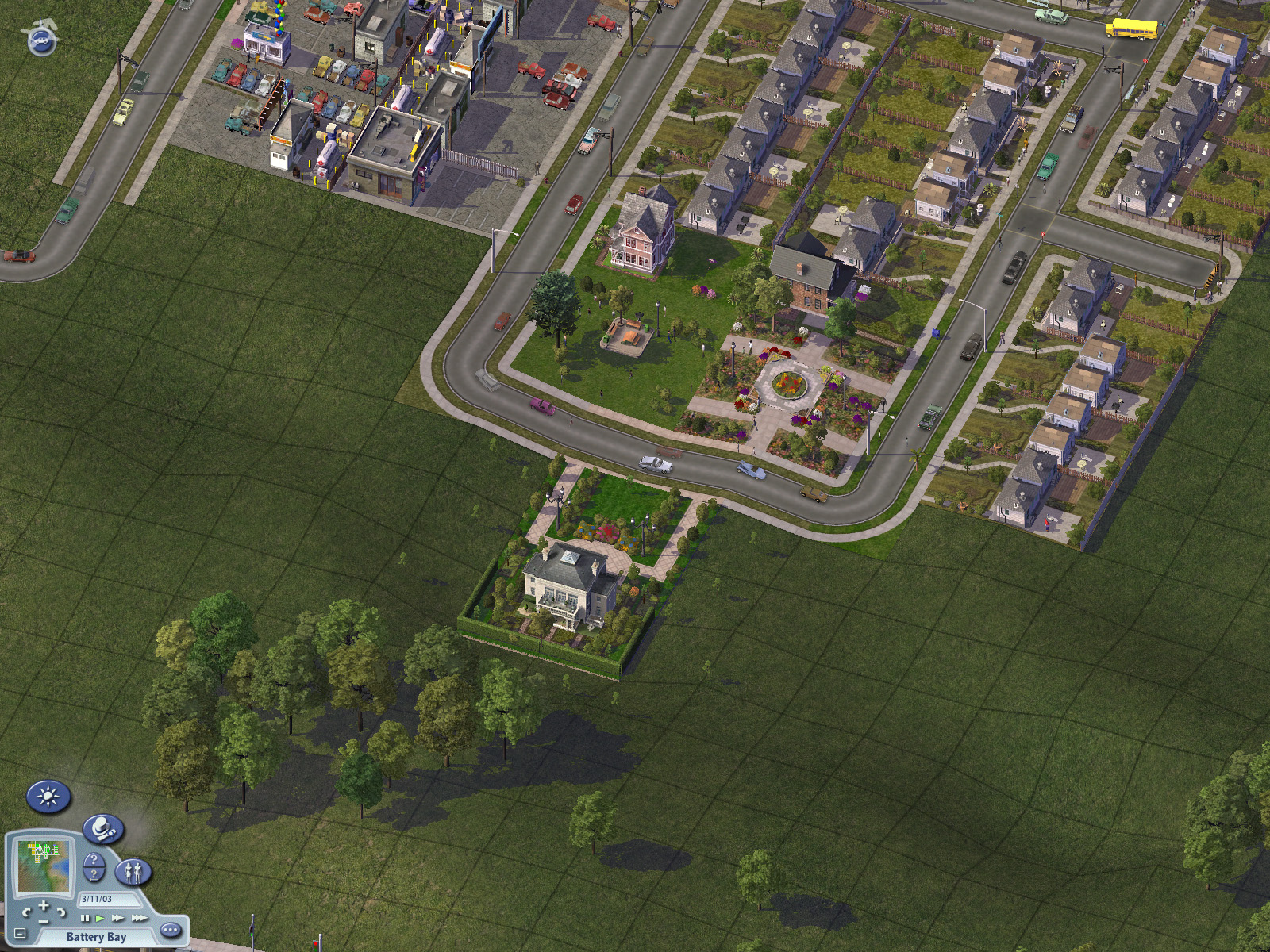
I was a big fan of SimCity 20001Hands down the best instruction manual that’s ever been shipped with a video game and even more into SimCity 3000. I think the latter was the first time I ever spent literally an entire day playing a video game. I’m still not sure whether the video game I’ve put the most time into is The Sims 2 or SimCity 3000, but they’re certainly the two top contenders. And whatever the actual number is, it’s an unhealthy amount.
So I came into SimCity 4 as a huge fan of the series. And I’ve always thought of my relationship to that project being as an “embedded fan:” I’m proud of the game and my work on it, while being completely comfortable saying that my part in it wasn’t what makes the game great.2I was responsible for programming the cars, trains, everything that moves on the ground in response to the simulation.
Which I mention just to make it absolutely clear that I’m not at all claiming to be one of the creative or technical leads on the project; there were some straight-up geniuses on that team, which is evident in the later work they did on Spore and the 2013 SimCity. And that I’m not a fan-level expert, either, since there are tons of people still making fantastic stuff with the game, 20+ years later, that I wouldn’t be able to replicate.
I haven’t even been able to really play the game since the expansion was released. Every time I’ve tried, I would find my muscle memory taking over, repeating the same first steps I did over and over, creating countless starter cities and building them up to test the game. Plus, there’s always been the anxiety of catching a bug I’d missed3In particular, cars bugging out and spinning off in a weird direction when they had a zero-length vector, a persistent bug that was eventually fixed but still haunts me to this day, and even though it’s far too late to matter, I would know it was there. It’s that case of getting the rare opportunity to work on exactly the game you’d most want to play, but never getting to play it.
But recently, I got the urge to dive back in. I started a couple of cities in SimCity 3000 Unlimited, and a new region in SimCity 4, figuring that enough time had passed that I could go in kind of fresh. Now that I’ve forgotten all the cheat codes and hot keys and even basic controls, much less the best strategies or weird quirks of the simulation.
And I was immediately hit with a shockwave of nostalgia. The first thing you notice is the thing that has always made these games exceptional: the music, and the art direction.
Both of these games have music that has become such a part of the soundtrack running constantly through my brain, that I’d stopped even associating them with SimCity or video games at all. There’s a track called “Epicenter” (which I can’t find a “legit” copy of, presumably because of licensing or rights issues with the vocals?) that seems to go way too hard for a game like this. But then, it’s always been an implicit part of the gestalt of this series that there’s something magical about seeing a living, breathing city come to life. You can’t hear the track “Rush Hour” without thinking F yeah I am laying infrastructure and zoning the ever-loving hell out of this metropolis!
And especially with SimCity 3000, you get such a dopamine hit from seeing huge plots develop with vibrant green, perfectly-manicured lawns that you happily ignore how much you’re being rewarded for gentrification. It’s so satisfying seeing these huge, glistening skyscrapers pop up in your downtown area that you don’t concentrate on how much the abstraction favors Reagan-era economics.4From my limited understanding, a ton of work went into the design of SimCity 4 to not lean on the trickle-down economics so much, and encourage more diverse cities.
The other day, I saw a conversation on Bluesky where a friend was wishing that EA would do another installment of SimCity. I’m still of the opinion that a successor won’t come from Electronic Arts ever again; it’s simply not the same company anymore. Specifically, I don’t get any sense that the company even has the same philosophy or agenda as it did when it acquired Maxis.
It may sound overly precious or high-minded, but it’s easy to forget that Maxis didn’t approach their series with the simple idea of “making simulations fun.” They were more like this holistic blend of science, art, philosophy, and culture, all abstracted into a simulation, and then turned into a game. That’s why the SimCity 2000 manual had lengthy sections about urban planning, with a bibliography of academic research on the topic. For that matter, that’s why The Sims mashed up ideas about the hierarchy of needs and a satire of consumerism into a game that was essentially an interactive dollhouse.
And it’s why really excellent games like Cities: Skylines can get so much right about the mechanics, and even have flashes of charm, but still leave SimCity fans with the sense that “the vibes are off.” I don’t believe that the game is shallow, just that its highest priority is making a city simulator game.
That’s also probably why the 2013 SimCity was so frustrating. Visually amazing, with the clear sense that not only the buildings but the entire presentation had a coherent vision. Musically exceptional, more orchestral than the jazzy soundtracks of earlier games, but still giving that feeling of the magic of watching an entire city come to life, neighborhood by neighborhood. And excellent in terms of designing a from-the-ground-up reimagining of the series. Getting away from the cell-based simulation and rethinking everything in terms of agents making connections — pulling in that philosophical abstraction of cities as living organisms.
There are various reasons it didn’t really work, most of them extremely well-documented already. But I don’t think it’s any one thing, like the always-online requirement (which was a bad call), or the limited city size (which, as I understand it, was primarily a technical restriction based on personal computer power at the time, required to reach the size of audience EA needed for the game to justify the cost).
From what I played of it, my personal opinion is just that it would’ve worked better if they’d leaned into a smaller scale, making it more like a SimTown or even SimNeighborhood. It had this obligation to appeal to players who always saw the end goal of the series as being a city with millions of residents and a downtown full of skyscrapers. Even though the series had a long history of emphasizing how there’s such a wide variety in even successful cities: sprawl vs density, types of transportation, balance of residence and industry and culture, all of the things that give a city a distinct personality.
Playing SimCity 3000 and SimCity 4 together, after such a long hiatus, I was surprised how quickly my starter cities started to feel completely distinct.
SimCity 4 just has more stuff, including a ton of “quality of life” things that I’d misremembered as always having been part of the series. I almost immediately started thinking of it in terms of specialized cities: this one would be where all the power infrastructure goes, this would become my industrial town, this would be my residential suburb, here would be where the waterfront resorts develop, and so on. I quickly zoned out big blocks of RCI zones, hooked everything up with power and water, plopped down city services and parks, and let it all cook for a bit.
Meanwhile, SimCity 3000 felt surprisingly finicky. I knew you had to stick to the grid, but had forgotten how much it prevented you from zoning on certain types of terrain. My randomly-generated hills were splitting up my residential zones, giving me pockets of unreachable land on slopes the roads refused to drive up.
But even in a short time, a kind of personality to the city started to develop. And it helped explain why I often had an uncanny sense of deja vu while driving through the Bay Area. This part feels like Piedmont, with a high-income, low-density main street at the foot of the hills. Houses on individual plots are popping up all over the higher elevations, with winding, narrow streets working upwards to reach them. This is a flat, industrial area, like the east and south of Oakland. Over here are bigger blocks of tiny residential homes, kind of like Berkeley and Richmond. There’s a circle of high-income housing around the university, with rings of service commercial and industry around it.
And I could finally see how a sequence of decisions while making SimCity 4, more than just the most obvious ones, led to the two games having such a different vibe. (And again I want to stress that the decisions were all made by people much smarter than me; I just had the somewhat unique position of being able to see the game as it was being made):
- It’s got an outstanding system for terrain generation and modification, even taking into account the different weather patterns in higher elevation, that got a ton of brilliant work even before any of the tools for city-building went in.
- That brought an unprecedented amount of fine changes in elevation to a game that was still inherently grid-based.
- That meant that the road-building and zoning had to be much more accommodating of changes in elevation, to allow for flat lots to exist on slopes.
- That meant that the game had to do more terrain-leveling under the hood, instead of just refusing to let the player build anywhere, meaning that it was a lot more tolerant of building on anything but the steepest slopes, and it would build retaining walls and such to account for everything else.
- Keeping with the mindset of being less finicky, the zoning tools automatically create side streets, to make it near-impossible to have lots that are unreachable.5Along with modifier keys that you can hold down to align the lots in specific ways.
Every one of those decisions makes perfect sense, either as an immediately-recognizable upgrade to the fidelity of the game, or as a quality-of-life improvement. And they all feed into and interact with each other, along with a thousand other decisions about the simulation layers, how buildings have areas of effect, and so on.
The end result is that SimCity 4 makes it easy to build sprawling grids across the landscape, paying as little attention to the underlying terrain as you care to. And that has a subtle but significant effect on how the city “feels” as you’re building it. In my experience, it’s less about neighborhoods with unique character, and more about individual cities that eventually develop an overall character, as part of a larger region. And of course, I don’t want to make it sound as if that’s accidental, since region play was one of the main ideas of this version of the game.
But it does change the vibe in a way that I’ve never before been able to articulate while playing it.
(And no doubt that I’ve got a built-in bias while playing it, since it was always in my best interest to get the densest city possible going as quickly as possible, because I needed enough cars on the road to find bugs).
So I guess in addition to being a short love letter to the SimCity series, and being happy that I can actually play them for fun again, my main point is that video games are complicated.
Especially when you’ve got a multi-layered complex simulation that’s being designed and implemented by dozens of different people, but just in general. Every single decision can have an effect that ripples out to affect everything else, completely changing the entire feel of the game.
I’m still skeptical that another SimCity will ever come from EA, at least in anything but name. But there are still plenty of city simulators being made. I’ve been watching a lot of the City Planner Plays channel on YouTube, which has been interesting not just for the kinds of ideas about urban planning that used to go into SimCity manuals, but about how different people play these games. His approach, for instance, has a lot of self-imposed limitations; part of his merch is a T-shirt that reads “respect the topography.”
Not to mention calling attention to how many different types of simulator games there are, and how varied the games are in what they prioritize. There are a lot of promising ones; one that I’m most interested in is Citystate Metropolis, simply because of its flexibility.
But none of them are ever going to be “the next SimCity” because that’s pretty much impossible. You could even nail the mechanics and the simulation, and it wouldn’t be the same, because it was never just about the mechanics or the simulation. It required not just a bunch of uniquely talented and smart people, but a philosophy about the union of science, games, culture, and art that you simply don’t see much of anymore.
So instead of trying to replicate the mechanics of SimCity, or even the vibes of it, I’d be a lot more interested in seeing what comes from people trying to replicate the vibes that went into the making of a SimCity game.