Wise men say only fools would rush in to make a concert movie about Elvis Presley in 2026! Will audiences find they can’t help falling in love with Baz Luhrmann’s Epic: Elvis Presley In Concert? Or will they declare it ain’t nothin’ but a hound dog, and leave them crying all over their blue suede shoes? Does the audience love it, but it doesn’t know it yet? Or will they think it’s the devil in disguise? Elvis is a hero to Baz Luhrmann, but will he ever mean shit to IMAX audiences?
Seriously, why hasn’t Rotten Tomatoes responded to my emails?! This stuff is solid gold!1Also: several of the real reviews of this movie on Rotten Tomatoes have actual adult human beings using these lines in their write-ups. Gene Shalit would be proud!
The start of this movie is an extended montage recapping the major events in Elvis’s life and career, all leading up to the Las Vegas concerts that make up the bulk of the footage. During the montage, in the sequence where Elvis is released from the Army and returns to making movies, someone mentions Hollywood. We see the word “HOLLYWOOD” in big red rhinestone letters, and then a shot of Elvis behind the gun of the tank, and then the tank fires and the word HOLLYWOOD explodes with a stock sound effect.
I’d been enjoying it up until then, but that was the specific moment when I finally said, “Ah, okay, I know exactly what this is now.”
Honestly, it shouldn’t have taken me that long. The titles have the overwrought logo of Luhrmann’s production company, then a big, sparkly, gaudy, computer-generated sequence putting BAZ LUHRMANN’S name first, and then spelling out Elvis Presley In Concert, much like the credits for CHiPs used to do.
And this is 100%, top to bottom, Baz Luhrmann’s take on an Elvis concert movie. Not a bio pic, not an expose, not really a documentary, and definitely not a Stop Making Sense-style cinematic presentation of an entire concert. Instead, this is exactly what you get when a filmmaker known for self-indulgent excess finds a kindred spirit in an entertainer known for self-indulgent excess, and is given free rein to sift through hours of concert footage, interviews, and backstage scenes.
It doesn’t even feel too tacky — at least, in an environment like this, which raises the bar on tacky to uncomfortable levels — for Luhrmann to put his name above the title, or to have his stylistic voice (not his literal one) all over the movie. It doesn’t come across as self-aggrandizing — at least, in an environment like this — so much as nerding out. Oddly, it’s a little like “Wuthering Heights” in that there’s the undeniable sense of someone saying, “I need people to understand why I love this so much!”
Almost all of the “never seen” footage that makes up this movie was the result of research for Luhrmann’s 2022 biopic Elvis. I never saw it, and frankly I forgot it even existed. But that was never a movie I had any interest in seeing; I’ve never been much of a fan of Elvis2Outside of karaoke. I can belt out a pretty solid version of “Devil in Disguise,” and I’ll do it at the slightest provocation., and have never been as interested in the person as in the performances. And the Vegas performances in particular.
And almost all of the audio in the movie is either from the concert — with modern remixes that in most cases, tried to get as close as possible to feeling like an unedited live performance — or from Elvis himself, in voice-over from interviews. The movie has Presley saying at the beginning and the end that this is his side of the story. The repetition seems to insist that you’re getting the whole unvarnished truth directly from the King himself, but that’s not really the case. It’s Luhrmann presenting a version of the man, through careful editing and presentation of clips.
Which again, I’m completely in favor of. Presley’s voice-overs feel like he’s either reading highlights from his own Wikipedia entry, or he’s reciting lines from his own biopic. None of it is controversial, or even particularly insightful. It all sounds like the kind of thing an absurdly famous man would be saying to a crowd of journalists — especially one raised in the south in the 30s and 40s, with all of the tact and politeness that implies. The personalities that come through are all in the choices of what to include and how to present it. And that’s personalities plural, since again, Luhrmann’s presence is very present throughout.
And you can see almost immediately why he’d feel like they were kindred spirits. It’s not just the love of spectacle and rings and rhinestones and other sparkly things — the first of the Las Vegas shows begins with a glittering gold curtain rising, and you can almost hear the gasp Luhrmann must’ve made when he first saw it. There’s also a feeling throughout that I’d always assumed was modern, and never would’ve associated with Elvis: a kind of completely earnest camp.
This version of Elvis comes across as goofy, unassuming, and self-aware. Which has this bizarre dissonance, since I never associate the word “unassuming” with someone so obsessed with capes, rings, tinted sunglasses, karate moves, and an entourage. And “self-awareness” might be even more odd, since it’s probably near the bottom of the list of 1000 Terms You’d Use To Describe Elvis Presley. But this version of him does seem to realize that the whole Elvis persona is pretty absurd. He wishes he’d been in better movies. And he thinks the early Sun recordings that helped make him famous are “weird” because they have so much echo.
I don’t want to oversell the “self-awareness,” since this version of Elvis doesn’t seem particularly deep, either. Frankly, this version of Elvis seems like he wouldn’t have even understood the concept of “appropriation” if somebody had explained it to him.
The biggest controversies he had to deal with — and a ton of the opening montage concentrates on those controversies — were from conservatives decrying him as too sexual, and a bad influence on The Youth. You get the feeling that if he time-traveled to 2026, after marveling at how many drugs are freely available now, it would take at least a week of explanations and Public Enemy videos to get him to understand what happened to his legacy. And most of that week would just be him saying “do what now?” and “come again?” before putting a microphone in his mouth or mugging for the camera with his glasses on upside down or a woman’s panties on his head.
I think the movie handles it in an interesting way in one scene, somewhat acknowledging the “problematic” part of Presley’s legacy, while also getting across the idea of why the movie seems uninterested in exploring that in any depth. And I want to stress that this is completely my interpretation; I can easily imagine 100 different takes on it, and am sure there are plenty more I can’t even predict.
It’s a moment on stage when Presley is harassing one of the backup singers. He’s vamping in the middle of a song, and he seems to single out one of the women and he seems to be coming in for a kiss.3He kissed a lot of women during these shows, by the looks of it. She looks extremely uncomfortable and is trying to get away, and the other singers are starting to make a kind of protective circle around her, all with plastered-on smiles of the “we’re on stage” and “we need this job” variety. He backs off and at least seems to be trying to make it clear that he was goofing around and trying to be playful. Shots earlier in the movie showed him interacting with all of the singers as if he were genuinely trying to build some backstage camaraderie.
I don’t remember enough about casual misogyny in the 1970s to tell just how gross it would’ve felt back then, but it feels hell of gross in 2026. And based on everything else in the movie, I can’t imagine that it wasn’t included for a specific purpose. This is not a subtle film.
It has cut-aways to audience reactions that seem so deliberately, 1950s-commercial-film-style staged that they made me laugh just by how on-the-nose they were. It has concert footage of Elvis singing about growing up in the south, and it has black and white photos of him as a baby fade up in the background, like the cheesiest and most maudlin movie showing in a Disney park. It has repeated shots of one of the male singers looking on in almost envious admiration as Elvis nails a key moment in a song. One of the few shots of Colonel Tom Parker is a brief glimpse of him in the audience, and the footage freezes and plays a camera-flash effect, as if they’d caught the villain in a True Crime documentary.
Because all of the chosen shots feel so blatantly purposeful, the impression I get is that the movie wanted to at least acknowledge that Presley wasn’t the best guy. It’s not the hagiography I expected, and it’s not a particularly deep or even comprehensive portrayal, either. The takeaway I got, at least, was that Elvis was fascinating, and it’s fun to watch him, even if it might not have been that fun to hang out with him. Presumably especially so if you weren’t a white man.
And while never mentioning cultural appropriation in any way, the movie does, I believe, make a case for why it chose not to. It includes a few of the gospel songs that made up the regular set list, and those are the performances that the movie really seems to linger on as performances. Not goofing off, flirting with the audience, making jokes about his costume, forgetting the lyrics, all the kinds of things he does with the “hits.” With these, it really plays up the idea that he’s singing with genuine passion, conviction, and sincerity. That they’re coming from a genuine place of faith.4Even if he is distractingly wearing an ankh necklace through some of them.
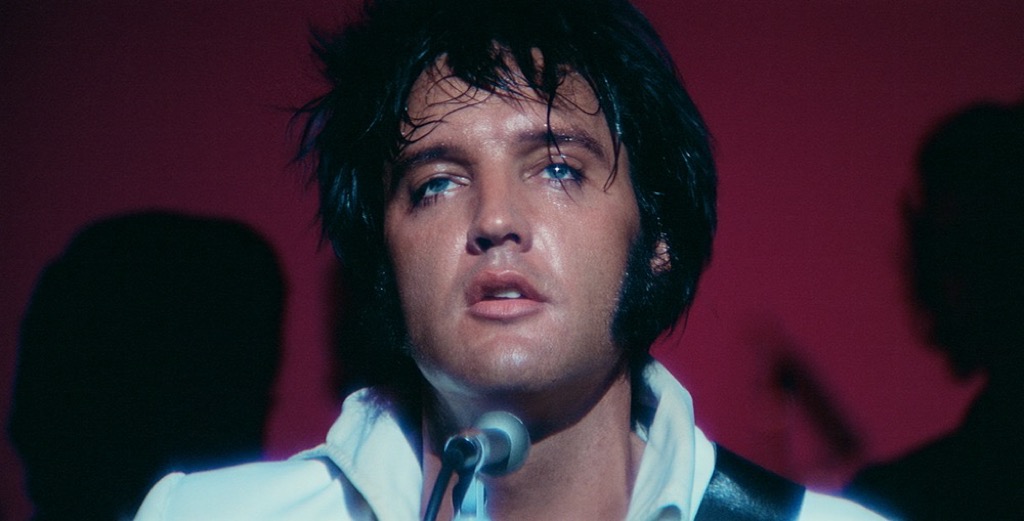
I’d assumed that Epic was an IMAX release because the show itself was spectacular, that there were some kind of huge stage theatrics that we’d never gotten the full effect of in cropped versions. That never seemed to be the case, though. Instead, it seemed to be in IMAX for a weird sense of intimacy. Everything is extremely large and incredibly close. You see every pore, every whisker in the gigantic sideburns, every cold sore, and especially, all the sweat. A lot of it feels uncomfortably like Ren & Stimpy close-ups, as if you’d been watching a fun stage show and then you suddenly zoomed close enough for it turn repulsive.
It feels like a sharp contrast from all of the footage used in the opening montage, mostly taken from his movies. In those, he’s got perfect skin, perfect hair, in scenes — if not entire movies — designed specifically to show off the eyes and the smirk. In another movie, the contrast might’ve been intended as mockery, to play into that popular perception of his rapid decline during the Vegas years. For all I know, in this movie, it might’ve been intended to add some verisimilitude, to draw attention to the fact that this is real, behind-the-scenes footage, and we truly were getting a side of the man that we hadn’t seen.
The impression I got was a little more nuanced than that. It felt like Luhrmann and the editors saying, this is why people loved this guy so much. Not just the fake, often silly movies, and not just the studio recordings. But the live performances, where he was putting all of himself into it, and it showed.
As the concert portion of the movie started, I had this weird feeling of being reminded of Cleopatra. Specifically, the way we’re often reminded how she lived in a time that’s ancient to us, but so much of Egyptian civilization was ancient to her. On a much smaller scale, obviously, but: I was watching a guy who died when I was six (and at a much younger age than I am now!), who was talking about most of his career and his unprecedented fame as if it were so many years in his past.
It helps sell this version of Elvis as somebody who was well aware that his legend was some made-up construct, and he didn’t take it all that seriously. Not exactly humble, and emphatically not austere, and way too famous to ever be some regular guy. But there’s a feeling of sincerity to it. Showmanship and spectacle, but not in the PT Barnum sense of trying to put one over on people, but more like the Dolly Parton sense of giving people exactly the version of you that they want.
You can see how Luhrmann, more than any other filmmaker, would be so captivated by this fearlessly corny and almost painfully earnest and sincere version of Elvis Presley. The one song in Epic that gets the heaviest remix treatment is “In The Ghetto,” which might be Presley’s most cringingly dated, condescending, and maudlin.5And if not deliberately racist, then definitely cluelessly so. My impression was that this was the movie’s way of trying to get audiences to reconsider it, instead of dismissing it immediately. To witness just how seriously Presley took it when he was performing it, and how much the line was blurred between “just a performance” and something he really believed in.
I’m highly skeptical that this movie will be enough to convert anybody who dislikes Elvis and turn them into a fan. I’m skeptical that it’ll bring in younger audiences, either, since it’s such a time capsule of the late 1970s. But for people like me, who had always been indifferent at best, they might be surprised to see a version of the guy that’s this unabashedly corny and goofy. I’m happy that there’s a recent resurgence of movies rejecting arch Gen-X bullshit and instead celebrating sincerity, and being unafraid to really feel things again.