My anti-Pixar theme week continues, with a scathing take-down of… well, hang on. I’m still not interested in jumping into backlashes or hot takes, or complaining about something instead of finding an interesting idea at the core of it.
The whole idea of my trying to stick to the “One Thing I Like” theme isn’t at all a reminder to find something positive to say, even when I think the subject is garbage.1Which is why I remind you that I still haven’t written anything about seeing Scary Movie. Or even commented on the trailer for the new Scary Movie, which starts with a “joke” about people angrily correcting innocent bystanders about using the right pronouns, which is funny and relatable because it’s a totally real thing that totally happens in the real world. I’d rather not waste time on something I don’t like, in favor of celebrating the stuff I do like. It’s only worth mentioning at all if I think there’s something interesting to be said about why exactly I don’t like it.
Anyway, yesterday I saw Hoppers. And while it’s definitely not for me, I can totally see why other people are enjoying it, and I don’t want to be completely dismissive of it. But over the course of the day, I caught myself turning my main criticism of it into a grudge, and piling more and more points against it as time went on.
My main criticism is that Pom Poko is one of my all-time favorite movies, and I can’t help but see all the ways that Hoppers tries to do the same thing and keeps coming up short. “Not as good as one of my favorite movies of all time” is an impossibly high bar to set, admittedly, but I will point out that Hoppers itself tries to lampshade comparisons to other movies by having a character stress that it’s nothing like Avatar.
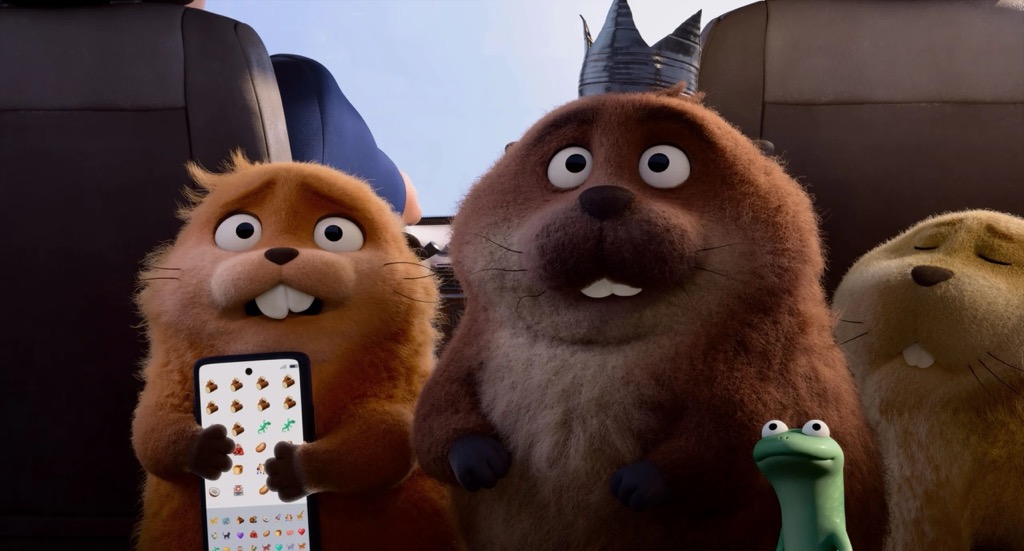
The comparison was so hard for me to shake that it undermined the one thing I liked most about Hoppers. The movie very cleverly gives a visual indication when your viewpoint is swapping between the animal world and the human world, by having the eyes change. When they have big, white, cartoony eyes, with pupils and everything, you’re in the world of the animals, able to talk to them and understand what they’re saying. When they have little black circles for eyes, they’re animals, and humans can only hear them making animal noises.
But as I kept thinking throughout Hoppers, “Pom Poko did this, too, but more subtly and cleverly.” The tanuki in that movie flow freely through multiple states, depending on who’s seeing them and what their current mental/emotional state is. They go from being realistic animal versions, to their “main” cartoon-animal form, to their super-cartoony form2Which is itself a reference to classic cartoons about tanuki, to their human form, to their statue form, to whatever they’re transforming into, all throughout the movie and sometimes within a single scene.
As I kept finding little things that didn’t work for me in Hoppers, it all had the cumulative effect of feeling very loud and very blunt, never letting me go for longer than a minute without telling me exactly what to think and what to feel. I have no doubt that I went in predisposed not to like it, since I’d just been thinking about Pixar in terms of authenticity vs forced universality, but it all felt like it was desperate to charm me instead of being genuinely charming. A montage sequence set to Loverboy’s “Everybody’s Working For the Weekend” didn’t help at all; it just felt like I was suddenly watching a trailer for a Dreamworks or Illumination movie. And it did something that Pixar movies almost never do: made me acutely aware that I was a 54-year-old man in a theater surrounded by children.
But all of that is just another case of my not enjoying a movie, and not even in a particularly interesting way. It’s completely tied up with my biases and expectations, judging the movie based on what it’s not instead of what it is.
Except for one thing about the tone and what I think is the message of the movie, which left me with a sour aftertaste from something I otherwise would’ve shrugged and said, “It’s fine.”
And again I’ve got to pull out Pom Poko for comparison. That movie nails the ending in a way that makes me cry every single time I see it: it’s very sad, but highlights a moment of pure joy amidst the sadness. It’s the perfect capper to the recurring idea that these creatures aren’t cut out for war, because it goes completely against their nature. We’ve seen them anthropomorphized — both in cartoon form and literally taking the form of humans — but it makes no sense to apply human traits to them. Many of them simply can’t live as humans, and even for the ones who can, it’s exhausting. It’s urgent that we understand that our relationship with nature isn’t a battle between opposing sides, but requires us to stop ignoring our own true nature, to appreciate that we’re just as much a part of nature as any other living creature, and to maintain that balance.
Which, to the credit of Hoppers, are all ideas that it touches on in one form or another. There are a couple of scenes that stress how animals live according to the natural order of things, and human concerns are weird to them. There’s a very strong emphasis on finding peace by recognizing that you’re just one part of nature, and not set apart from it. And there is a vague sense of reframing environmental issues not as a perpetual battle between opposing sides, but more as a question of long-term sustainability.
And, I should stress: I don’t get any sense that this movie is all that concerned with having an impactful message about ecology. It’s first and foremost trying to be funny.
But that’s kind of the problem. It ends up undercutting and undermining any sense of urgency. And worse, it turns it into a mushy “both sides” message. So much of the story is about the main character learning to get control of her anger, that it’s presented as if that anger were just as much a part of the problem as the politician deliberately lying to the public so that he can destroy the environment.
The lesson, we learn, is to turn that anger into acceptance. To turn our rage into calm. To try and see the good in everyone. And to appreciate that instead of angry, unproductive activism, we need to work together to make the world a better place.
Why not try to see things from the perspective of our antagonist whose hairy chest hides a heart of gold, voiced by America’s sweetheart Jon Hamm? Sure, we saw that he’d been lying to drive animals out of their habitat into a crowded one that couldn’t support them, and then we saw his actions result in the destruction of even more of that habitat. But surely he learned his lesson when that destruction threatened to almost touch the human city! Didn’t you even see him helping clean up afterwards? (And giving orders to a construction crew, suggesting that he suffered absolutely zero repercussions to even his political career?) Why hold a grudge? It all turned out okay!
It’s just really tough for me to see this as a message about peace, calm, and balance; instead of one about passivity, acceptance, and moving on instead of holding people accountable. Maybe it’s because I’d been already jostled out of my enjoy-this-movie-like-a-little-kid state, and been reminded that I’m a middle-aged man, but it was very difficult for me to watch the last half of this movie without imagining a bunch of studio execs freaking out that the white guy authority figure was coming across as too much of a villain. I can’t help but picture a bunch of people scrambling to make sure the movie stressed how much our angry young hero had some growin’ up to do herself.
I don’t think every movie has to be as good as Pom Poko, and I don’t think most movies even need to aspire to that. I don’t think every message about ecology and our relationship to the environment needs to be strident and self-righteous. I think it’s fine for a movie to just want to be fun and silly, with just enough depth to keep from floating away into complete irrelevance.
But it does make me uncomfortable when I see movies aimed at all ages reject the message of “fight for what you believe in!” in favor of “whoa, calm down there, champ!”
I don’t know how to make a message of environmentalism land with the urgency it needs to, since it’s always dismissed and ignored. And I do genuinely appreciate reframing it as a holistic question of sustainable balance instead of just one tiresome battle after another. But there has to be a better way than the paper-straws-and-carbon-offsets approach. Blandly asserting “we’re all in this together!” and absolving anyone of actual consequences means just continuing to ignore the problems for a few more years, and we’ve pretty much run out of time to keep doing that.
Leave a Reply