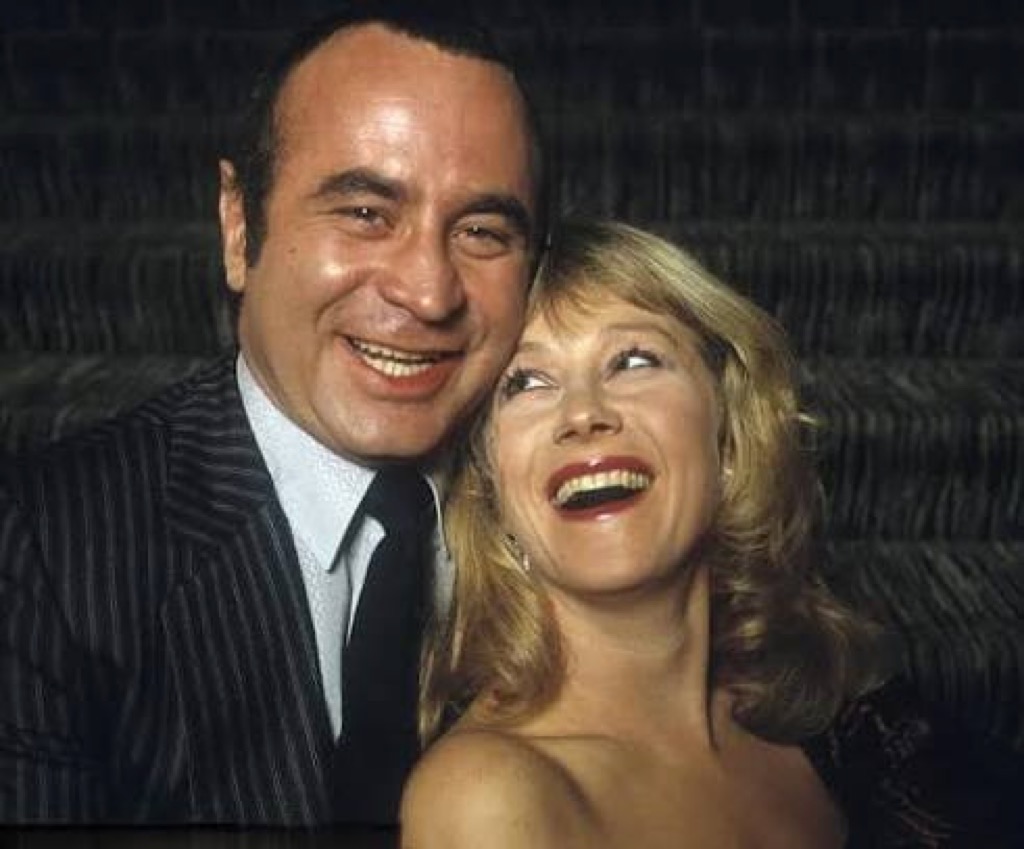
The Long Good Friday1Not to be confused with The Long Goodbye, like I did for years. 2And also it’s set on Good Friday, so it’s not The Long, Good, Friday like I always assumed. was made in 1979, and you can tell pretty much instantly. The film is grainy, the soundtrack is synthesizer heavy, and it comes from a time when movies were confident enough to let you go for 10 or 15 minutes without having even the slightest clue as to what’s going on.
That’s before you see familiar actors like Pierce Brosnan at his youngest, Kevin McNally at his most wait-is-that-Bill-Hader?-ish, and Paul Freeman at his most beautiful. (It made me remember that one of the off-putting things about Belloq in Raiders of the Lost Ark was that he was so distractingly handsome).
In any case, the movie starts with several scenes of dialogue-less intrigue: a suitcase full of money! A clandestine hand-off! Two guys sitting in a remote farm house! A gay hook-up in a pub! Murders! British Airways jets! A widow! Architectural plans! A funeral procession that stops to let the widow get out of the car and spit on a guy! Swimming! And that’s all before we even see our first glimpse of our main characters, played by Bob Hoskins and Helen Mirren.
I’ll admit that I’m just far enough into the MTV generation that I rarely have the attention span required for movies made before 1982. And I did have to pause the movie a few times, both to go out for a cigarette — everybody is smoking constantly in this movie — and to let my brain recalibrate to a style of storytelling in which everything is given time to play out.
The Long Good Friday isn’t what I’d call slow; in fact, it’s sometimes disorienting, as it often jumps to a new scene and forces you to figure out how it fits in with everything else. But even once I was able to make sense (mostly) of all the different accents, it still felt as if I were having to translate between the language of film this movie was using, and the one I’m so used to now.
It wasn’t until the brilliant, iconic, final scene that I could even identify what was different. This isn’t a movie that works in symbols and metaphors. In fact, it feels like the kind of movie that would call me a ponce who took too many cinema studies classes in college for even trying to do so. I could conclude that a scene takes place at a stock car race to show how a story about control and order had suddenly escalated into chaos and mayhem. It’s more likely that it was set at a stock car race because that looked cool and exciting.
It’s not at all a shallow movie, but its complexity comes not from trying to pick it apart for meaning, but from fitting all the disparate pieces of the story together to make sense. Which is exactly what the main character, Harold Shand, spends the entire movie trying to do. Someone is trying to take him down, on the day he’s trying to broker the biggest deal of his life, the deal that might take him from “businessman” and head of a “corporation” to becoming an actual businessman and head of a real corporation. Who’s behind it, and why?
Over the course of the movie, you see him transform from an almost cartoonish version of a Cockney gangster into a real character. There’s a scene near the beginning where he’s addressing the people on his boat as it glides down the Thames, and you see him framed by the Tower Bridge as he gives the kind of puffed-up monologue worthy of Johnny Caspar. By the end of the movie, he doesn’t have to talk. The camera stays fixed on him for minutes, as you see him making sense of his situation and figuring out what exactly he’s going to do next.
It’s all allowed to just play out across his face. That’s possible only because you’ve got an actor like Bob Hoskins playing him, but also because just about every scene that advances the plot and gets closer to figuring out what’s going on, also tells you a little bit about who he is and what he values. Loyalty, trust, respect, honor, order, and to no small degree, London itself. The stereotype of “gangster with a strict code of honor” is pretty familiar, but The Long Good Friday and Hoskins’s performance makes it feel legit. He really believes in it.
He’s typically not the kind of guy who’s about playing the angles or secretly pulling the strings, and when he does try a double-cross, it goes badly. He’s the kind of guy who hangs out with an enforcer named Razors. You can usually tell what’s going on just by looking at his face, and if he looks like he’s about to kill you, that’s because he likely is.
And while the movie is spooling out its plot, it’s giving Harold one opportunity after another to tell you exactly what’s on his mind. The thing that they all have in common is that he’s a traditionalist. He reminisces about his friends, his childhood as a petty crook, the past ten years of peace between warring gangs, the good old days before the illegal narcotics trade, everything that London used to be, everything that England used to be.
There’s one scene I noticed in The Long Good Friday that never seems to be explicitly tied to anything else, and I never caught an explanation or resolution. The camera’s in some kind of underground space, panning silently across an entire grid of yellow containers marked “EXPLOSIVE.” I couldn’t tell if it had been established as part of the construction project, or if it was there just as ominous foreshadowing.
In any case, it along with the final scene were the only two cases of the movie inviting you to do any of your fancy-pants “interpretation of symbols and implicit metaphors.” They suggest that Harold is finally understanding that the world is changing, things are getting too complicated and too dangerous, and coming to terms with the idea that he’s probably not going to be part of whatever comes next.
Leave a Reply