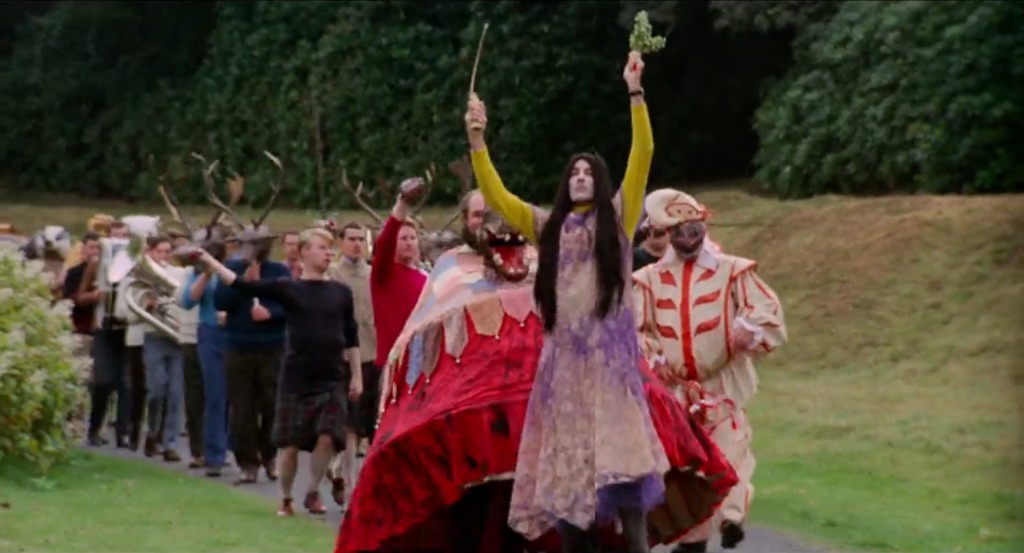
When a movie has been on my to-watch backlog for as long as The Wicker Man, I go into it with a lot of assumptions based on stuff that’s been outright spoiled, or stuff I knew from general cultural diffusion.
And from watching the inexcusably awful remake. I hadn’t thought it was possible for me to hate that movie even worse, but finally seeing the original transformed my take on the remake from “offensively unnecessary” to “thoroughly offensive.”1Hard to believe, I realize, but all of the misogynistic bullshit that permeates the remake is a new addition to the Neil LaBute version. Imagine that!
So after watching the original The Wicker Man, I can’t remember ever seeing a movie and so thoroughly wishing I could’ve seen it in its original context. Watching it in 2026, it feels bold and transgressive and completely unique. How much of that is the result of my formative years being in the height of an American conservative movement? My impression of the early 1970s in the UK is mostly formed from Led Zeppelin album covers; maybe pagan imagery wasn’t as immediately shocking.2This episode of the Dead Meat Podcast gives a little more context, suggesting that the UK’s puritannical backlash to the 1960s began around the time of The Wicker Man‘s release. Which makes sense, because I vaguely remember Thatcherism having a few year’s worth of a head start there before the Reagan flavor took hold in the US.
In any case, I don’t want to give the impression that The Wicker Man is one of those movies that can only be appreciated in its original context. It does a great job establishing its contrasts right from the start. We see immediately that the protagonist Sergeant Howie, played by Edward Woodward, is kind of a weirdo even by contemporary Scottish standards. His first line is a comically by-the-book “get a haircut” to a younger officer. Immediately after, he sees some graffiti reading “Jesus saves,” and although he agrees with the sentiment, there is a time and place.
While the younger officers are gossiping about how he’s so devout that he’s even saving himself for marriage, we see essential cutaways to Sgt Howie singing hymns with his bride to be, and then taking communion. We hear the entire ritual in voice-over, as the principle of transubstantiation is described from scripture. It’s immediately clear that for the Sergeant, it’s not just a familiar ritual; he believes in it with the true conviction of the faithful.
It’s the key idea that drives most of the movie, and it’s so effectively established from the start. When he goes to the island of Summerisle to investigate an anonymous report of a missing girl, he’s there not just with the authority of the police, but with the even higher authority of acting on behalf of a Christian nation. So when he encounters the obstruction of the older men at the harbor, and then the increasing raunchiness of the locals in and around the pub, you can practically feel his irritation building. They don’t respect the police, they don’t respect the mainland, they don’t respect the Crown, they don’t respect common decency, and they don’t even respect (his) God.
And it was fascinating to see how the movie put such a wholesome spin on heresy and debauchery. Or at least, what our protagonist considered heresy and debauchery. Everyone is perfectly polite and seemingly respectful to Sgt Howie, even as it becomes increasingly clear that they’re obstructing justice.
And I wasn’t prepared for how much of The Wicker Man plays almost like a musical. There always seems to be at least a violinist and guitarist somewhere nearby, waiting to turn the scene into an early 1970s music video. After he meets the innkeeper’s daughter, played by Britt Ekland, everyone in the bar, young and old, male and female, sings a lengthy song about wanting to have sex with the innkeeper’s daughter, to her delight. The song, and even the orgy happening outside, in and around the cemetery, are presented so joyfully that it makes Howie’s disdain and disgust for it seem uptight and rude.
As Howie’s investigation continues, he sees more and more signs that the islanders are lying to him and worse, that they’ve rejected God and are corrupting the children. The thing I love about the first half of The Wicker Man is that it presents all of this as innocuous at worst. Because so much of it is set to music, it often suggests that it’s the residents of Summerisle who are living in happiness and harmony.
It’s easy to imagine a lesser version of this movie, where the idyllic small town gradually reveals increasingly sinister signs of wickedness and blasphemy. Each with a tense musical stinger, instead of a lovely acoustic folk song. Here, it’s all open and in the daylight, and the camera dispassionately treats most of it as it would any quaint old village that has its own traditions. Of course the local pharmacy would have a jar full of foreskins; isn’t that charming?

Because we’ve already seen that Sgt Howie is out of place even on the mainland, and we’ve been reminded of one of the oddest and most symbolic rituals in mainstream Christianity, it adds a powerful subversion on the expected dynamic. Howie often reads not as the “fish out of water” so much as the judgmental invader. Never the villain, since you’re always reminded that he’s on a quest to find a missing child, and it becomes increasingly evident that the residents are hiding something. But the story refuses to give you a protagonist that you can relate to entirely, so for most of the movie, it maintains a sense of your being a dispassionate third party.
Which makes me think that much of the power and the timelessness of The Wicker Man is that your interpretation inevitably brings in so much of yourself and your own experiences and prejudices. I grew up in an environment where until the time I was a teenager, just the suggestion of teaching Christianity as a “comparative religion” would’ve seemed dangerously heretical. How does the tension of the movie play to audiences who grew up in secular households, and how does that differ from audiences who grew up in faithful households with non-Christian religions?
I’ve learned that Christopher Lee not only plays Lord Summerisle, but spearheaded the entire project, acting as more or less an uncredited producer. He also claimed that it was the film and the performance that he was most proud of. The movie isn’t the showcase for him that I’d been expecting, but it absolutely does not work without him. There’s such a strong association with his persona as an intelligent, literate, cultured, and impeccably genteel villain, and that’s crucial to making the core tension of the story work.
We begin to hear mention of him from the moment Sgt Howie arrives at Summerisle, with all of the residents deferring to him as the absolute, unquestioned authority of the island. The connotations of Count Dracula are unavoidable, and the movie takes full advantage of that, foreshadowing a climactic showdown with the blasphemous monster who’s bent an entire town to his will.
So their meeting is a fantastic subversion of that. Summerisle immediately reads as a direct contrast to Sgt Howie: tall, shaggy-haired, jovial, and worldly. He asserts that the community are “deeply religious people,” and that their practices are different from the mainland but equally valid. As Howie insists that they’ve rejected the “true God,” it flips the way paganism is typically presented in Western media. Summerisle is contemporary and enlightened, and Howie is the one who’s clinging to the superstitious old ways. Of course the women are dancing about the fire naked; doing it with clothes on would be far too dangerous!
Watching The Wicker Man in 2026, it’s impossible for me not to see comparisons between Lord Summerisle and a current-day hoodie-wearing tech billionaire. Casually describing a history of social engineering as a grand experiment, where fealty to gods of nature has resulted in greater productivity. His education, wealth, and rank demand a level of deference from a representative of The Crown, even as he’s matter-of-factly describing how they’re not subject to the rules of The Crown. You can imagine a current-day journalist calling it “disruption.”
While the movie’s not a showcase for Christopher Lee, despite his being essential to making it work, it absolutely is a showcase for Edward Woodward. His performance is phenomenal. I kept seeing scene after scene where taking it even a tiny bit too far in any direction would’ve undermined the entire film. As it is, he reads as a man whose self-righteousness is absolute, without ever turning into desperation or defensiveness. The island is constantly and increasingly challenging his baseline understanding of what’s “normal,” but it’s not breaking him, and it’s not making him lose his cool.
Except for the best scene in the entire movie, which is a scene of seduction presented as a musical number.

The innkeeper’s daughter Willow is lying nude on her bed in the next room, slapping her hand against an adjoining wall to the beat of the music, singing to the accompaniment of a guitarist and drum player downstairs. As the song continues, she dances around the room, pressing herself against the furniture, the window, and the walls, like a siren calling out to the Christian policeman next door.
And again, the song is presented as more lovely than sinister. If you’re watching a full edit of the movie3I saw the version on Kanopy, which is assembled from two different prints of varying quality, as it includes several minutes that were cut from an earlier release, you saw an earlier scene where a young man from the village was presented to Willow, she called him up to her room, and everyone in the pub sang a song celebrating the two of them having sex upstairs. Here, her dancing is shown as beautiful and natural, her singing as more of a willing invitation than a seduction or temptation.
In the next room, we see Sgt Howie losing control for the first time. He’s sleepless, sweaty, and mad horny, pressing himself against the wall, almost physically restraining himself from running out of the room and into the bed next door. The premise clearly suggests the story of Sir Galahad: a virtuous knight and servant of the King, victorious over wicked temptation and maintaining his chastity. But with the music, and with the way it’s shot — cutting between the brightly-lit dance in Willow’s room, with the dark, shadowy, sweaty desperation in Howie’s — it forces you to consider how much of that torment is purely of Howie’s own making.
We saw so little of Howie’s fiancee that there’s little sense of infidelity; she’s practically a non-character. There’s not even the usual sense of the uneven power dynamic, especially if we saw the earlier “Gently Johnny” scene. It makes you realize that even the notion of a woman having bodily autonomy is considered a threat to a puritanical society. Which of these two characters is really the more “wicked?”
Obviously, I don’t want to suggest that the key takeaway of The Wicker Man is “honestly, there are no bad guys here.” As the story advances towards its conclusion, it becomes increasingly clear what’s going on, even if you hadn’t already been spoiled for the ending. And that, ultimately, is my main criticism of the movie, the thing that keeps it from being unique and perfect.
For all of the interesting and transgressive things it does purely with imagery and music, it still has several scenes of clunky exposition. Most of the initial conversation between Lord Summerisle and Sgt Howie is telling the history of the island outright. As Howie’s focus returns to the police procedural portion of the story, we get several scenes of his thoughts in voice-over, or even saying out loud, his theory on exactly what happened. He finds a book describing the May Day ritual, which lays out step by step what the different roles are, and exactly what happens. And the end of the movie is a character explicitly spelling out exactly what was going on all along.
Of course, what was going on all along is interesting and tragic and horrific, so the movie’s iconic finale still totally works. Especially since Woodward’s portrayal of Sgt Howie remains phenomenal to the end. He’s not simply a fool, and he doesn’t act purely out of self-righteous conviction. His appeal to the people of the island is one of reason, trying to explain the futility of what they’re doing. And the only time in the entire movie that we see a crack in Lord Summerisle’s confidence, a moment of hesitation while considering he hasn’t achieved a flawless victory, is when Howie points out that he’ll be the target the next time the crops inevitably fail. Raising the question of whether Summerisle was ever a true believer, or simply manipulating it for his own benefit.
Even at the end, Howie remains steadfast in his faith, and there’s even a sense that he’s “won” in the sense that’s most meaningful to him. He resisted temptation, and he stayed true to fulfilling his quest, the only person on the entire island who wasn’t being deceitful. Woodward plays him as a man who didn’t succumb to fear or desperation, and stayed true to his beliefs when a more contemporary man wouldn’t have.
The biggest criticism I have of The Wicker Man is that the scenes of explicit exposition are disappointing in a movie that’s so effective at suggestion. And its folk horror/thriller4Although Christopher Lee stressed in interviews that he didn’t consider it a horror movie resolution does pretty definitively turn it into a story about a Christian martyr remaining steadfast against the evils of paganism. Plus, when you go back and consider it just in terms of plot, a lot of the moments don’t make that much sense as part of a grand scheme.
But those just keep the movie from being perfect. They don’t change the fact that The Wicker Man is a transgressive and timeless examination of belief, ritual, religious imperialism, comparative religion vs dogma, unchallenged cultural assumptions, and the role that faith plays in our natural lives. It’s so much better than the movie I’d expected it to be, and it absolutely deserves its status as a classic.