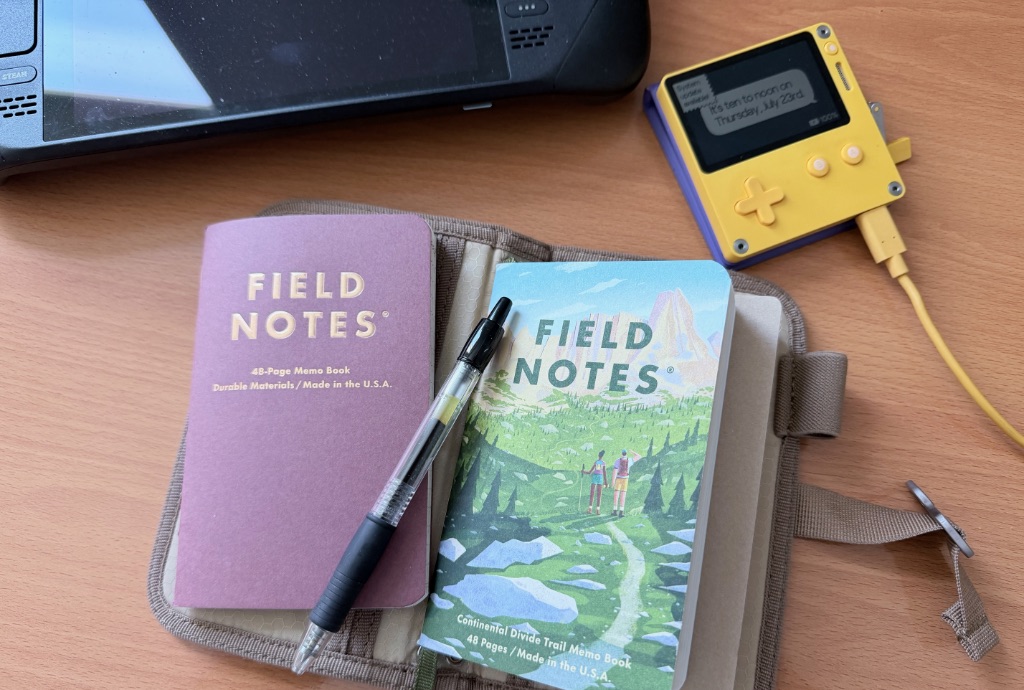
Field Notes sends out a monthly newsletter called “Staple Day” to its customers, and as I was going through this morning’s email, I casually read this month’s installment: promoting their new run of notebooks1Which promote Chicago’s Mexican community and its Paletarías in particular, a mention on Jeopardy!, some blogger talking about how they use the notebooks, the writer’s commonplace journal, and a discount for people working in education to get their pocket-sized editions of the Constitution and Declaration of Independence.2I ordered one for myself after realizing how thoroughly the current administration has corrupted the entire notion of the federal .gov web presence, and it’s a sign of how corrupted it’s gotten that I don’t even trust them not to rewrite the “official” online versions of our founding documents.
All pretty standard stuff for a company that… wait, hang on. I’d gotten to the end of the newsletter without even realizing that the notebook-obsessed blogger they’d mentioned was me. It was this post in particular.
Any time something I write “escapes containment,” I go back and re-read to gauge how it sounds to someone who’s not already familiar with my usual bullshit.3Big ups to the 33 subscribers that WordPress tells me I have. So I was surprised by how much that post sounds not just critical, but dismissive! Saying I was “under the thrall” of the company’s marketing. Calling them “overpriced for what they are.” Claiming “the paper isn’t that great.”
An embarrassingly odd thing to be linked to in a marketing newsletter. Even if you assume, like I did, that the photo of a desk full of the things and a commitment to subscribe to them4Which I did, soon after writing that would make it clear that “overpriced for what they are” meant “compared to cheap, purely functional notebooks you can get just about anywhere” and “the paper isn’t that great” meant “for fountain pens, which isn’t how most people want to use them anyway.”
It also made me hyper-aware of all the times I’ve called the Playdate a “hipster GameBoy,” assuming that of course it was clear to everyone that I’m still deeply enamored of the platform and the entire philosophy behind it. Seems pretty arrogant of me to assume that people would even know who I am, much less that I’ve got a long history5Without the software library to show for it, on account of taking forever to make things with the platform. Or that it literally saved my interest in game development, after decades of working in the industry had pretty much killed it.
But then I realized that the Field Notes newsletter isn’t a marketing newsletter with some community mentions contained in it; it’s a community newsletter with some marketing blurbs contained in it. Meaning the focus isn’t just on selling the product, but paying attention to how people use it and the ideas behind selling the product in the first place.
The old The Adventurer catalog from LucasArts was the main thing responsible for my becoming such a big fan of the company, and the interviews and “Games to Play After Hours”6Get it?! sections made me have parasocial relationships with the people who worked there long before I met them. It was a focus on the community of fans, instead of the market of customers, that sold the philosophy of the product just as much as the product itself. And it’s an idea that Telltale’s community team worked hard to carry on, at least in the early years.
I also suspect it’s one of the clearest generational breaks between Gen-X and millennials, which I’d been starting to think was a purely made-up distinction, as they kept getting older and I remained steadfastly a 40-year-old trapped in a 55-year-old’s body. But I was so infected by Late Night With David Letterman — my belief that his mockery of General Electric genuinely was stickin’ it to The Man — that I think it metastasized into a constant, impotent cynicism. It’s only people younger than me who can genuinely like things, instead of always feeling the need to be suspicious of them, or qualify my enthusiasm by making it clear I’m neither a shill nor a sellout.
Maybe that’s too optimistic. Maybe the prevalence of influencer culture, and being constantly surrounded by grifters, has made it even worse. But it’s comforting for me to believe that it’s a mindset that will gradually die off, and good riddance.
The reason I feel strongly about it at all is that I genuinely believe small, ethical businesses are going to be a huge part of what saves us. I canceled Amazon Prime about a year ago, after many years of wondering whether I was part of the problem and then shrugging for the sake of convenience. The most surprising thing has been realizing just how unnecessary it was the whole time. I haven’t missed it at all. It just had me often buying stuff I didn’t need.
I had come to the conclusion that if small businesses couldn’t compete on price — which was perfectly understandable when you’ve got a corporate giant doing everything it can to undercut everyone and drive out competition — then they had to make up for that some other way, like curation. When I kept going to local businesses, not finding something in stock, and then seeing them just go to the computer and order it, I started to wonder what was the advantage of shopping locally in the first place? “Support small businesses” sounded more like altruism than anything else: no, they don’t have what you want in stock, and they’ll have to order it online just like you would have, but at least it’ll cost more!
But now, I am 100% back on the small business bandwagon, except this time for partly selfish reasons. None of the logistics issues have changed; I could still go on Amazon and most often find exactly what I’m looking for, get it cheaper, and get it faster. But the real cost to me turns out to be exactly the same thing that makes Amazon’s prices so cheap: volume.7Ironically, the punchline to a repeated joke on David Letterman’s show. Any saving I’d have on any one item is counteracted by the fact that I’m also buying a ton of shit I don’t need.
But the less selfish and more feel-good part of the equation is even more true than it’s ever been. Small businesses are unlikely to ever buy out your doctor’s office and make you wonder how a bookstore ended up dealing in HIPAA violations. And they’re unlikely to be contributing to the net worth of one of the world’s most embarrassing billionaires.8Which is more impressive when you consider just how fierce the competition is.
And I still say, as cruel as it may sound, that if a small local business never has what you want in stock, but just offers to order it for you online, so you just go home and do it yourself, there’s a good possibility it deserves to go out of business. Not because a small business needs to have an inventory as large as the world’s largest online retailer. But because a good small business has more going for it than just “we have that in stock.” Maybe they’ve built a nice environment that’s enjoyable to be in even if you don’t buy anything. Maybe they don’t have what you came in for, but they can recommend something you’ll like even more. Maybe they’ve built up a community and an ethos, that makes you feel like you’re buying an idea as much as a product.
Maybe they just give you a sticker and a lollipop. As part of my latest weird thing with fountain pens, I recently ordered one that cost a couple dollars more than it would have on Amazon, simply because the company’s YouTube videos had been so helpful. The box took a little over a week to get here. It contained a free set of sample inks for being a new customer and giving them my email. The box also had a sticker, and a Tootsie Pop.
Doesn’t seem like the most consequential thing, especially since I don’t like lollipops. But it just made me happy to be reminded that there were real human beings involved on both sides of that transaction. And it made me even happier to remember that the person who put a lollipop in my box almost certainly wasn’t having to pee in a jar to meet their quota.