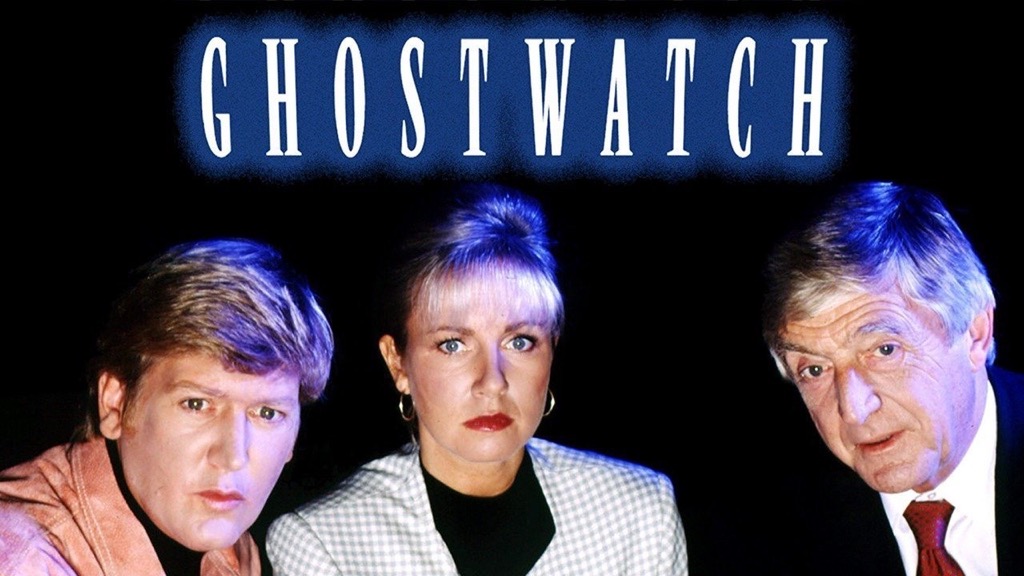
YouTube loves recommending video essays to me, so for a long time I’ve seen thumbnail after thumbnail promising a deep dive on “The scariest scene ever filmed!” or “The hidden secrets of the most surprising twists!” and the like.
Often, it’ll be “The most horrifying TV broadcast you’ve never heard of!” and about 90% of the time, they’ll be talking about Ghostwatch as if they’re the first ones to introduce it to anyone. So I’ve had years of having the internet hyping it up, elevating it to legendary status, and introducing the basics before I was able to see it.
Ghostwatch is a horror movie that aired on the BBC on Halloween night in 1992. It’s presented as if it were a live broadcast, split between studio segments and a remote crew spending the night in one of London’s most haunted houses. The family living there — a single mother and her two daughters — have a long history with poltergeist activity in the house, an entity that the younger daughter has nicknamed “Pipes.” A crew of three has gone inside with a camera and sensitive audio recording equipment to try and catch any evidence of ghostly activity for the live broadcast.
Slashfilm has a write-up from 2022 by Lee Adams, who watched the original broadcast. I think a non-sensationalized essay like that is essential for getting an idea of the movie’s original context and why it became so notorious. As an American watching it streaming in 2026 (on Shudder), clearly labeled as fiction, it was near impossible to put myself in the mindset of someone in England watching in 1992.
For instance: four of the lead actors are playing themselves, banking on their notoriety as real-life television presenters. The only one that I recognized was Craig Charles, from Red Dwarf, who does segments outside the house and treats the whole thing like a big joke, but he’s getting paid to entertain. Sarah Greene is inside the house and interacts most closely with the children and their mother; like Charles, she was both an actress and a television presenter, so her presence alone wouldn’t have been an indicator of whether it was real or fiction. Her husband Mike Smith also played himself, manning the phone bank during the broadcast. As I understand, he would also have been an immediately-recognizable presenter to anyone who was familiar with the BBC, but wasn’t known as an actor.
The host is Michael Parkinson, who from the descriptions of Ghostwatch that I’d seen over the years, I’d assumed to be a newscaster. But as I understand it, he was primarily known as a talk show host and frequent presenter. When trying to “translate” the cast to an American context, I’d been imagining that he’d be like us seeing Dan Rather or Charles Brokaw witnessing a live haunting, but it might be more accurate to compare him to someone like Johnny Carson or Mike Douglas? Or there might not even be a perfect American alternative.
In any case, they add a sense of legitimacy to the whole thing that still works, even if you don’t have that immediate sense of familiarity with them. The first part does a pretty great job of hitting that sweet spot of awkward corniness that feels more like a live broadcast than the setup of a found footage movie. Any cracks in the verisimilitude are immediately patched over by knowing how people on live television so often sound awkward or wooden, artificially friendly, or vamping to fill time. It’s especially interesting since the actors playing purely fictional characters often come across as fake or wooden, simply because they don’t have that built-in veneer of artificiality.
The other thing that makes it difficult for me to put myself in the right context has nothing to do with being American, but simply unable to remember what the state of VFX was in 1992. One of the cleverest parts of the movie happens early on, when a live caller to the show says that she spotted something hidden in the background of video footage they’d aired earlier. There’s a really great build-up of tension as they politely thank her for the call and then have to cut to a different segment while they wait for the technicians in the studio to be able to bring up the footage again. You’re spending the entire time wondering, “what did she see? Did I just miss it?” I had to resist the urge to rewind the movie to look for myself, because I knew that that wouldn’t have been an option for most people watching the original.
It’s one of the most effective and creepiest things a found footage or ghost story has in its arsenal, and it’s done especially well in stuff like Lake Mungo and Mike Flanagan’s The Haunting of Hill House. So it’s a little disappointing that it’s given such a brilliant set-up here, but is a bit lessened by the execution.
A mild spoiler for Ghostwatch: the effect here is cheapened a little bit by some obvious trickery. They play the footage back once where the figure is pretty clearly visible if you’re looking for it, but when the people in the studio rewind it to look one more time, they use a different clip. A clever addition is when they have the resident “paranormal expert” in the studio outline the spot with a light pen, to make you question whether you saw what you think you saw. But on the whole, it felt like it could’ve been a flawless moment, but was hobbled by early 1990s television VFX.
So I’d been ready to think of this as a good-but-not-great experiment in unconventional horror moviemaking and broadcasting, more interesting as a historical novelty than as a genuinely scary movie. I figured that years of hype had been over-playing just how traumatized the people of England had been, or how many people believed it was the real thing. We’ve seen similar with War of the Worlds and The Blair Witch Project, and I guess even as far back as The Arrival of a Train at La Ciotat station, where the urban legends about people being fooled were able to gain so much more traction in the public consciousness than the reality.
But the whole “were people tricked into thinking this was real?” aspect isn’t what makes Ghostwatch remarkable. It’s both more clever than I would’ve expected from a production like this, and it goes harder, too.
One of the cleverest aspects is how it bakes in its content warnings in a way that doesn’t interfere with the fiction. After the opening, there’s little indication that you’re watching a movie instead of a live broadcast. But Parkinson gives content warnings to the viewers before certain clips or audio recordings are played back for the audience, a perfectly in-universe method of getting the creepy moments but also being responsible broadcasters. Even more clever are the frequent reminders that kids should be in bed instead of watching this. Both of the daughters are put to bed with a reminder of what time it is, and there are lines of dialogue about how they shouldn’t still be awake. When a “caller” phones into the studio to report a strange occurrence — which happens right before the story takes a darker turn — Parkinson seems more curious about why her children are still up after the “watershed,” and practically begs her to put them to bed.
And the darker moments pay off more than I’d expected. The exposition for what’s happening is delivered gradually and mostly naturally, as we get seemingly unrelated info from neighbors and unseen people calling into the live studio. It all gets lumped in with the various other reports of ghostly incidents reported over the course of the show — with Greene’s description of her own previous experience being an interesting highlight — until it all crystalizes into an understanding of who “Pipes” is.
So I really enjoyed Ghostwatch, possibly even more than I’d expected to. It definitely feels like the best time to see it would’ve been when you were a British adolescent or teenager in 1992, but the next best time is whenever you’re in the mood to see a clever ghost story and early pioneer of the whole found footage format.