The Roottrees are Dead is a deduction game by Jeremy Johnston set in 1998, which tasks you with doing online research to complete the family tree of a trio of very famous teen celebrities.
The history of the game itself is pretty interesting. I’d have more details if I hadn’t spent the last six hours doing fake internet searches and wanted to dive deeper into real ones. But I did immediately find that it was begun as a game jam project, which Johnston later released as a free browser game using art created by Midjourney. In 2025, a remastered version led by Robin Ward, with real art by Henning Ludvigsen, was released on Steam.
And the developers have just released The Incident at Galley House, which is a remaster of another browser-based text-only game called Type Help.
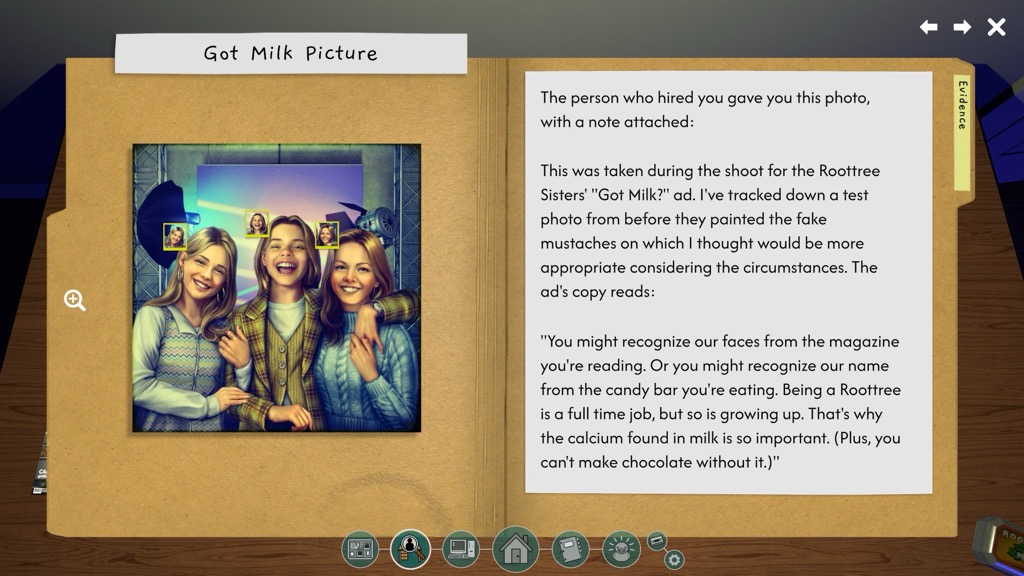
Finding out that the original solo project used Midjourney was interesting, since one of the most compelling draws of the game for me (apart from the buzz I’d been hearing online) was the title art. It’s a depiction of the titular characters smiling, and the art itself, combined with the game’s title, are an immediately intriguing pull into the mystery.
It’s the third version of the title art I’ve seen online, and it’s a thousand times more interesting than the original Midjourney version, and more aesthetically interesting than an earlier version. The developers of the remaster make a point of stressing that no generative AI is used in the Steam version, and the the original will always be free, because of the ethical issues associated with selling something that uses AI art, even if everything else is original.
If I were still interested in going down investigative rabbit holes, I’d like to dig up what exactly the production process of the remaster was. You can see an art style shift in the assets themselves, beyond the deliberate attempt to recreate styles of media throughout the 20th century, from black-and-white photos and ads to late-90s art projects. And comparing the remaster to the browser game quickly becomes a testament to the value of real art: simply in terms of visuals, the stuff in the browser game is technically more photo-realistic and “professional,” but there’s a bland nothingness to it all as well. Acceptable competence, but nothing memorable or compelling.
In any case, the game is in a burgeoning genre I wasn’t even aware existed, the “Return of the Obra Dinn-alike.” It’s not a secret, and my pointing it out isn’t an insult; the developers thank Lucas Pope in the credits, and a key mechanic is lifted directly. As you work to complete everything required for each person on the genealogy chart — name, photo, and most recent occupation — when you get three entries correct, you’re interrupted by a screen saying “Well Done.” and showing you which correct items are now locked in.
Like so many of the design decisions in Obra Dinn, it was an ingenious way to maintain a sense of progression, and the feeling that you were making deliberate deductions instead of just choosing items from a list, while discouraging you from just guessing for everything until you got it right. And it works in much the same way in The Roottrees are Dead: you get confirmation that something still isn’t correct, but it’s not so immediate that you can just use trial-and-error without its being tedious.
It’s very rare for me to finish a video game these days, but I was drawn into the story of The Roottrees are Dead enough to finish it, over the course of about three nights and a little over six and a half hours of play time. There’s a huge volume of writing in the game, having to mimic styles from early-1900s novels and diaries to fan websites to teen magazines to ad copy. It’d all be an impressive achievement for a small team of developers, which becomes even more impressive when you see just how small the team was.
My biggest criticism is that it’s possible to get completely stuck. The reason I played over the course of three nights was mainly because I would get to the point where nothing was turning up new leads, I was reading the same articles over and over again, and all of my searches were turning up nothing. Because of the nature of the game, it suggests an infinite internet that even by late 1990s standards, a game like this can’t possibly recreate. The game will prune out branches that won’t be productive, by just telling you flat out when you’re finding “flavor text” instead of something relevant, which is absolutely the right call. But I also kept running into cases where it seemed like a search should’ve turned up something, but the game wanted me to find a piece of info from a different direction. So the end result sometimes feels counter-intuitive and arbitrary, instead of feeling like finding a stray mention in one article that leads you off on an interesting tangent.
At the conclusion of the game, as it explains the back story (which I did complete correctly, thank you very much), it highlights the specific quotes and sources that should’ve led to each one of the revelations. That’s a fantastic touch, the equivalent of flashbacks when a detective is going over the details of a murder mystery to a room full of suspects. The recap mentions an entire piece of source material that I hadn’t seen, and I couldn’t retroactively figure out what would’ve let me to that.
Also, as the possibility space contracts towards the end of the game, it pretty much flat-out tells you that you’re going to have to guess for some of the names. You’re working from a finite list, so you can just use the process of elimination. That’s inevitably what you’re going to be doing in some cases anyway in a game like this, but it has a tinge of defeatism to it that’s not super-satisfying.
I had to use a couple of hints to complete the game (and still ended up missing 2 of the optional side photos). One led me back to a search that I’d done dozens of times already, when I finally got that it wanted me to do a search that is casually mentioned. The other just reminded me of a photo that I’d collected near the start of the game, before I had realized that you could click on faces in the photos.1I did like the wording of the hint, though; it was so direct that it made me wonder if it was commonly missed during playtesting: “Lbh’er ybbxvat sbe n onol.” (ROT13)
My other criticisms are broader, not even really criticisms so much as observations about this type of game, the decisions it makes, the nature of storytelling vs mechanics in video games, and how projects that in theory should feel very similar end up feeling completely different.
Ostensibly, the info you’re looking for in Roottrees is exactly the same as Obra Dinn: name, photo, occupation. With the latter, it’s all integrated in one passenger manifest and a couple of hand-drawn images depicting almost everybody on board. With the former, you’re finding more pictures as you go along. That means Obra Dinn builds up a familiarity over the course of the game, where you keep seeing faces pop up repeatedly, but don’t yet know who they are. Roottrees has many situations where you know exactly who a person is, but just can’t find a photograph of them.
The occupation is also more integral to Obra Dinn, since roles on a ship are more immediately relevant, and you can infer them from a combination of clothing, the kinds of things you see them doing, and the areas of the ship they’re in most frequently. In Roottrees, it’s another item to fill out, and it often feels arbitrary with little bearing on the rest of the story.2There’s one notable exception I can think of, where a late-in-life career change for a character kind of gives them a story arc, while most of the characters in the game remain pretty static.
But the significant addition in Roottrees is filling out a family tree, which means inferring relationships from written descriptions, but also age, ethnicity, hair color, and so on. Of course, it’s thematically appropriate for a story about a sprawling, 20th century American dynasty.
It’s interesting because the same mechanic ends up doing significantly different things with storytelling. Roottrees is engaging but is largely administrative; the focus is on filling out the form, while you’re fed developments happening in a smaller-scale story taking place in the present.3The remaster on Steam includes a bonus mode that I did not play, but from what I understand, it’s both more difficult and has more twists to it. But I’d initially dismissed Obra Dinn as being administrative, until I discovered that it’s actually telling a high seas adventure story.
It’s a neat example of how game mechanics deliver stories and vice-versa; using the same game loop as an existing game doesn’t mean you’re going to end up with something that feels like the same thing, just with a re-skin.
I say The Roottrees are Dead is a solid example of what a very small team can accomplish with a game. It’s more like the feeling of authorship you got back in the days of Infocom and the “album cover” era of Electronic Arts, where game releases felt more like new novels than the video games we think of now. Not necessarily inventing a completely new format each time, but bringing in new themes and settings and types of stories they want to tell.