I haven’t seen Jane Schoenbrun’s other movies, We’re All Going to the World’s Fair and I Saw the TV Glow, but I thought I had a fairly accurate high-level idea of what they were. Art film horror. Heavily influenced by online culture and queer society, but almost certainly humorless and dripping with self-serious pretentiousness.
So I’m happy to say that whether I’m right about those movies or completely off-base, Teenage Sex and Death at Camp Miasma is silly and funny as hell. It pulls off the amazing trick of having all the trappings of a queer confessional art film, with plenty of symbolism and metaphor and open interpretation, but also is dead set on having as much fun with it as possible.
There’s a lot in the movie that feels like Schoenbrun poking fun at themself, via main character Kris (Hannah Einbinder) as a sort-of stand-in for the filmmaker, but it’s always with a sense of kindness and genuine self-love. Satire without mockery1Except for the business of filmmaking but coming from a place of affection.
It’s unique to see a movie with this much blood and gore that also feels so kind and joyful.
It’s also structured like a deconstruction of slasher movies, while simultaneously insisting that an academic deconstruction is missing the entire point of a slasher movie. It has metaphors that seem painfully on-the-nose — like the virginal final girl in the movie-within-a-movie, who literally wears a little red hood — but also insists that there’s never a simple one-to-one this-means-that interpretation.
And it’s couched in representation of queerness, polyamory, and transgender identity, but it doesn’t treat them as sensitive hot-potato topics that must be talked about the right way. There’s an extended sequence where Kris and actress Billy (Gillian Anderson) are watching the first Camp Miasma movie, which had starred Billy as that final girl. As a bunch of camp counselors gather around a fire to tell the origin story of “Little Death,” the franchise’s spear-wielding killer who wears an air vent as a helmet, Kris announces, “This scene is transphobic.” Billy just shushes her.
It was such a clever and funny moment, for a dozen different reasons. It was just a funny gag, with a filmmaker trying to explain an aspect of a movie to the older and more experienced star of the movie. It was a direct reference to how weird it is to be a socially-conscious horror movie fan. It was an assertion of one of the core themes of the movie, the idea of the appeal of horror being the direct opposite of intellectual analysis; it’s about visceral reactions, pushing boundaries, and giving in with abandon to feeling something instead of understanding it.
The Camp Miasma franchise in the movie is a pastiche of the entirety of 80s slashers, but Friday the 13th and Sleepaway Camp in particular. We see the full version of the transphobic scene that Kris warned about, and it is so over-the-top transphobic that it’s absurdly comedic. The comedy comes from characters explicitly stating negative ideas about trans and gender-nonconforming people that were all over 1980s and 90s horror, but even slasher movies in the 1980s were a bit more subtle about and reluctant to just say outright.
I was reminded of a really good episode of the Dead Meat Podcast about Transgender Representation in Horror, which had horror movie fan2And frequent Um, Actually contestant Joan Ford as a guest. I have to admit that I went into that episode with a subconscious goal of getting Joan to tell me what I’m allowed to think, to even be able to consider a movie like Sleepaway Camp as campy horror instead of having to dismiss it outright as completely objectionable.
Which is dumb, because even with the best of intentions, it treats trans people as “other,” and as a monoculture. Instead of the far simpler golden rule of treating everybody with kindness and realizing we’re all going to have our own takes. She stresses that in the opening, saying that she’s not the expert and not the one to give the final word (that’s Patti Harrison). And the larger point: you can acknowledge the problematic aspects of something without necessarily dismissing everything you might get out of it.
I will never like Sleepaway Camp, since I think it’s a just plain bad movie, but there’s no denying that it’s full of stuff that is unforgettable. A kind of perverse appeal in seeing something committed to reveling in bad taste without being John Waters-levels of aware of what they’re doing.
Anyway, all of that is summed up by one moment in Camp Miasma. A simple assertion of “That’s not what we’re talking about right now. Watch the movie.” Especially relevant for Einbinder’s character Kris, who lives her entire life in her head, and has felt some kind of draw to what slasher movies do ever since her childhood, but has never quite been able to get the whole way to getting the entirety of them.3In an early scene, she watches one of the Camp Miasma sequels and writes in a notebook, “DESIRE” in all capital letters, then underlines it three times.
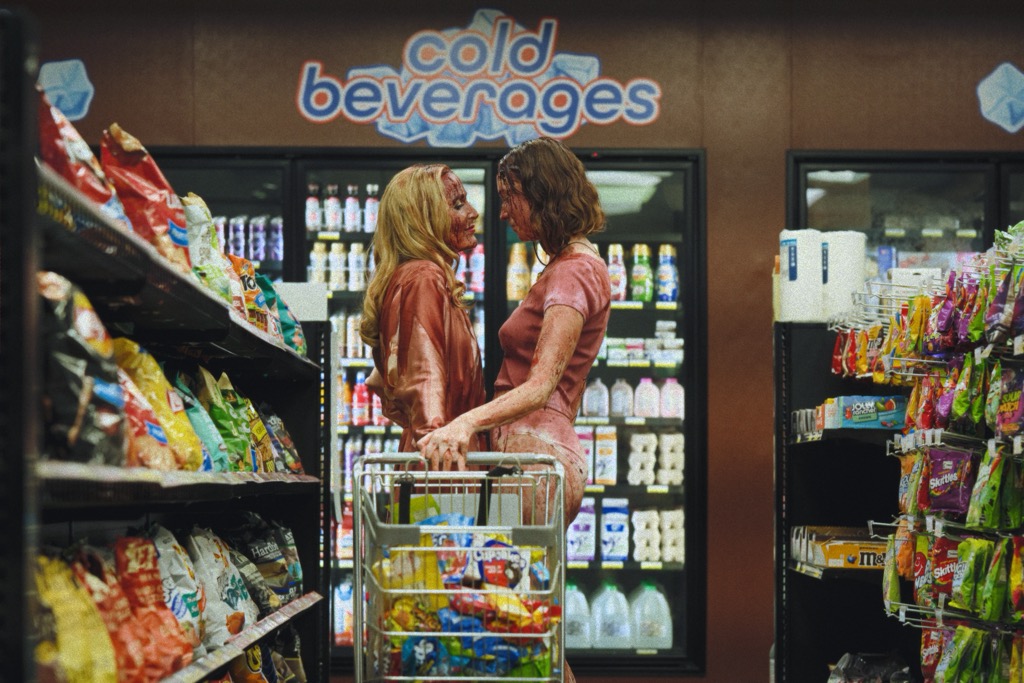
There’s a fantastic earlier scene in which Anderson’s Billy holds a plate of fried chicken and seductively drawls, “Do you like dipping sauce?” Followed by a scene of the two of them opening sauce packets and dipping chicken tenders into them, with heightened squicky and slurpy sound effects. The movie is full of imagery where junk food serves as a stand-in for4And occasionally, supplement to the Pleasures of the Flesh.
And the movie sets the tone early. The beginning shows us a scene from Camp Miasma with Little Death’s first kills. As is repeated often over the rest of the movie, bodies shoot out ridiculous geysers of blood over a dozen feet into the air. It lets you know from the start that this isn’t a movie that’s taking itself too seriously.5By the way, the post-credits scene isn’t huge but is very, very funny.
That sense of playfulness doesn’t simply set the tone of the movie, either: it emphasizes one of the core themes, of resisting the urge to reduce the complexity of everything into a single meaning. Schoenbrun seems to be insisting that they’re not going to tell you what to think about any of this, or what it represents, because that’s not how horror movies work. Or at least, not the reason they’re drawn to them. They can’t explain what it means to you; that’s the part you have to feel for yourself.
So murders will be comically over-the-top but not otherwise signal that they’re being played for laughs. (With the caveat that Sarah Sherman is in this movie, so there is inevitably a sequence near the end that plays out like an SNL Digital Short). The most violent killing spree in the movie plays out to wildly incongruous music. And the most realistic bloody murder scene in the movie is at least partly a metaphor for some really great sex.
When I saw that Little Death’s mask resembles an air vent, I quickly figured out that it was an image that was supposed to evoke someone staring up at the ceiling and dissociating during unsatisfying sex. I wouldn’t normally give a direct this-represents-that “explanation” in a review of a movie, especially not a “spoiler-free” review, but a key part of this movie is that it refuses to give explicit explanation of its images. It lets you know the air vent is a significant image, since it’s repeated multiple times in various forms and used for various different things. But it’s adamant that it “means” whatever it means to you.
There is a lot of more overt imagery, like the ice and snow around the camp thawing, and especially the use of fake backdrops and film grain to constantly remind you that you’re watching a movie; it’s not any more “real” than the Camp Miasma footage. But there’s also a sense of self-awareness throughout — it’s not the movie showing you a clever trick, but almost the opposite. Not “do you understand the correct interpretation of this moment?” but “how does this make you feel?”
This is a movie where a split diopter shot used for no real reason got a laugh out of the audience. (In Burbank, but still).
It does lead to my main criticism about the movie, which is that level of meta artificiality. Einbinder’s character stresses that it’s not meta, like New Nightmare by horror master Wes Craven, but it has the same effect in the end. I liked that the movie refused to tell you what was “real,” to remind you that it’s all something to be experienced instead of something to be understood. A major obstacle for Kris at the start is that she’s spent her life watching people go through extremes of emotion on the other side of a screen, without feeling them herself.
But the constant reminders that all of this is a movie backfires somewhat. It has the side effect of making everything feel like it’s kept at a distance, even what should be the most intimate and relatable moments.
That said, I was extremely impressed by both of the leads’ performances. Anderson plays Billy as Norma Desmond (they make that reference explicitly) with Dolly Parton’s accent, and it could’ve easily slipped into caricature, but she makes her believable as a real human being. Einbinder has to be grounded and relatable but also make a significant transformation as a person, all while being vulnerable both emotionally and physically. Essentially having to be both the uptight filmmaker and the target-of-the-male-gaze final girl. I think she’s outstanding.
That sense of relatability is one of the most remarkable things about this movie. I’m not a woman, I’m not transgender, and I only within the past several years started to consider myself a horror movie fan. But still, so much of this felt as if it were made specifically for me. I’m not even convinced that queerness is an aspect of relating to Camp Miasma, since it has this sense of universality that touches on something deeper than identity. It seems to speak to anyone who’s ever felt repressed.
There’s a scene near the climax6No pun intended where Kris assumes the role that was all but inevitable the moment the movie started, and it struck me as the moment when the movie was most overtly showing what the appeal of horror movies is for some people, why fans like Schoenbrun are so drawn to them.
I was reminded of a story by Joe Hill in 20th Century Ghosts called “Best New Horror,” which ends on a similar idea. Both depict that feeling of exhilaration and joy mixed with horror that is so all-encompassing that it’s literally ineffable; you can only just hint at it. Even the phrase “I just want to feel something” is insufficient, much less an academic breakdown of how using a spear as a weapon is phallic imagery, or how slashers reflect the anxieties of our time, or all the psycho-sexual implications of the “final girl.”
In that sense, Teenage Sex and Death at Camp Miasma is kind of a rejection of Scream and Cabin in the Woods, or anything that tries to break horror movies down to explain their rules. It suggests that there are no rules, and that’s the whole point.