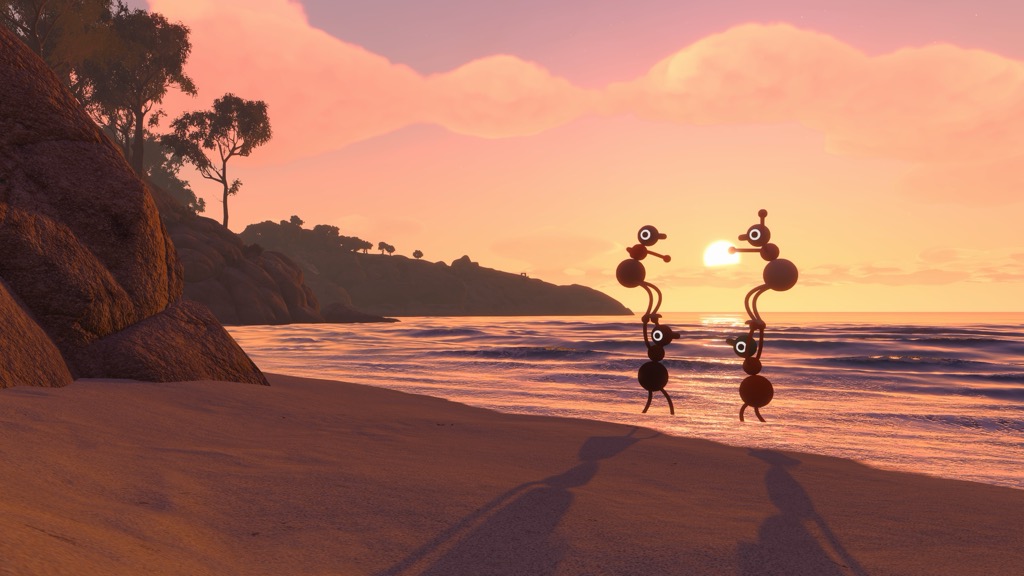
Because I have connections in the industry, I was getting hints about the game Big Walk over a year ago during a business lunch.1Because people sometimes can’t tell when I’m being serious: No I’m not being serious, and yes I am trying to make myself sound important. A friend was in town and visited me at work to chat over lunch and go to Mickey’s of Glendale. I got the sense that it was something really special. When you’re talking to someone who’s infectiously enthusiastic about seemingly everything, and even they seem especially enthusiastic, it sets a high bar.
As previews and details about the game were released, and I kept hearing people from Panic talk about it with reverence and excitement, my natural skepticism started to kick in and temper expectations. I am an unabashed fan of Panic, the people there, and the whole philosophy they bring to game dev and publishing. And I honestly don’t think it’s hyperbole to say that Untitled Goose Game, the previous game from developers House House, was a quiet masterpiece. So it wasn’t “I don’t believe you,” but “I’m skeptical that I’m going to see what you all are seeing.”
After all, I’ve never been into multiplayer games, but I have still played several. So I do have some experience with being in an MMO and ignoring the quests to just hang out with friends and go exploring together. And even in a single-player game like Skyrim, I’ve spent an entire real-world night just wandering around, doing nothing of significance beyond enjoying a sunset, exploring the caves of the unknown, or just doing a photowalk through fake wilderness.
Last weekend, I played Big Walk for the first time with my husband and a group of four other friends from their Twitch stream. We played for a little less than five hours including breaks, and we got through the first two major checkpoints of the game. Without spoiling anything, I can say that that’s exactly enough to get an idea of just how big the game world is, and how much there’s left to explore.
It’s also enough to see what makes the game so special. It’s full of very deliberate design decisions, all working in concert to take those magical moments that happened as side effects in multiplayer and open-world games, and make them the core focus of the experience.
And it often seems designed specifically for people like me, whose experience with multiplayer games has been:
- Getting ruthlessly and repeatedly ganked while having to hear a grown-ass man throw a tantrum about how much you suck, and then having an adolescent call you a slur
- Having to kill 100 rats or goblins on a quest to get to the fun part of the game, while having an adolescent call you a slur
- A myriad of variations on the same small-group-multiplayer format, all designed primarily to generate moments that will go viral on streaming video
Big Walk is also a perfect example of how ideas aren’t worth much of anything without execution. I think it’s perfectly reasonable to hear the pitch for the game and think that it’s nothing particularly new or innovative. “I could already do the same in Final Fantasy XIV,” for instance. Or maybe there already exist small-group-multiplayer games that are puzzle-focused instead of being variations on Phasmaphobia and Lethal Company, and I’m just not aware of them.
But I suspect that it’s more like claiming “I can use a table knife to unscrew this.” Technically, it might be true, but it’s clearly not what it was designed for, and it’s definitely not the best experience.
In Big Walk, the good vibes aren’t a happy side effect. They’re the point of the experience. Right out of the gate, you do character customization by finding a structure with a big palette and asking your friends to paint you different colors. It’s charming as hell, and it lets you know this game’s priorities right from the start:
- You have to rely on each other and communicate.
- You have to learn the game’s tools for communication, e.g. pointing at this specific square of color and saying, “Green for my middle, please.”
- You have to take turns and be engaged in what other players are doing, instead of just making your own choices.
- And you have to appreciate that there are probably a dozen more efficient ways to do this, which we’ve seen in countless character customization screens.
That last part is key, because Big Walk is largely a game about slowing down. Which means it runs directly counter to everything else in the 21st century, which is (supposedly) all about speeding everything up, increasing efficiency, and getting to the point already.
Even 20+ years ago, I found myself working at companies that were obsessed with “reducing friction” and “the first five minutes.” That fetishization of underestimating the audience’s attention span just got more and more extreme across all of tech giant-driven entertainment, to the point where even movie trailers have trailers. Because if you can’t show somebody an explosion or a car flipping over in the first nanosecond, they’ll have already scrolled away.
Big Walk is a lot more about vibes. While you’re doing the set of puzzles in the starting area, you can choose to just hang out on the beach. Or just sit on a rock and chill out. And after solving that starting block of puzzles, your reward is a little amphitheater overlooking the ocean, lined with speakers playing the game’s great music.
That music, at least all that I’ve noticed so far, is all 1) excellent, and 2) diegetic. The sound design is a huge part of Big Walk, so voices and other sounds get louder and softer and move around as you move around the environment. That alone isn’t entirely new. What does feel new is seeing a game that so completely embraces it at its core, making it essential for an experience that’s about communication, cooperation, and exploration.
So the world design makes everything work in concert to serve that core idea. When you get a somewhat cinematic moment, like the successful conclusion of a set of puzzles, it’s delivered in the form of an area where you can walk to, hang out, enjoy the music, and talk about what you just did and what you’re going to do next. When you walk away from the speakers, you can enjoy the quiet and nature sounds.
Or ideally, conversation, since you really shouldn’t set off without a buddy nearby. We spent much of the game getting separated from each other and then trying in vain to reconnect. One of our players fell into a hole and spent over an hour trying to get back to everyone else before giving up, all the while saying that they could occasionally hear people nearby, but nobody could hear them.
I was making an active effort to stick close to people, staying in a support role holding lights or whatever else was needed, all the while strictly staying true to the spirit of the game — no messaging, no communication outside the tools the game provides — and still kept finding that I could get completely separated from the group in under 30 seconds. A simple “I’m going to check out this blue thing” could result in you, or people in your group, wandering around in pitch darkness, trying to figure out which of the five or six blue things on the horizon they were talking about.
It’s more than a little frustrating, not just in practice, but knowing that it’s a case of the purity of the game design conflicting with reality. We had a really good group assembled. Everybody was cooperative and really into the spirit of the game. It’s a group that plays co-op games together frequently, so they naturally work well together. So it’s not like anybody was deliberately trying to break the game, or was even insisting that it act like something that it’s not.
But partly because the group works so well together in other co-op games, there’s a base-line assumption of how a co-op game works, and the kinds of “quality of life” tools that they usually make available, and which Big Walk deliberately removes. And it’s deeply unsatisfying to be left just saying, “Well, you must be playing it wrong.” It feels like when people2Like me, I’m people would get frustrated with the weapons constantly breaking in Breath of the Wild, and they were met with a response of “it is crucial to the design of the game and you just don’t get it.” I can understand why it’s there, and still not think it’s a satisfying experience.
I’m also a bit reminded of how Imagineering has insisted on a purity of theme park experience over and over again, all the way back to Epcot, and it invariably falls apart when it comes into contact with reality. You can show people your design bible all you want, but that doesn’t change the fact that when they come to Disney World, they want to see Mickey Mouse. When they come to a Star Wars land, they’re more interested in Star Wars than whatever alternate immersive timeline you’ve designed. And it doesn’t matter how meticulously you’ve designed your alternate-reality African and South Asian fantasy cities if people on vacation can’t find a shady and dry place to sit down.
To be absolutely clear, I’m not suggesting there’s any hint of arrogance in Big Walk. It’s an opinionated game, but also genuinely committed to delivering on a different kind of experience. And I really love the poignant idea that you can be left completely in the dark unless you have a friend nearby holding a light. Or that if you want to find somebody, you can’t just ping them on a minimap; you have to climb to a high vantage point and look, or call out and hope they can hear the echo.
But it’s also a game. Which means it’s playing to an audience for whom time is a fairly precious commodity, and putting them in a digital world — no matter how immersive! — is going to feel like a step backwards if that “friction” feels like an irritation instead of an interesting challenge. Especially when getting a group of adults together at the same time to play a video game is as difficult as getting a group of adults together to play an RPG campaign.
I don’t know what the answer is; I don’t even know if it’s a problem, or just a case of different strokes. It’s definitely not something with a solution as simple as “just stop being so precious with the timeline and put Darth Vader into Star Wars land already.”
I could tell it’s not a simple solution because opinions in our party wildly vacillated between “the proximity audio is wonderful!” and “the proximity audio is ass.” Based entirely on how urgent it was to hook up with other people in that moment.
So I really do hope that is as simple as “friction” and a case of adjusting expectations. Because I spent the first hour or so of the game thinking “okay I totally get why people are calling this the game of the year now.” It’s not something that’s easy to explain, because it comes from being in the moment and having a hundred different well-executed decisions all working in concert to deliver that moment. A game where you happen to find puzzles on the way to your next memorable hang-out experience, instead of vice versa.
Or a game where you can be hanging out on a beach with a new friend you don’t yet know very well, and they’re sitting and vibing and you’re both commenting on how well the game delivers on slow-down-and-relax moments, which is unheard of in modern video games, if not modern life itself. And then you sit down on a rock without realizing it’s sloped, so you slide helplessly down a cliff face and land on the ground dazed, hearing tweeting bird sounds. And you both laugh your asses off about it, until the rest of the group hears and comes over to ask what’s going on, and you tell the whole story.
And then a short time later, they fall down a hole and get cut off from the rest of the group for over an hour, until they log off and just watch everybody else playing on the stream. I’m hoping that future sessions have more of the former and a lot less of the latter, assuming they even have interest in playing again.
Comments
One response to “Big Walk, or, I Command You To Relax”
Yeah, I have a small group that only manages to get together (digitally) for games occasionally, so we’re fairly selective about the games we choose. This one is perfect for us, because by now we’re scattered all over the world and really missing the time (20 years ago) were we would all just hang around in some forest or dive bar seemingly all the time. The puzzles are great because of the reliance on communication, often reminding me of the goofiness and inventiveness of the British show Taskmaster, but the real joy is just sitting around a campfire (well, glowing orb) and talking about nothing. I think we all fell in love with it pretty quickly.
One example of a small but genius puzzle: (and this is a spoiler for a fun part, so please ignore this bit if you feel inclined to): we all walk into this small room containing nothing but a couch, a chair and a big tv. Once we closed the door, a big 5 minute countdown started on the tv. We couldn’t do anything in the room except open the door, which would turn off (and then reset) the timer. The solution? Just hang out and have a conversation with each other for 5 minutes. It’s a small idea, but genius in its own way. We loved it.
But yeah, the frustrations you mentioned are very real. Once it gets dark, it gets very dark, and its super easy to get turned around and fall down a thing and losing the rest of your friends for ages. It resulted in some fun moments though. At one point I was wandering around a forest after losing the group, only to run into a friend who was sent out to look for me, but she had also lost her way. We spend some time desperately looking for whatever gathering point they had chosen, until we suddenly saw some fireworks the others had found, and heard one of my friends singing a silly song over a megaphone (just to make sure he could keep making noise). It was kind of magical and funny in its own way.
Of course, that was an example of it turning into a fun story with a lot of things coming together. There are a lot of frustrating versions that happened often as well. I wish the distance your voices carry was just a bit larger (if only to be able to follow conversations easier), and it’s very easy to get stuck on things in the environment.
Still, it’s not perfect, but when it works it’s pretty amazing.