AMC has been taking part in the celebration of life for Dolly Parton by bringing some of her movies back to theaters, albeit at times that only unemployed people can see them. Luckily, I’m unemployed, so I got to finally see The Best Little Whorehouse in Texas from 1982.
From the quick glimpse of the crowd, it looked like a couple dozen other Gen X-ers who were able to go see a movie in the afternoon on a Monday. And I shouldn’t make assumptions, but I’m guessing about half of us were gay male Gen X-ers. And all of us were clapping at the end and laughing throughout.
Even though I loved 9 to 5, and this was Dolly Parton’s follow-up, and was also directed and co-written by Colin Higgins, I’d never seen it before. At the time, I was too young to get permission. By the time I was old enough not to need permission, I figured I’d already outgrown it. After all, it had to be corny and unsophisticated, way too goofy for the sophisticated film-lover that I had evolved into by my late teens and early twenties.
The advertising for the movie seemed relentless, probably taking up an oversized space in my imagination just because it seemed so scandalous. A lot of sources couldn’t even say “whorehouse,” so they had to dance around it when describing the movie. I’m not sure if it was in the trailers or otherwise, but I do remember seeing the gag where Burt Reynolds’s character describes trying to fit into a small piece of underwear as “trying to stuff two bowling balls into a marble bag.” Pretty edgy stuff, to an 11 year old!
So I always figured that the movie was likely Smokey and the Bandit or Cannonball Run, but turned into a musical, bumped up from PG to R rated, and featuring Dolly Parton as a special guest star. The fact that Dom DeLuise is there as a muck-raking, sensationalist TV personality; having Jim Nabors, Charles Durning, Barry Corbin, and Robert Mandan also show up made it seem like peak early-1980s Hollywood Countryfied Comedy Product.
The thing I never appreciated is that I’ve never actually gone back and watched a lot of the R-rated movies that came out in the years I wasn’t allowed to see them. I’ve always had a very skewed sense of how sophisticated “grown-up stuff” was, based solely on what grown-ups could and would broadcast on television. So I figured this movie was essentially Hee-Haw where they could show tits.
Apparently, to fans of the stage musical, which was based on an article that was published in Playboy, that’s what this movie is. A bastardized, Hollywood-ized version of more mature material. Coming at it from the opposite direction, I was surprised to see that the movie is campy, corny, slapsticky, and silly, but (almost) always with the feeling that they knew exactly what they were doing.
I’d expected to see Burt Reynolds from Smokey and the Bandit, but he seemed to me more like the Burt Reynolds from Deliverance playing the Bandit. Over the years, my image of Reynolds has merged with Norm Macdonald’s impression of him. It was odd to see him in a part that’s practically begging him to be the cocky, self-aggrandizing caricature that made him famous, but he’s instead choosing to act. He and Parton even seem to have actual chemistry, which somehow felt even more genuine than his chemistry with Sally Field.
Even more surprising than that to me were the rare moments where Dolly — who I’d expected to just run away with the movie without even breaking a sweat — showed just the tiniest sliver of insincerity. There are lines that felt like they’d obviously been inserted to let her deliver her famous one-liners, when she makes a couple of gags about her chest. A couple of moments where she just didn’t seem to be quite feeling it that day, the kind of thing you’d never notice with anyone else.
There’s also the insertion of “I Will Always Love You” at the end, although it hits even harder now, and even though the score kept foreshadowing it throughout, in a moment that turned her from Miss Mona back into Dolly Parton. It’s easy to think that she’s always been the unassailable superstar, but this was only her second Hollywood movie. She was a name draw, obviously, and 9 to 5 had been a huge hit, and even though she didn’t get top billing, she was the first one cast. But she was still in the process of crossing over into “mainstream” stardom. Still building the brand that would become unstoppable.
The other standout is Charles Durning. Reynolds claimed credit for encouraging the studio to cast Durning instead of a known musical theater star, since nobody would expect him to be able to sing and dance so well. If that’s a true story, then good call, Mr Reynolds. Charles Durning absolutely crushed it. Can you imagine being a respected actor and still almost being able to steal a musical comedy out from under Dolly Parton? With only about 10 minutes of screen time, total? (In retrospect, I probably shouldn’t have been surprised that the man who played Doc Hopper would excel at musical comedy).
Jim Nabors is basically doing his Gomer Pyle schtick, but it all works. Dom DeLuise is going as broad and campy as the movie demands, and it all works.1I knew where the gag was going as soon as he had Ed Earl hold his sock, but I definitely didn’t expect them to give us a close-up showing him positioning and forming the sock. The movie overall has that very specific 1980s flavor of diversity, where there is exactly one (1) black performer and one (1) Asian performer in every group. It’s very cop-friendly, and has two scenes where a sheriff assaulting a journalist2Even a cartoonishly awful journalist designed to be hated is designed to get applause from the crowd.
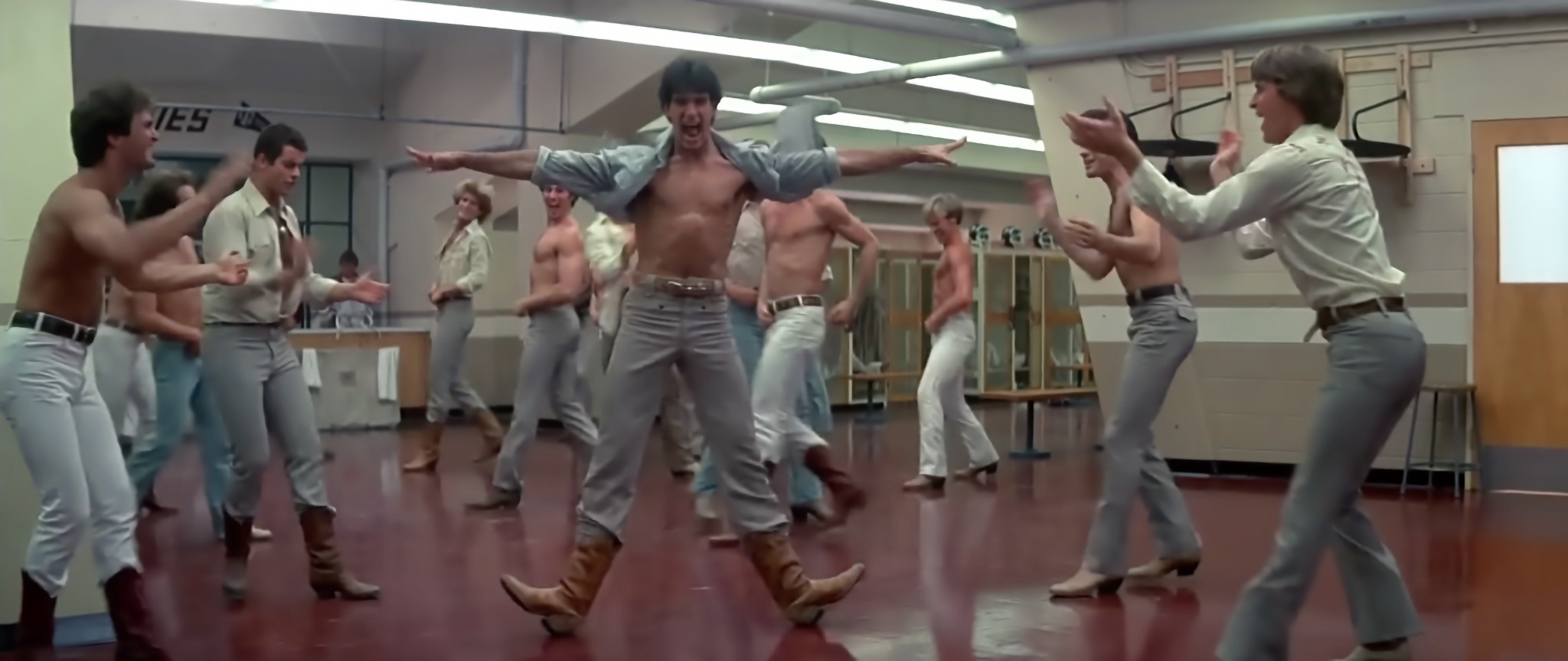
I kept expecting it to feel too corny and dated, but it just kept feeling like a bunch of actual adults who all knew exactly what they were making and exactly the tone of it. The one thing that did make it feel most dated was that it’s very sex-positive, but only for the straights. There’s a lengthy scene where the “Aggie Boys” are dancing around in their jock straps, naked in the showers, or in shirts open to the waist with colorful neckerchiefs on, and somehow I was never once convinced that they would be interested in what the Chicken Ranch had to offer them.
By the end, I was blown away to see a movie that functioned as a big Hollywood musical, with two stars establishing their brands, capitalizing on the new trend of commercialized country, but that still felt smart and genuinely progressive. A rejection of the hypocrisy of prudishness, the kind of thing I didn’t expect to see until much later in the decade at the earliest. And even then, only from stuff that was a little less mainstream and more pointedly queer, like Elvira: Mistress of the Dark.
So it was a bit of a cold shower to read even a little bit about the making of the movie and hear just how bitter everybody is about it. I do recognize the irony of seeing a movie about prostitution and not realizing that they were all faking it. Dolly has said she was miserable while making it, and part of that was having to manage Reynolds’ moods after breaking up with Sally Fields. Reynolds is quoted with a lot of back-handed comments suggesting Parton was controlling. The one who comes out sounding the worst is writer of the original article and the book for the stage play, Larry L King, who complains that they turned the musical into something unrecognizable, and calls the director the f-slur.3But speaks fondly of Tommy Tune, who co-directed the stage play, and is also openly gay, so who knows what that’s all about.
It should surprise nobody that I’m on Team Dolly through all of that. I have an easy time imagining that Reynolds didn’t know how to handle a confident woman in the process of building a brand based on charisma and star power, much like he already had, without thinking of her as controlling. And even without ever having seen the original musical, all of the changes for the movie sound to me like the correct ones.
The years-long romance between Ed Earl and Mona was invented for the movie, and apparently it was a one-night stand in the musical. I think it’s the key to why the movie hit so hard with me, the one thing that makes the whole movie feel special.
I’d expected — and it seems pretty obvious that I was supposed to — that this was going to be about a tough, small-town sheriff who don’t take no guff from nobody, clashing with a kind-hearted madame who also don’t take no guff from nobody, and while dealing with outside pressure from Big City types, they melt each other’s defenses and find themselves in love.
Instead, they’re just two adults who have been happily hooking up for years. Dolly added the song “Sneakin’ Around,” and it’s a happy duet to drive home the idea that there’s no shame or exploitation in any of it. They’re having fun. The only reason they keep it secret is for everybody else’s benefit, keeping up appearances. There’s a later scene where they go out camping together, and on top of the romantic comedy stuff that still works even though it’s not that unexpected — she’s a prostitute who can quote scripture better than any of the moralizers who claim to know The Bible! — it drives home that they’re both pretty smart, they both have aspirations, and they both just enjoy being together.
Which may all seem unremarkable unless you remember how the media in the seventies through the nineties treated casual sex like this bold, new, transgressive concept. In the early 80s, we got lots of sex comedies, which were all from the guys’ perspective, and which is largely how The Best Little Whorehouse was marketed. Even this movie pokes fun at the assumption that women don’t actually enjoy sex, with one character speculating on it as if it were a novel idea, and older married women saying they appreciated their husbands going to the Chicken Ranch, since it gave them a break from their obligation to satisfy their husbands.
The rest of the movie is social satire and political satire, but none of it feels all that relevant without a more realistic relationship, and more realistic ideas about sex, at their core. The other night, I watched an episode of Hee-Haw that had Dolly as a guest. On top of being reminded how it combined the corniest, barely-even-a-joke jokes with the most talented musicians, I was reminded how its “comedy” was covering the same topics. Alternating between battle-of-the-sexes jokes and government-types-are-hypocritical-and-ineffectual jokes, which were so well-worn and toothless because they were calling back to Will Rogers more than commenting on anything contemporary.
The most contemporary satire in Best Little Whorehouse had to do with the influence of the media and television. Lots of reminders that it’s all fake, everybody knows it’s fake, nobody takes it seriously, and it only becomes an issue when people have to be perceived as taking it seriously. The idea itself feels even more relevant now than it did in 1982, but it still comes across in this movie as a kind of toothless cynicism. Looking at it with a kind of shrug, turning to the camera, and saying something like “Congress is the opposite of progress!” and holding for canned laughter.
So I felt like there was this defiant spark at the heart of The Best Little Whorehouse in Texas, a little pilot light of insight keeping the movie from burning out into a manipulative, mainstream bit of nothing but entertainment, or a broad and cynical rejection of attention-seeking moralizers as being hypocritical, just leaving it with a “that’s the way it is” shrug and not offering any kind of progressive optimism in its place.
The scene with Robert Mandan’s senator holding a press conference blaming the Communists for his getting caught in a bordello was very funny. And the satire feels relevant now, after seeing the most prudish and judgmental people from my hometown be swept into supporting the most brazenly corrupt and amoral politicians in my lifetime. But if you just meet it with a shrug and a song and dance number, you’re not really saying anything. You’re just biding time as yet another wave of faux-conservatism sweeps through and sets progress back another decade or so.
That’s why I thought that the movie felt so effective and “mature,” even though it’s a Hollywood-ized romantic comedy sex farce musical, which has its madame with a heart of gold find happiness settling down and marrying a gruff but sensitive cop. There’s not a sense of him making an honest woman out of her, but of two happily independent adults finding out they complement each other. All the stuff about women’s autonomy, sex positivity, performative and insincere moralizing, and the hypocrisy and ineffectiveness of politics and the media, just float away into nothing unless they’re anchored by a couple of likeable, believable grown-ups.