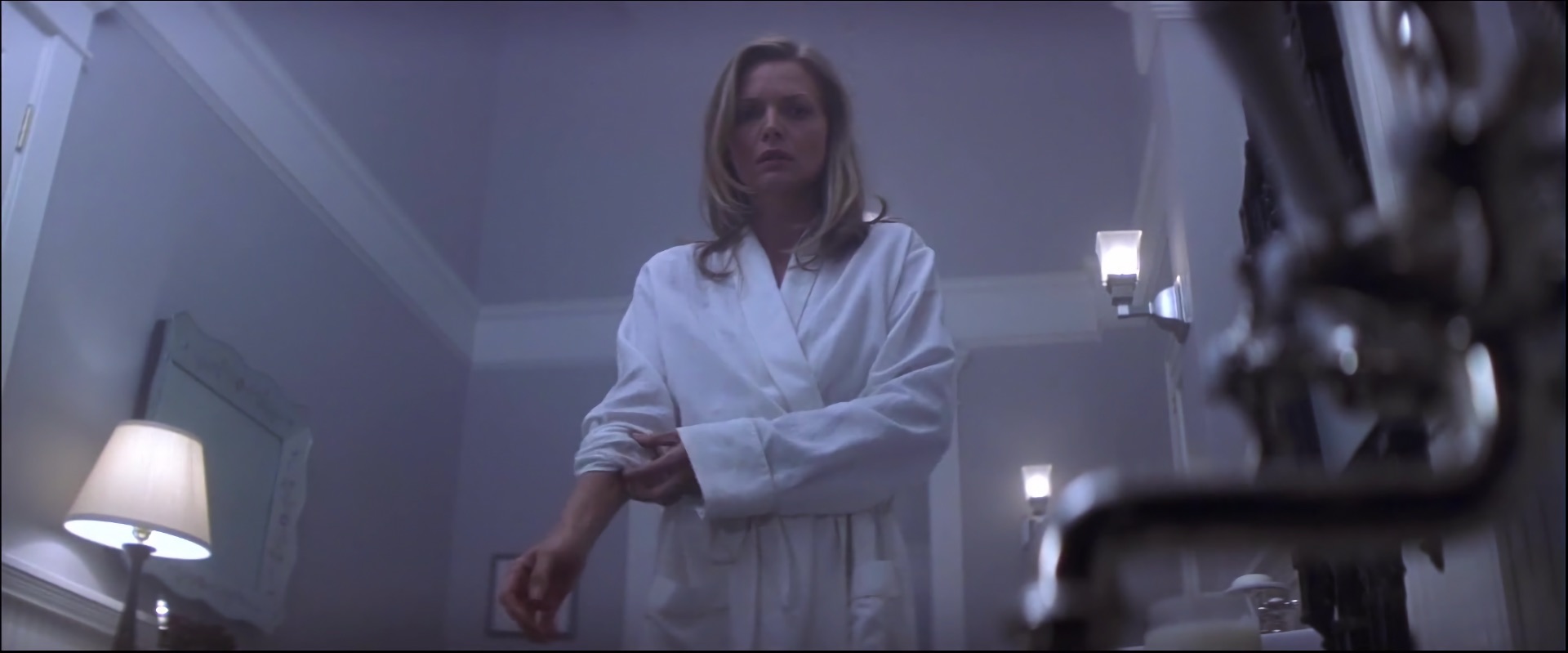
It’s still early September and I’m already in a Halloween mood. I always assumed that I’ve been getting an earlier and earlier start every year because I’ve been immersed in theme park-adjacent cultural awareness, and they always start Halloween in August. But I think it’s also just part of the residual energy of the San Fernando Valley, somehow, and people want it to be spooky season year round.
And it’s been a rainy Labor Day weekend, where I’ve been feeling intensely in the mood to sit inside and watch some scary movies. So I decided to soft-launch Spooktober 2026 with a suspense thriller from 2000 that everyone has seen except me, What Lies Beneath.
The movie stars Michelle Pfeiffer (Grease 2) as a musician-turned-homemaker, married to an overworked geneticist played by Harrison Ford (The Possessed) and dealing with having to send their only daughter off to college, and having a big house mostly to herself. It’s directed by Robert Zemeckis (Used Cars), and it feels very much like a Dreamworks SKG take on a ghost story combined with a millennial take on the Alfred Hitchcock suspense thriller.
I’m not sure why I didn’t watch this around the time it was released, since I’m very on board with the concept, and I really like everybody involved with it. In the years since, it’s kept popping up every time I look for a list of recommendations for good ghost-story movies. And every time, somebody has spoilt another small part of it, to the point where I went into last night knowing almost all of the story except for the final 30 minutes.
Even the short synopsis on most of the streaming services (like Kanopy, where I watched it) gives away a pretty significant plot point, one that isn’t actually revealed until halfway through the movie. I was starting to wonder whether it were one of those movies where the twists and reveals are just part of the marketing, and aren’t that essential to the movie itself.
That is not the case. I kept wishing that I’d seen it earlier, since the story goes off in multiple directions simultaneously, but I wasn’t able to fully appreciate how disorienting that must’ve been to someone coming in cold. Because I knew the end point that it was working towards, I was pruning out story possibilities that should’ve stayed in play.
But I wasn’t spoiled for what happens in the last 30 minutes or so of the movie, and I’m thankful for that, because it’s all pretty fantastic. It’s here that the influences become the clearest, and I think it did a spectacular job of translating late-career Hitchcock thrillers into the turn of the millennium. It’s all based on plot points that are given a pretty heavy-handed setup earlier in the movie, in scenes that might as well have a “REMEMBER THIS CONVERSATION” title card before them. It’s full of attention-grabbing camera trickery, and exactly the kind of CGI that the early 2000s are known for. And the score is often overbearing and draws unnecessary attention to itself.
Those are all compliments, not criticisms. Twenty-six years later, it has a lot of the same charms as the sometimes-dodgy composites in The Birds, or using very specific limitations of technology to build suspense, like in Dial M for Murder. It feels less like a super-grounded movie striving for absolute realism, but being hamstrung by Big Hollywood contrivances, or distractingly dated filmmaking, and more like a deliberately old-school, stylish, suspense thriller.
Which makes me think I might have gotten the best of both worlds, seeing it now. The first 2/3 of What Lies Beneath were basically like a rewatch of a movie I’d never seen, where I could better appreciate exactly how it was working, where it was foreshadowing, where it was building up red herrings, and how it all fit into the overall mood. And then the finale, where I had no idea exactly how it was all going to play out, could work on me moment to moment. I could appreciate how well it builds tension from prolonging something as simple as a bathtub plunger.
The biggest surprise for me was getting to the end credits, and seeing Clark Gregg (The Avengers, Agents of SHIELD) credited as screenwriter and co-story writer. I knew him only as an actor, and frankly wouldn’t have expected a screenplay this clever and savvy to come from someone who isn’t mainly known as a screenwriter.
Because obviously, a ton of the appeal of the movie comes from having Michelle Pfeiffer and Harrison Ford at (or possibly just after) the absolute top of their game, having the chops and star power to be able to just throw themselves into the parts. I don’t think these are especially challenging characters, but they do depend on having supernaturally charismatic and attractive people who don’t have anything to prove. They do have a chemistry that feels genuine — not just as a couple, but as a couple who’ve been together for a long time — but mostly give off a vibe that they don’t need to be Movie Stars and can instead just concentrate on feeling like their characters.
But there are also lots of fairly subtle things in the script that struck me as unusually clever. Exposition was the big one. Names are introduced in a way that feels natural — there’s one significant character who’s not even named until after she’s been in a couple of scenes, and I don’t think the movie ever establishes definitively whether she’s just a friend of Claire’s (Pfeiffer), a sibling, a former co-worker, or what. There’s a scene where it needs to be ambiguous what Claire’s motivations and mindset are, and it cleverly uses flirty talk (“Dr. Spencer.” “Mrs. Spencer.”) to keep it kind of a mystery as to what’s actually happening. And ideas are introduced, but then left dangling for a surprisingly long time, until there’s a natural way to bring them into the conversation. For instance, a notable dinner party, and an auto accident that Claire was involved in.
And on a larger scale, I really liked how the movie spent so long keeping you guessing at what kind of movie this was, exactly. You may know the basic premise — “affluent empty nester in a haunted house” — but still be left unable to predict exactly how that premise is going to play out? Who are the ghosts? What happened in this house? What happened to this family, that we’re only seeing suggestions of? How many of these story threads are just red herrings?
I say none of them are, which might be the most impressive thing about the script. It never closes off a path, or has a completely superfluous beat, since everything that happens eventually ties into the overall story, either directly or as an example of setting the mood and the stakes.
An extremely mild spoiler: one example of this is the character of the daughter, Caitlin. She is one of the first characters introduced, and at least these days, she’s given third billing after Pfeiffer and Ford. The spoiler is that she’s not actually in the movie very much. But her presence is, or more accurately, her absence. I thought What Lies Beneath does an excellent job of subtly making you feel Claire’s sense of isolation, simply by introducing Caitlin as a major character and then having her be, pointedly, not there anymore. It effectively gets you more into Claire’s mindset. Is any of this stuff actually happening? Or is she slowly losing her grip on reality?

A much more shallow surprise for me was the appearance of James Remar (The Warriors) as the sinister neighbor. He’s had a really interesting career, occasionally in a lead role but more often as a memorable character actor and voice artist. Most recently he was halfway embedded in the ground and covered with a black shawl as Tiresias in The Odyssey.
Seeing him here was like a secret Winter Soldier-like activation phrase that awakened a younger me I’d completely forgotten. The 90s were filled with this very specific Type of Guy: medium-length hair, glasses, beardy professor type, essentially Tweedy Daddy, except hot. I hadn’t realized just how much that imprinted on me until I saw a movie with a guy who could actually distract me from Harrison Ford. Something I never would’ve thought possible.
His wife is played by Miranda Otto (The Lord of the Rings), and that’s a sign of how far you have to go to cast neighbors in a movie set in a universe where Michelle Pfeiffer and Harrison Ford are unremarkable levels of attractive. And that’s a reminder of how much inherent appeal there is in making an old-school suspense thriller with the maximum level of Hollywood Star Power attached to it.