Mārama is currently a Shudder exclusive, which I’m hoping will do a lot to bring it to a wider audience. It’s the debut feature from writer and director Taratoa Stappard, and it has the feeling of a very earnest and opinionated production that is doing a lot with a modest budget.
The story centers on Mary, a young Māori woman who’s been summoned to Yorkshire from her home in Wellington, by a mysterious letter from a man who claimed to know about her birth parents. She soon finds herself inside an impossibly dark gothic mansion, filled with haunted mirrors and strange visions, owned by a wealthy Englishman who seems to be obsessed with Māori culture. He’s learned the language, he’s taught the language to his granddaughter, and he invites Mary to live at the mansion as the girl’s governess.
Based on the premise and the few promotional images, I’d expected this to be similar to Mexican Gothic by Silvia Moreno-Garcia, or something like Victorian Psycho by Virginia Feito. And it is, somewhat, although it’s much more earnest and serious in tone than either one of them. It’s more like a drama with horrific scenes than a full-on horror movie, which isn’t what I usually associate with Shudder. And it’s so eager to show proper respect to Māori culture that it sometimes feels more like the culture is a set of taboos not to be violated, instead of something to be celebrated. The result is that it’s a movie where I like the ideas behind it a good bit more than I like the movie itself.
Choosing a gothic horror to tell a story about colonialism is absolutely brilliant. And all the standard elements of gothic horror fit perfectly with a culture that so strongly values respect for ancestors and looking to the past; the phrase “walking backwards into the future” is repeated several times throughout the movie. The dark mansion in the English countryside, filled with repression and secrets, cursed by the sins of the past that are waiting to be revealed by the young governess forced to make it her new home, it all fits perfectly into place.
Especially when that kind of you-don’t-belong-here wrongness that plagued the protagonist of Rebecca is here not just as a reflection of her station or her relationships, but the entirety of her identity. A big part of the feeling of dread in Mārama comes from the sense of people and a culture who’ve been transplanted to the wrong place. When wealthy Englishman Cole speaks the language and has the artwork, it doesn’t feel respectful, but stolen.
But as with a lot of Mārama, it’s better at making you recognize the way you’re supposed to feel than it is at making you actually feel it. As one example: there’s a dramatic moment when Mary/Mārama is shown a Māori house that Cole has moved to his gardens in Yorkshire. She sees it as a desecration, enough to pointedly and accusingly ask him about it in a later scene. But the way it was presented, it wasn’t clear whether this was offensive to her as a Māori person, or offensive to her personally for some reason, tied to the visions she keeps having. And I couldn’t tell the scale of the offense, either. Is it generally disrespectful, or is it along the lines of exhuming a grave?
Normally, this would settle comfortably into the category of “not everything was made for you to get it.” But I do think that the first half of the movie was so unnecessarily impenetrable that it backfired. I started second-guessing the details I thought I’d heard, and then the entire premise. Was Mary raised by Māori or Europeans? (There’s a line where she mentions her adoptive parents, to explain how she speaks French, but I forgot the details). How much of this is a culture that she lived in, vs part of her ethnicity? Is the movie suggesting an innate understanding of culture vs one developed through lived experience? Are the filmmakers suggesting that?
Around the midpoint of the movie, Mārama does a complete 180 from impenetrable to too-obvious, with a scene where the characters are so over-the-top in their disrespect of the Māori culture and mockery of the people that it would be impossible for even the densest person in the audience to misinterpret it. But I do at least appreciate a movie where one of the most horrific scenes is one that’s about cultural appropriation and arrogant disrespect.
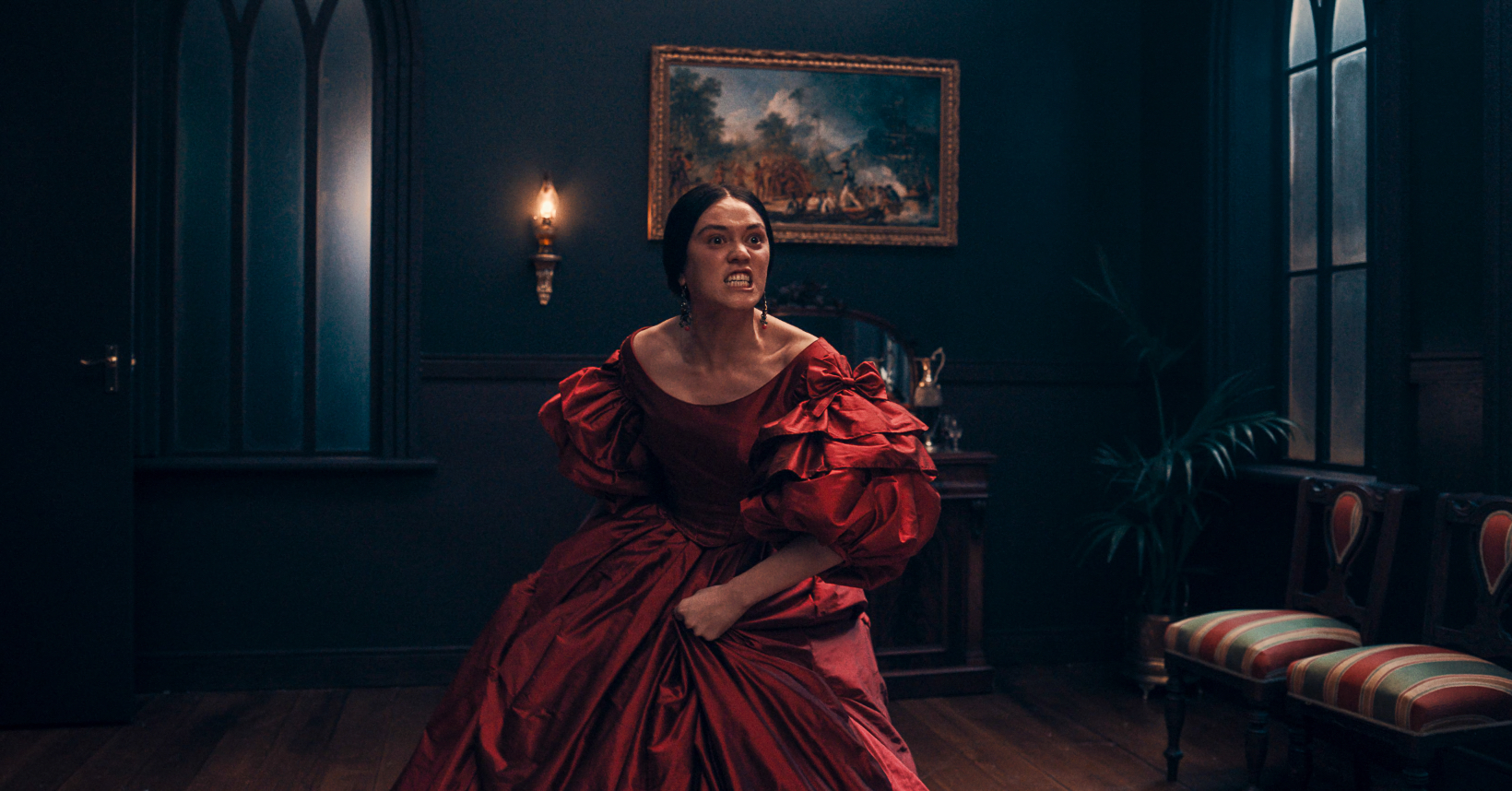
It also becomes the clear standout scene of the entire movie, as Mārama, wearing the crimson dress chosen for her by her host, becomes so enraged that she performs a haka directed at the crowd. (In front of a painting honoring Captain Cook). It’s fantastic.
It’s also one of the only moments in the movie where you really feel it, instead of understanding how you’re supposed to feel. I don’t think it’s a huge surprise that Mārama transforms from gothic horror to revenge horror. Which is another genre that happens to fit perfectly into a story about the evils of colonialism. And the strength is that the appropriately convoluted and dark, lurid story involving Mārama herself isn’t the only thing driving it. It feels like the rage of an entire culture screaming against centuries of history.
Leave a Reply