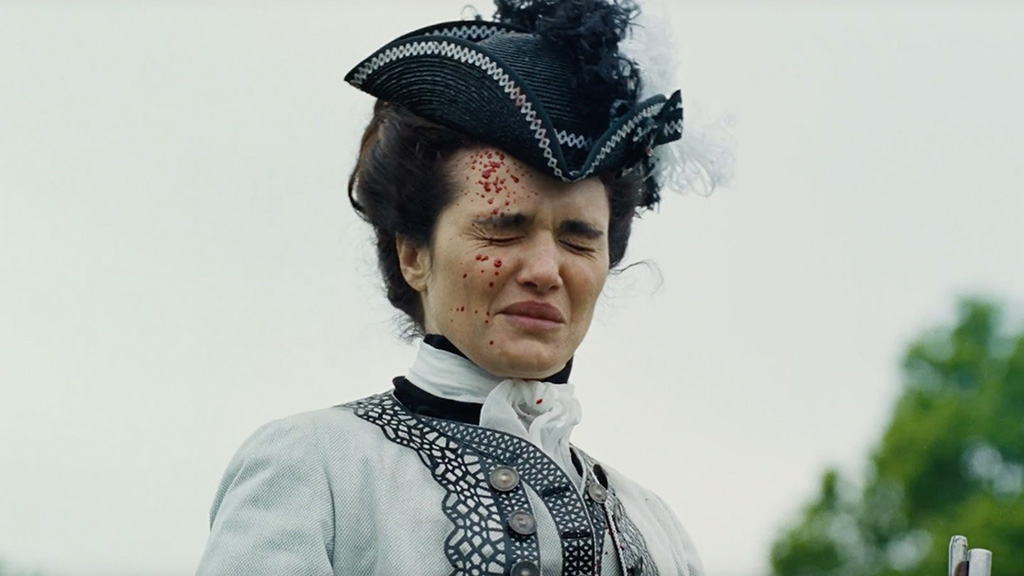
While I was looking online for more info about The Favourite, I was surprised and more than a little disappointed in what seemed to be at the top of the search results. One recurring idea was people on Reddit and the like complaining that the movie wasn’t all that funny, actually. Another was the tendency, especially for media outlets, to use headlines that emphasized it as having a predominantly female cast.
It made me feel like I’d crawled at least partially up my own ass, since I’d been hyper-critical of Poor Things and The Great for being good but not perfect. I was reminded just how difficult it must be to make anything that tries to raise the bar or be innovative, since there’s so much push back against anything weird. A less ambitious mainstream movie will get a better response — yes, including from me — than a more daring one that doesn’t get every single thing right.
I hope it’s obvious why I think it’s shallow to complain about the movie not being funny enough. More than that, though, I was surprised to see anyone watching The Favourite and coming to such a reductive conclusion that the most interesting thing about it is having female leads. I hadn’t thought of it as a movie about women, so much as about three distinct characters who are women.
Isn’t that the goal, after all? To have characters who are interesting enough, and enough of them, that they’re no longer defined predominantly by their gender?
But you don’t have to think back on the movie for very long to realize that that take is reductive as well. The movie is full of ideas about sex, gender roles, motherhood, and the patriarchy, and it’s not particularly subtle about it. But one of the things that The Favourite does so well is keep all of these ideas present throughout, but it doesn’t let them take over. It keeps almost all of the focus on the characters’ relationships with each other, not their relationships with men. (Unless it serves their purpose, in Abigail’s case, or gives insight into their character and what they value, in Sarah’s).
In other words: the patriarchy is the instigating event of this story, but it’s not the story itself.
Much of Anne’s sadness, loneliness, and insecurity have to do not with being Queen, but with being a wife and mother. Her husband is dead, and she keeps constant reminders of all the children she doesn’t have.
At the start of the story, Sarah has already established herself as a woman treated as equal in a man’s world. The first time we see her, she’s talking about affairs of state with two men, and there’s little question as to who’s in charge. She defers to her husband, but it always feels like a combination of propriety and genuine affection; in the few moments we see them alone together, they speak as equals.
And the movie doesn’t treat this as a regular occurrence in the early 1700s, either. In an early exchange with Harley, she’s flinging witty and clever insults at him, and it outrages him so much that he can only respond with the most misogynistic swear that I can’t say. You quickly get the impression that the respect she’s earned in the court was hard-won, and the result of being at least twice as smart and capable as anyone else.
Which helps explain why there’s immediate tension between her and Abigail, and why she so quickly considers Abigail a threat. You can imagine that she’s rarely intimidated by men, but instead sees them as either contemptible (like Harley) or with a mutual respect (like Gondolphin). But another woman with education and ambition is a vivid reminder of how tenuous her own position is, since it’s allowed not based on her own merit or competence, but because she has the favor of the Queen.
And Abigail is to me the most interesting, because I immediately thought of her story as being about class instead of gender. She’d seen life as a noble and a life in poverty, and was willing to do whatever it took to get back to a place of comfort and high rank. That took all of my attention, even though her first scene involves her getting sexually harassed. She matter-of-factly tells Sarah about getting sold by her father to another man, and how the saving grace was taking advantage of the fact that men don’t understand menstrual cycles. Later on, it’s taken for granted that her key to being part of nobility once again is by marrying a nobleman. The interesting thing there is that the marriage of convenience isn’t treated as taking advantage of her; she may not be in love with him, but she at least finds him fun and interesting (at first), and she doesn’t hesitate to treat him as an equal.
One of the other things that I thought was so interesting about Abigail is that she’s almost always shown with a book. That’s such a well-worn cinematic shorthand for a woman who’s got more than just her looks — see, fellas, she can think, too! — that I’d been expecting the movie to make a point of it. But it never does. Even when she’s smashing herself in the face with a book.
Overall, I got the impression that Abigail is a character whose life was defined by patriarchy — it’s why she starts the story severely disadvantaged by her father’s mistakes, and why her only means of getting ahead are by exploiting her femininity and finding a noble husband. But I never got the impression that she, or any of the women, considered patriarchy to be the obstacle that had to be overcome. It was just an inescapable part of the world they lived in. It defined the rules of the game, but it wasn’t the game itself.
Which, in my opinion, makes them interesting characters. Because they’re defined by what they want for themselves — and what parts of themselves they’d lose by achieving it — instead of being defined by their struggle against characters who aren’t as interesting or as relevant to the story. The best victory isn’t the one where you defeat the villain, but the one where you achieve so much of what you want for yourself that you don’t have to care about the villain one way or the other.
Near the end of The Favourite, Sarah mocks Abigail by saying “You think you’ve won,” to which Abigail responds, “Haven’t I?” I’m still not sure exactly how to interpret that.
The most obvious interpretation is that it was a spiteful attempt by Sarah to get in the last word. “You’ll see how hard I had it, constantly having to placate and reassure her, and be just as miserable as I was.” That would be in line with Sarah’s character, stubborn, always convinced she was in the right, and prone to lose her temper and make cold, dismissive, threatening remarks. But it seems a little too simple, since even at her angriest, she still had undeniable affection for Anne.
The most convenient interpretation for a blog post reconsidering whether The Favourite was feminist after all: it was Sarah observing that nobody really won, because there are no winners when society forces smart and capable women to immediately see each other as rivals and fight. But that would be a case of sardonic hindsight on Sarah’s part, because Abigail had offered an apology (too late, and at the worst possible time) and a truce to let them all have what they wanted, but Sarah (understandably) refused.
And The Favourite is one of the few cases where I actually like the ambiguity. It tells you who these characters are, instead of telling you what to think about them. That’s why I think it’s shallow to describe it as a movie about women, since that reduces interesting characters down to their gender and how much they do or don’t conform to expectations of their gender. It certainly doesn’t ignore the characters’ gender, but it refuses to define them in terms of it, either.