Dust Bunny was written, directed, and produced by Bryan Fuller. Normally I wouldn’t lead with that, because I’m not a big proponent of auteur theory (except when the Coen Brothers are involved). But this is undeniably, unmistakably, the product of his voice and his vision.
Which means that whether you like it or not probably depends on how much tolerance you had for Pushing Daisies. That’s a series that’s always frustrated the heck out of me, since I wanted so much to like it, but it felt like it was constantly trying to throw me off with all of its affectations.
There’s a lot to like in Dust Bunny; it’s weird, often beautiful, always interesting, and it feels like it always chooses the original over the derivative.
Or at least, it doesn’t feel derivative as soon as it’s gotten past the setup. The premise is kind of like Léon: The Professional crossed with Maurice Sendak, and set in an antique store run by the richest, gayest couple you’ve ever met.
Aurora is a young girl who witnesses her unnamed neighbor killing a group of gang members/assassins, which she interprets as his killing a dragon. Based on this, she hires him to kill the monster that lives under her bed.
A lot of the movie is genuinely charming. But just as much of the movie also desperately wants to be charming, and to constantly remind you that it’s combining imagery from a children’s story with a much darker and edgier movie, and did you notice how it’s doing that? There’s such a sense of forced quirkiness throughout that you’re always kept at arm’s length from genuinely connecting with it.
It would be absurd to say that it doesn’t feel “real,” since it’s all deliberately intended to feel like a surreal fantasy environment. Maybe it’s more accurate to say that it doesn’t feel true.
Just one example: an assassin who’s camouflaged himself to perfectly blend in with the pattern on some wallpaper. Obviously done for the sake of the visual of its reveal, but I spent the entirety of the subsequent scene distracted by how much it made no sense whatsoever, even by the terms of this surreal fantasy world.
And yet, it’s often engaging, and a lot of it still works as intended. There’s a moment when Aurora is using a key to unlock the door to her apartment, and the camera does a distractingly unnecessary swoop into the mechanism of the door lock, showing the key moving the tumblers. It had me thinking, “Come on, man, just calm the hell down and let me enjoy this movie without constantly hitting me with this nonsense.”
But not long after, we see the same close-up shot of the mechanism, as some kind of lock pick is inserted and moves the tumblers. Letting us know instantly and wordlessly that an intruder was violating Aurora’s safe space. That had me thinking, “Okay, fine.”
Watching Dust Bunny did feel a bit like riding a bucking bronco through a Wes Anderson movie: every time the twee affectations were about to throw me off, something would come in to pull me back on.
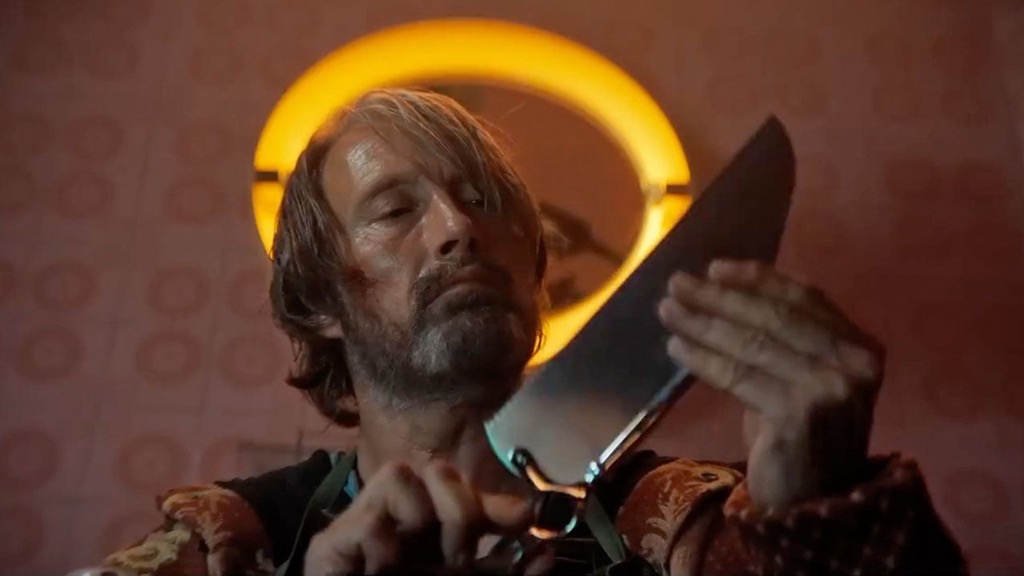
There’s a ton of imagery that’s constantly drawing attention to itself, even though it exists strictly for its own sake: Mads Mikkelsen is framed by a light so that it looks like he has a halo. The pattern on Sigourney Weaver’s dress matches the restaurant she’s in. The assassins are wearing basketball socks and checked blazers, for some reason. It never stopped being distracting, but it did always reinforce the idea that this is all taking place in a fantasy world.
Ultimately, I’m very glad that Dust Bunny exists, because I want there to be room for weird, imaginative projects like this to get made. Movies with enough budget to afford big names and plenty of VFX, but not so big that all the weirdness gets drained out of them and the rough edges get sanded away.