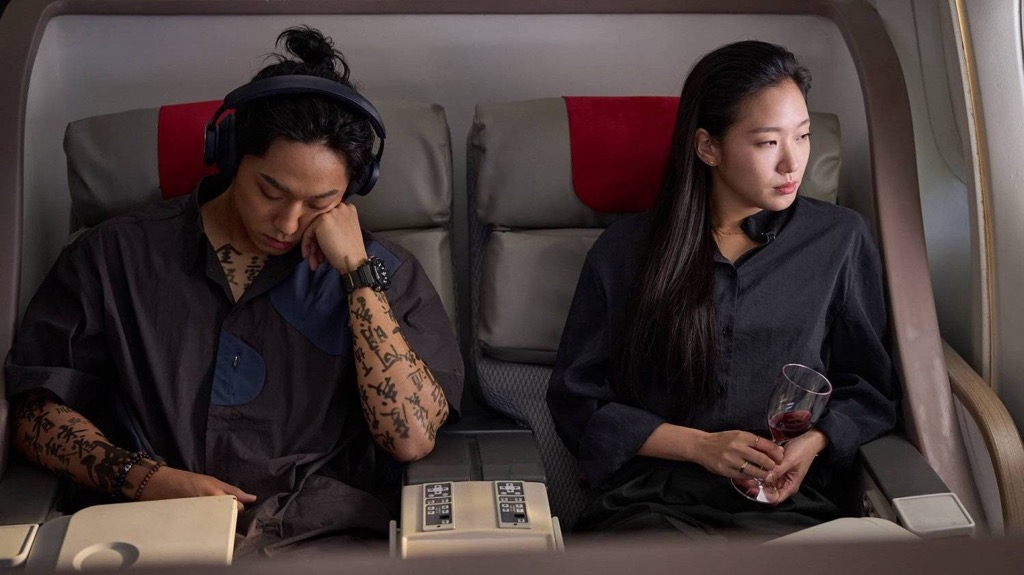
At the start of Exhuma, we see a young woman and man sitting next to each other on a first-class flight. Both of them go beyond movie-star beautiful into model or pop star beautiful, and they’re both fashionably dressed. The man is more casually dressed, and he’s resting while listening to headphones. His arms and chest are covered in tattoos of Chinese characters. The woman is more serious, looking out the window and thinking. A flight attendant comes up and asks, in Japanese I believe, whether the woman needs anything else before landing. The woman says no and then politely but firmly points out that she’s Korean, not Japanese. The flight attendant apologizes in Korean and moves on.
There’s a ton that’s packed into that short moment. It’s the modern day. They’re at the end of a long flight. They’re affluent, or at least stylish, and they seem to be effortlessly so, instead of keeping up a show of style and sophistication. He gives off the vibe of an up-and-coming pop star. She’s more unreadable: serious, thoughtful, composed, and cool. She feels strongly enough about her Korean identity to make a point of it, even though she’s multilingual, and even in situations where it wouldn’t seem to matter to anyone else.
Almost all of Exhuma has that same feeling of density, of having so much packed into each scene. The movie itself seems to have at least five movies packed into it, the way that it’s relentlessly building, twisting, and expanding. Incorporating contemporary horror, folklore, history, and suspense thriller while never feeling overstuffed, ponderous, or disjointed.
And like that scene, there’s the definite sense that there’s more going on than I have context for. I have a very simplified and high-level idea of the contentious relationship between Korea and Japan, and almost no knowledge of Korean folklore. But I never felt excluded, only intrigued. So many moments had implications that I suspected would be more impactful if I were Korean, but it wasn’t necessary. Everything crucial to the story was explained, and everything else felt like discovering an entirely new magical world I’d been completely unaware of.
We learn that the woman on the plane is named Hwa-rim (Kim Go-eun), an experienced shaman who’s been hired by an extremely wealthy family of second-generation Korean Americans to find out what’s troubling their newborn son. The young man with her is her protege, Bong-gil (Lee Do-hyun). Hwa-rim quickly figures out that the baby is being cursed by the vengeful ghost of an ancestor. The client, the baby’s father, refuses to tell them too much, but concedes that he’s also been cursed by dreams of his grandfather, dreams where he feels like he’s being choked to death.
Hwa-rim decides they need to exhume the grandfather’s grave and either relocate the body or have it cremated. To do this, she calls on our other two main characters: older men named Mr Kim (Choi Min-sik), a geomancer; and Mr Go (Yoo Hae-jin), a mortician. Kim uses his gift for reading the land and the five elements to charge wealthy families to find the best burial sites for their deceased family members. Go is a devout Christian but is also familiar with all of the traditional Korean burial rites, so he helps make sure that funerals and exhumations are handled correctly. They both lament that their income is dwindling, as all the best locations for burial in South Korea have already been taken. Kim is extremely respectful to the families and the dead, but also isn’t above telling a family that a site is 100% perfect when it’s truthfully only 60% perfect.
All of that is still just the initial setup. We get four expert paranormal-ish investigators of varying ages, backgrounds, and areas of expertise. They all have their own histories, back-stories, and relationships, and it all becomes clear via casting, demeanor, and sparing use of dialogue.
Even cooler is that they’re operating in a version of modern-day Korea where their talents and expertise aren’t immediately met with suspicion. The only character who’s dismissive of them is the baby’s mother, who we can infer was probably born in America, since she speaks English and is wary of what she calls “superstition.”
It created this neat dynamic where I, as an American with almost no familiarity with Korean culture, was always wondering how many of the rituals and beliefs were unique to the team, unique to people of certain faiths, unique to Korea, or made up for this movie. It felt like a story about present-day Seoul where magic exists and everyone knows it.
There are several different rituals performed throughout Exhuma, including a spectacular one that Hwa-rim leads while the grandfather’s coffin is exhumed. And it’s another example of how the movie establishes character: Hwa-rim is cool, stoic, and completely professional through just about everything, so it’s a dramatic contrast against the passionate energy she demonstrates as part of the ritual.
The movie is divided into titled chapters. It was a little jarring at first because the chapter headings often appear after a scene has already started, instead of being a clear break in the action. There’s nothing episodic or disjointed in the story, once the events start. I eventually realized that the chapters are really signaling that the movie is about to subtly change genres. It’s a story of family intrigue, and then about Korean religious practices1My ignorance means that I don’t even know which religion is being practiced, or even how much of it is distinct from general Korean culture, vs my only frame of reference in Japanese culture, which I understand more freely combines elements of multiple religions and incorporates more traditional spiritual beliefs. So I’m going the opposite extreme and just calling it “Korean,” in an attempt to be as respectful as I can in a movie review., and then an extended ghost story, and then straight-up horror, and so on.
Each chapter has a stand-out sequence, each of which would be the highlight of a different movie. That first ritual during the exhumation makes the movie worth seeing on its own, since it’s as powerful as a taiko performance and beautiful as a dance performance, and also filled with tension as we anticipate what is going to happen that will set the movie’s events in motion.
Fairly late in the story, a couple of new characters are introduced, who were quietly foreshadowed earlier with a phone call. They seamlessly segue into a scene with a new ritual, and it was then that I realized, “this movie has everything!”
My main criticism — really, my only criticism — of Exhuma is that its admirable sense of confident restraint often goes a little bit too far. Our first sign of the supernatural is only shown in a glimpse, and the movie brilliantly cuts away at exactly the right moment. But it was still such a surprise that I wanted to get a better look at it. Later, there’s a long sequence that depends on seeing things that are only visible in reflections, but I could never quite make out what I was looking at.
It was frustrating, because as much as I admired the movie for showing just enough and never being too on-the-nose, I still found myself wanting it to be a little clumsier and more obvious.
Apparently, Exhuma was a huge hit in Korea, and it’s become one of the highest-grossing Korean movies of all time. Based on that and on its premise (I’d been spoiled for some of the later reveals before seeing it), I’d expected it to be somewhat impenetrable for me.
But I never felt like I was watching a movie that was lost on me, as someone who couldn’t fully appreciate what it says about Korean patriotism or cultural heritage. It’s just a really solid, accessible, relentlessly expanding story that transcends language and even transcends genre. It feels both restrained and maximalist, modern and old-fashioned. And especially when compared to the state of American movies, it’s a valuable reminder of how you can make a movie feel big without its feeling excessive, saving the moments of spectacle for when they have the most impact.