It was ironic to be watching Toy Story 5, which is largely about breaking an over-dependence on screens and living in the moment, and constantly be distracted by people in the row in front of me using their phones during the movie. But it was even more ironic to be watching a Toy Story movie and wondering whether I’ve simply outgrown all of it.
The movie hits all the right beats and is exceptionally well done. It’s engaging and often very funny, with a pacing and sense of humor similar to Toy Story 2. Its messages are strong without being didactic, taking a more even-handed approach than you might expect from the premise: it stresses that it’s not making accusations about “tech,” but asking us to remember that it’s a tool to foster connection and creativity, not a replacement for it. It’s sentimental without being maudlin, and while it didn’t leave me an emotional wreck as past Pixar movies have, the ending did having me tearing up a bit.
But for me, it was less about a genuine emotional connection so much as the fact that I’m a weirdo. I was crying from the satisfaction of having so many story threads slam together at once. More like hearing an orchestra all coming together at the most powerful part of a symphony, or a gymnast hitting a perfect landing after a flawless vault. I appreciated the artistry of it more than the emotional resonance.
I’ve got to remember that I brought all of my own biases to it; it’s still been less than a year since Disney tossed me into the donation box, so I’m still not as moved by the opening castle logo as I once was. And it’s been disappointing to see Pixar tearing through all of its good will lately, all but insisting that we realize they were never interested in forging a personal, emotional connection with every single person in the audience, but really were just a cabal of middle-aged affluent white men the whole time.
So I have no idea whether that’s why it felt like it was doing all of the right things, but still felt so hollow. Maybe that’s just inevitable when you have a bunch of really talented people working on a studio-mandated fifth installment of a franchise. For all I know, maybe it felt like the light had gone out simply because I was sitting there watching it. If I’d left the room, it might’ve sprung back to life.
But as it was, it felt like they were dragging all of the old toys out of the toybox and setting them down in front of me, expecting me to connect with them the same way, without noticing that I’ve become a very old man. Even that idea is addressed in the movie, with all of the jokes about how Woody and Jessie are very old vintage toys at this point. But there was still an odd feeling of insincerity to it, as if the movie was doing crowd work. “Woody’s got a bald spot now, just like a lot of us do, since we’ve been making these things since 1995! These dads in the front row know what I’m talking about, am I right?!”
Some of the best moments in the movie, when it really comes alive, are appropriately when it shows the fantasy play sessions when a kid starts playing with the toys. They’re done in this pastel style and immediately jump into the action, with each of the toys playing whatever role the kid has cast them in. The best has Jessie as a super-spy in a ballroom full of horse guests, trying to foil a bomb threat from a villain played by a potty-training toy, which is played by Conan O’Brien.
Even there, we get a dramatic reveal of the villain with a big head of red hair — you know, like Conan has! Even as a fan of Conan, I found myself wondering, “who is this for, exactly?” Even the gags and references that worked well in the moment still had this undercurrent of a movie that was both quite pleased with itself and also a little too eager to be liked.
And it was a shame, because I think if I’d seen this as recently as ten years ago, I would have adored it, maybe even as much as Toy Story 2. It also would’ve helped it feel a little more relevant, and less like a circle of middle-aged men shaking their fists and saying, “The problem with kids today is those dang screens!”
And it was especially a shame because this isn’t a movie that could’ve been made ten years ago. It’s fantastic in terms of technical artistry. Not just flawless lighting, effects animation, and blending photorealistic and stylized rendering, but for combining so many different styles of animation and character design and rendering and having them all work together in the same scenes.
I didn’t love Ralph Breaks the Internet, but I really appreciated how it acted as a mash-up of a bunch of different animation styles, in particular bringing UPA-style characters into 3D. Inside Out expanded on that, by having characters that should only have been able to exist in two dimensions, freely moving around in 3D with all of their weird proportions and pastel or crayon texturing intact.
In Toy Story 5, the various eras of toys are each handled differently, and they all seamlessly coexist throughout the movie. The “tech” toys all have animated eyes on their digital displays, each one having the era-appropriate pixel density. Two of them have traditional 2D-animated mouths on a flat surface, meaning that multiple styles of animation will be active in a single expression for a single character.
This was my favorite thing about the movie, because it had the “we can do anything we want!” spark of Pixar’s best. They’ve frequently gone all-in on a particular rendering tech for an individual project (like water for Finding Nemo or natural lighting to reflect the seasons in Monsters University), but this one feels like a sampler of every single thing they know how to do in 2026.
Maybe the best example of this is that there are at least a dozen different kinds of horses in Toy Story 5. Obviously, there’s Bullseye, a ragdoll toy who basically acts like Pluto. He’s got his toy and living-toy variant, plus an upright-walking version that appears in the play sequences. There are sequences with Bullseye riding on top of a “real” horse, done in a similar almost-but-not-quite-photorealistic style to the Toy Story humans, that feels a bit like the character artists and animators showing off.
And then they add an entire shelf full of horse toys, each with varying levels of “realism” and an appropriate animation style to match. A huge part of my love of animation is that because it’s so time-intensive, it’s so dense and thoughtful: a ton of planning and imagination had to go into every single detail, even if it’s only on screen for a few seconds.
Here, the animators and modelers at Pixar had to figure out exactly how to distinguish a realistic-looking plastic horse toy from a cartoony one, and establish a distinct way of moving for each, which is similar but not identical to a real horse. It really did feel to me like a celebration of the core idea of the entire 30-year-old franchise, which at its core was a celebration of a centuries-old art form: bringing an inanimate object to life.
Toy Story 5 is artistically brilliant, which would make it worth seeing even if it weren’t so genuinely fun. It just didn’t have the spark of life that’s so often resonated with me when I’ve watched Pixar’s best movies. I never expected I’d be leaving a Toy Story movie feeling like it was long past time for me to put away childish things.
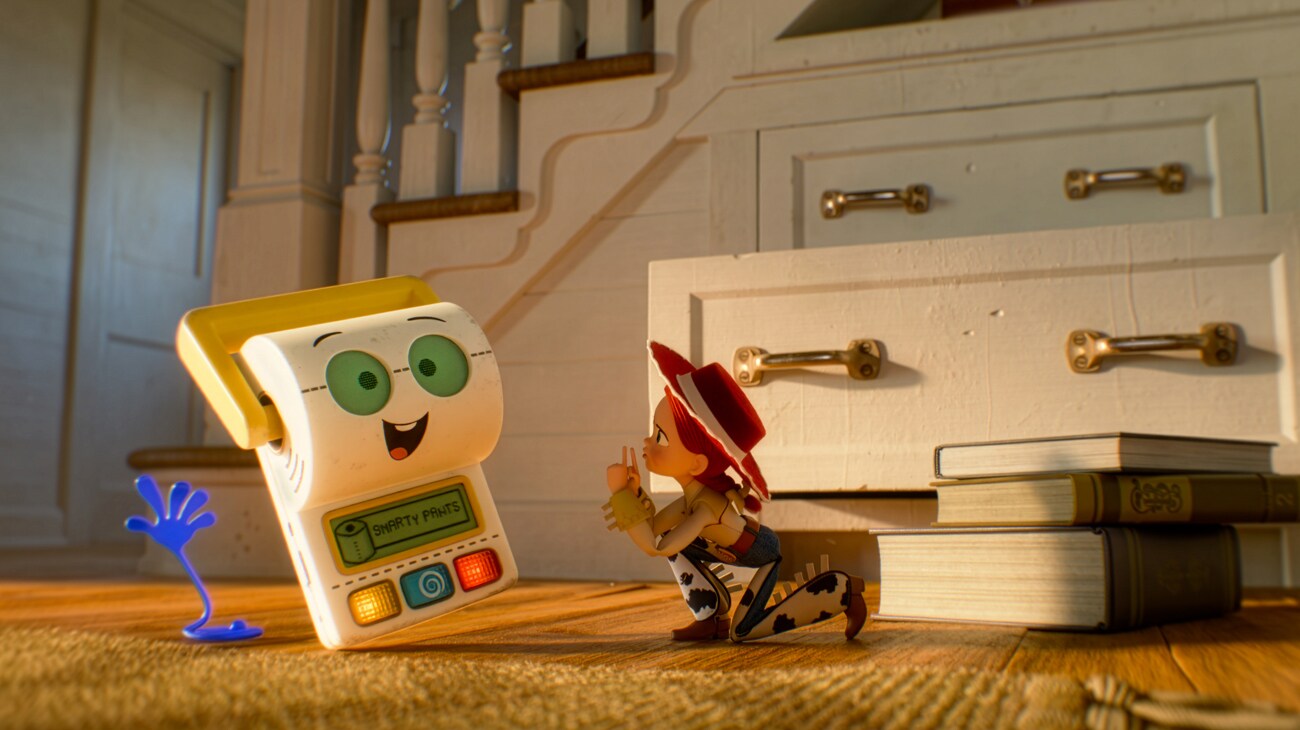
I do have to add that it was kind of hilarious that the movie went out of its way to be even-handed about the role of tech and gadgets, but was so unapologetically anti-video game throughout. There’s one scene where Jessie is briefly entertained by using a pattern-matching game on the Smarty Pants toy like it was Dance Dance Revolution, but on the whole, the movie seems adamant that video games are the antithesis of real play.
The games that it depicted were the types of mobile games that Disney has spent the last twenty years (or more?) pushing onto every available platform. It was funny to think of all of the game developers who will now be putting out games based on a license that seems to hate them. And ironic that an animated family movie felt secure (and honestly, out of touch) enough to be so dismissive of an entire genre of entertainment, like if I’d said, “Toy Story 5? Oh, is that like that Smurfs movie?”