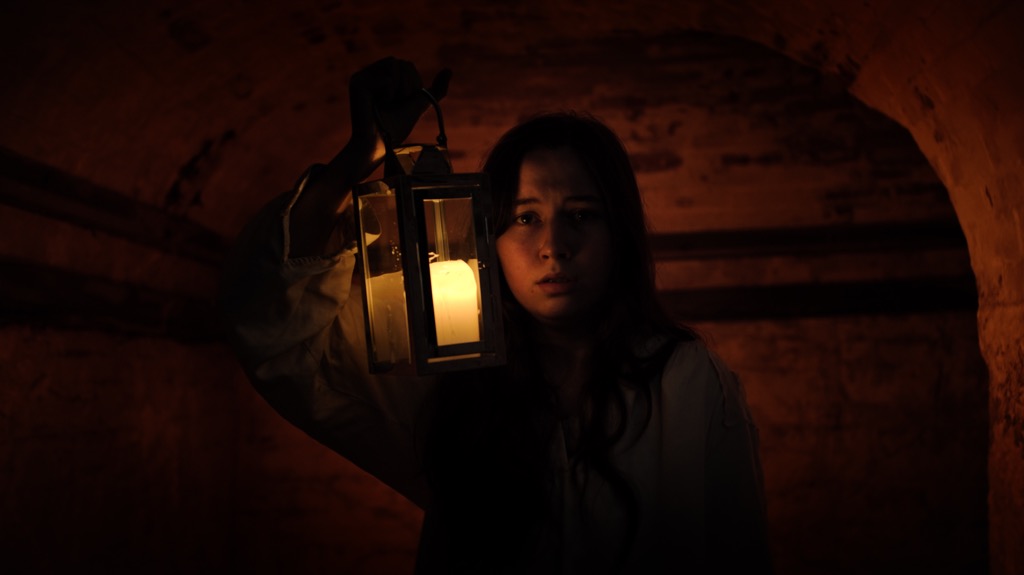
An Taibhse (The Ghost) is an Irish-language horror movie1According to the press, the first horror movie made entirely in the Irish language from 2024, set in the period after the Great Famine. It deals with a young woman, Máire, and her father traveling alone to a remote Edwardian mansion to become its caretakers for the winter. After they arrive, Máire fears that the malevolent spirit she calls Alexander has followed them to the new house.
The movie is gorgeous, full of every-frame-a-painting cinematography that emphasizes the solitude and the emptiness of the house. We see the contrast of the stark, bare servants quarters against the parts of the house where the family would stay, and it’s a perfect setting for a ghost story. Edwardian houses suggest a sparing opulence, untouchable wealth that still feels empty. And we see just enough of the other rooms, and the grounds surrounding the house, to be repeatedly reminded that the father and daughter are the only two living people for miles.
It’s also very dark, with a lot of black hallways or rooms lit only by an orange lantern or candles. It’s used to good effect, making Máire seem that she’s always in danger of being swallowed by the darkness.
Because almost every scene in the movie centers on one or both of the two lead characters, it entirely relies on their performances, and they deliver. They’re always believable, and they both have to go from mundane scenes to extremely intense ones. There’s never a hint of a performance.
And the concept itself is intriguing. Máire becomes convinced that the ghost continues to haunt her, as the initial displays of doors rattling and her closet opening on its own quickly get more frequent and more undeniable. She has horrific and violent visions, always culminating in a ghostly voice saying “Don’t be afraid.” The visions end suddenly with her in the light of day doing one of her many chores, but noticing that she has bruises on her arms, or that she’s bleeding. It’s always effective and disorienting, never clear whether we’re seeing a dream or a vision, and how much if any of it is real.
When she tries to tell her father about Alexander, he gets angry, telling her that he’s not real, and that he doesn’t want to hear her say that name again. After he’s injured in an accident, he’s forced to stay inside to recover. That’s when things seriously take a turn for the worse, as whatever malevolent force is inside the house seems to take him over as well, turning him from a strict but loving father into an abusive monster.
So in other words: it’s like The Shining. But without outright spoiling An Taibhse, I’ll say that it has none of the complexity or ambiguity of The Shining. Part of that simply comes from reducing the cast of characters to two humans and one ghost. The rest comes from changing the young boy to a teenage daughter.
Bluntly speaking, An Taibhse just doesn’t have enough substance to be more than a very stylish and beautiful exercise in misery. Once it becomes completely clear what’s going on — which for me, was around the 30 minute mark, although that was only confirming what I’d suspected from the start — then it just feels as if it’s prolonging a bleak situation for its own sake. Never expanding or building on it, just relentlessly repeating it.
I’ve seen a lot of extremely positive reviews, so maybe its effectiveness depends on how much you go into it with the attitude of absorbing it instead of interpreting it. For me, I kept waiting for a reveal or a twist that would add some depth or complexity to what I was seeing, but that never came. It felt like a movie that relies on the audience having absolutely no comprehension of subtext. It’s not simply that being able to predict the ending makes the movie unsatisfying; it’s that it turns the entire movie into an hour and a half of ghoulishly watching someone suffer.
Leave a Reply