I decided to watch The Lair of the White Worm in preparation for watching the new release of Ken Russell’s The Devils this weekend. I know that movie only by reputation, and am not that familiar with Russell’s other movies. I had no patience for Tommy, and I might have seen Crimes of Passion, but have no memory of it if I did. The only ones that I’m sure I’ve seen before are Altered States and Women in Love, and I only watched each of them once, years ago.1Or more accurately: I’ve only seen Women in Love once in its entirety. There’s one scene in particular that I’ve watched lots and lots of times.
To be completely honest: I’ve always had Ken Russell and Peter Greenaway conflated in my mind. Some vague category of “horny British filmmakers,” with no regard to just how different their work actually is. I’ve seen a lot more of Greenaway’s movies, and they’re rarely to my taste. It would be outright false to say that Greenaway’s movies are humorless, but the ones I’ve seen seem to be going for more of a dry, dark humor. Firmly in the realm of art movies, more sophisticated and challenging than simply provocative.2This is largely based on The Cook, The Thief, His Wife, and Her Lover and The Pillow Book, the two I remember most vividly.
This also came out when I was a teenager, so I think I also conflated it with Kiss of the Spider Woman. I imagined it to be similarly dark, serious, and “adult.”
Which is a long way of saying that I expected The Lair of the White Worm to be horny, lurid, and blasphemous, but I absolutely did not expect it to be so much fun.
A lot of that can be credited to Russell, of course: the fantastic and weird rear-projection dream sequences that I associate with Altered States are also used to great effect here. But he found a dream collaborator in Amanda Donohoe, who is almost indescribably glorious as the villain Lady Sylvia Marsh. She not only matches his freak, but exceeds it.
We first see her dressed completely in white, wearing a long jacket and what I was calling a Stand And Deliver hat even before I was aware of her earlier relationship with Adam Ant, and the fact that she’s in the video to that song. From the first shot onwards, she’s in complete command of this movie. Sexy and evil and funny in equal measure, flawlessly selling moments that would look absurd or even demeaning coming from someone without her seemingly effortless confidence.

At one point, Hugh Grant’s character Lord D’Ampton, after seeing a game of Snakes and Ladders she’s set up, asks “Do you have children?” She replies, “Only when there are no men around.”
Oh yeah, Hugh Grant is in it, too. And if I’d seen this back in 1988, I wouldn’t have been as surprised to see how naturally he’s slid into comedy (and unrepentant villainy, like Heretic) in the recent stage of his career. This was back when he was in peak floppy-haired self-effacing leading man territory, but he plays it perfectly, taking full advantage of what he knows audiences will expect from the actor and the role, and subtly3For a Ken Russell movie, anyway undermining it. He’s a suave nobleman who’s practically fated to be the hero, but in practice, he’s kind of a foppish sidekick.
There’s also Peter Capaldi, only barely recognizable under a head of hair competing with Grant’s for sheer floppiness.4I couldn’t help but notice that Capaldi and Grant also have monobrows, which must’ve been more acceptable in the 1980s, which makes me feel a little less awkward for not having gotten rid of my own much earlier. He’s a Scottish archeologist who uncovers a strange creature’s skull in the ruins of a Roman settlement beneath an English farm. That discovery sets off the events of the movie.
It also creates this scene, where a combination of a wide-angle lens and Donohoe’s completely deadpan commitment to the creepiness of Lady Marsh make it absolutely clear that this movie has little interest in playing it straight.

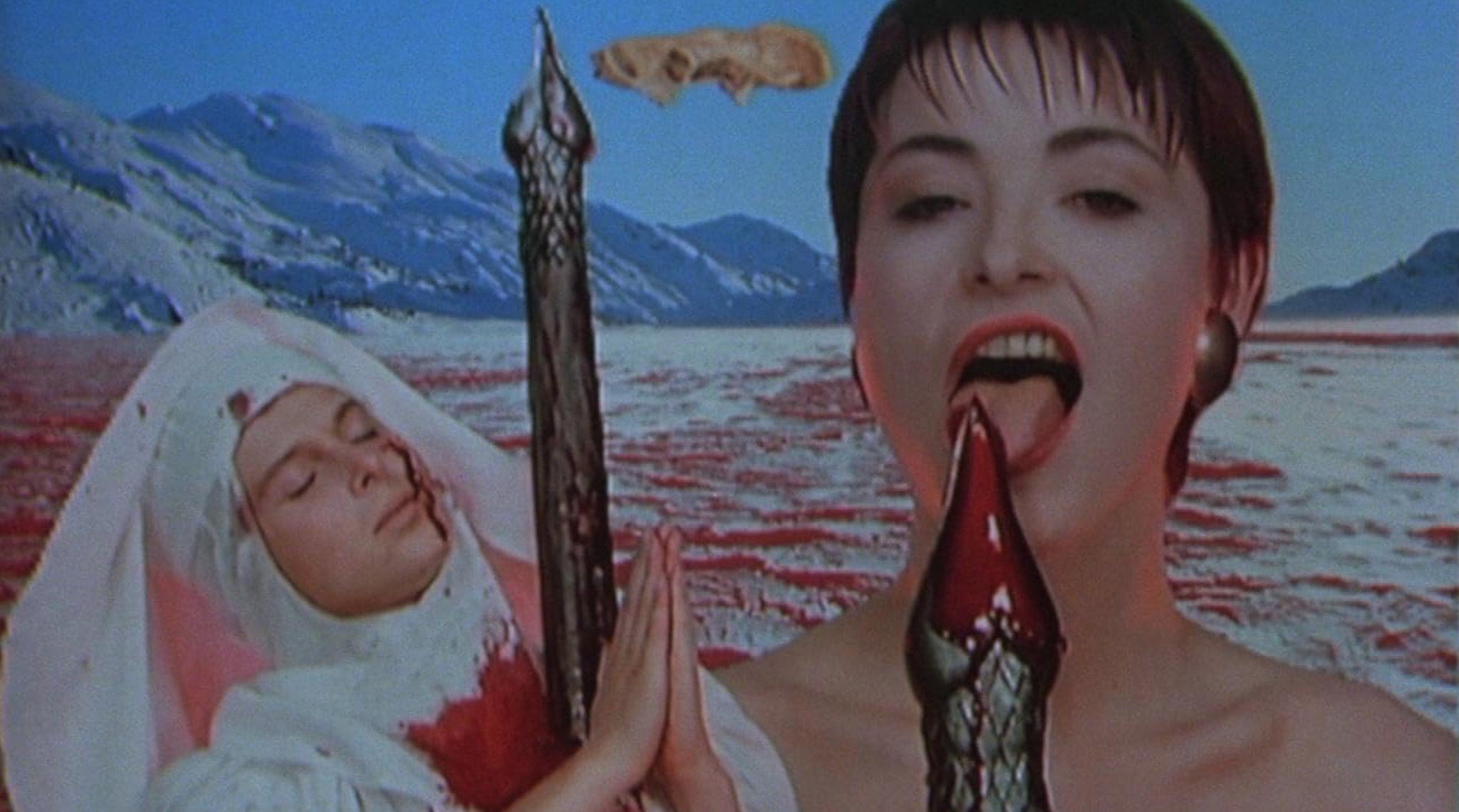
But although the movie belongs to Donohoe, it feels like everyone involved thoroughly gets it. Catherine Oxenberg has kind of a thankless job as the virginal Eve, but she seems to be having some fun with the damsel-in-distress role early in the movie. After she has one of Ken Russell’s weird visions about a pagan snake cult attacking Jesus on the cross and collapses, she really plays up the accent, going on about “me watch” that she’d put in “me pocket.” The whole scene is played like it could’ve come straight out of Garth Marenghi’s Darkplace.
(The vision, by the way, happened when Eve touched the venom that Lady Marsh had spit onto a crucifix on the wall, as she was leaving the house, saw the symbol of Christ, and hissed and turned into a snake lady).
And Sammi Davis plays Eve’s sister Mary, although you might spend the first 20 minutes or so wondering how Kate McKinnon had gotten into this movie. They look eerily similar through most of it. She has to basically be the straight man for most of The Lair of the White Worm, but she’s still keeping up with all of the absurdity and making it work, without ever feeling out of place.
Other standouts are Paul Brooke as PC Erny, with a fantastic detail that’s a spoiler in a footnote5When he has snake eyes, they account for the actor’s real glass eye and make it aimed similarly, and Stratford Johns as D’Ampton’s butler Peters, who does seem like he’s in a different movie, but he’s hamming it up to such a degree that it meshes perfectly with the camp of this one.
It’s important to call out the performances, because even the slightest misstep anywhere in this movie would’ve turned it into something insufferable. The Lair of the White Worm is as corny as it is horny, never above a snake pun or reference, and it depends on everybody treating it as seriously as Bram Stoker himself probably did.
There’s a (relatively understated) dream sequence where D’Ampton is on board the Concorde solving a connect-the-dots puzzle (it’s a snake) while watching Eve and Lady Marsh dressed as flight attendants and wrestling on the floor. As he watches, we see his pen, which is red-tipped, possibly to evoke a dog’s “lipstick,” slowly rise to fully upright and erect.
One scene, which was used for the poster, has Donohoe rising out of a wicker basket in response to snake-charming music played on giant loudspeakers mounted on the top of D’Ampton’s estate. It’s a moment that doesn’t make even a tiny bit of sense, and yet here, it feels not just natural, but essential.
And that’s before it gets full-on tits-out bonkers, with a scene in which Lady Marsh wears nothing but blue body paint and a ritual thong with a giant carved spiky phallus attached to the front, with which she means to defile Eve before a human sacrifice. It’s one thing to appear in a scene that could be a degrading and demeaning T&A spectacle, and have such a complete command over how you’re presented that there’s no hint that you’re being manipulated or taken advantage of. It’s on a whole other level to pull that off when you’re in a situation that’s so patently absurd. It’s a genuinely fearless performance, a standout in a cast and crew full of people who get the tone of this movie down to the atomic level.
The Lair of the White Worm is yet another one of those movies where I simultaneously regret not having seen it earlier, but also am pretty sure that I just wouldn’t have gotten it if I’d seen it in 1988. I would’ve dismissed it as nothing but camp, without appreciating what it takes to commit so completely to camp. There’s so much dry humor in this movie, which seems to be aiming strictly for the broadest humor. And there’s a surprising amount of subtlety in a movie that seems to have such an open, hissing, contempt for the concept of subtlety.
Leave a Reply