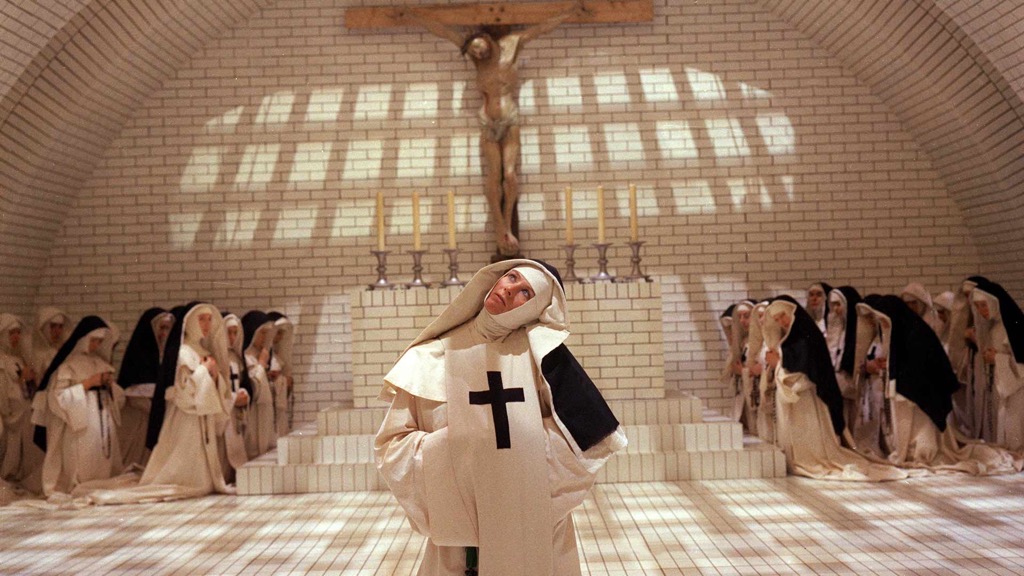
The Devils is almost exactly as old as I am, which is something I had to keep reminding myself as I watched the new restoration of the director’s cut, currently running in major theater chains under an NC-17 rating. The restoration is so clean, and the picture quality is so flawless, that it can be easy to treat it like a new release and forget to put yourself in the mindset of someone watching it fifty years ago.
Ideally, the movie wouldn’t require that kind of translation. It’d be timeless. It’s set in the town of Loudun in France, during the time of the Inquisition, and tells the true-life account of a womanizing priest Father Grandier (Oliver Reed), and Jeanne des Anges (Vanessa Redgrave), mother superior of the town’s convent, who’s sexually obsessed with Grandier and driven by jealousy to falsely accuse him of witchcraft. Because it’s a period movie, there’s little in the costuming or subject matter that feels locked in the 1970s. At least, until Michael Gothard shows up as the Witchfinder Father Barre, looking like he’d wandered in off the set of Tommy. I’m still not sure whether that was intentional.
And the subject matter is as relevant now as it’s ever been. In particular, the themes of sexual repression, ritual and dogma vs genuine righteousness, and the forces of corruption manipulating our institutions for their own gain.
I kept having to remind myself that for as new and fresh as The Devils looks now, it’s still frozen in 1970-71, while the world and the media have matured. I’m not at all suggesting that its imagery feels quaint or old-fashioned now; it’s still very challenging and uncomfortable, even if it’s not as unprecedentedly shocking as it would’ve been on its release. It’s more that its style of filmmaking belies the substance. I could sense that it had more profound intentions than to be merely provocative, but it kept undermining that with moments that were so over-the-top that they seemed to be aiming for little more than to provoke a shocked reaction.

One aspect that is unquestionably and undeniably brilliant is the architecture and set design. The town itself is stark white and brutalist, and we get a fantastic scene of Grandier eulogizing the deceased governor to the townspeople, all dressed in black.
Inside the town walls, we see close-ups of the boils and sores of the plague victims, and their mass graves, and the clean white walls and arches make it clear that this town is fully enclosed and self-contained, a safe enclave against the ravaged wasteland (full of the decaying corpses of Protestants) that surrounds it.
The convent is covered in white tile, separated from the rest of the town by heavy iron bars, driving home the idea that it’s a prison — or a mental institution — instead of a sanctuary. The quote I keep seeing is that Russell wanted it to look like an exorcism taking place in a public lavatory.
Later in the movie, we see the machinations of the Inquisitors, and it looks like a giant bureaucratic nightmare straight out of 1984 or Brazil. There are more iron bars everywhere, reminiscent of Alcatraz, and paired with the multi-story iron doors with a giant red cross emblazoned on them, it clearly suggests institutional Catholicism as a prison.
During Grandier’s trial, the Inquisitors wear white pointed hoods with red crosses on them, and combined with the starkness of the architecture, the scene evokes sci-fi horror more than a period piece.
Another striking location is Grandier’s home/sleeping quarters, at the top of a round tower accessible only by stone spiral stairs. We see him awaiting trial wearing a fur-lined dressing gown with a multicolored paisley pattern that’s almost gaudy, a reminder that for as much as the story has emphasized his earnest righteousness, he never lived an austere life.

Because the movie is relentlessly surreal in all of its imagery, its sequences of dreams or visions don’t stand out quite as much as they do in Russell’s other movies, like Altered States or The Lair of the White Worm. But they’re still striking. In one, Jeanne imagines Grandier walking on water. In another she sees him as Christ after the crucifixion, and she comes to lick the blood from all of his wounds. They’re filmed not as religious rapture, but intense sexual desire, blood and pain and violence combined with lustful passion.
In the moment, they read as little more than “Jeanne is seriously unstable,” and her sexual desire has gone past run-of-the-mill horniness into a willingness to debase herself and do actual self-harm. It’s only later in the movie, after we’ve seen all of the Inquisition-led and sanctioned scenes of depravity, debauchery, and violence that go far beyond even her most intense visions, that you get any sense of sympathy for her.
She was not particularly a woman of faith; when the woman who would become Grandier’s wife tries to be admitted to the convent, Jeanne tells her that none of the women are there because of their religious devotion. They’re in the convent because they’ve been cast off. Jeanne has a physical abnormality that we can assume would’ve made her an outcast during the period, even without the church’s involvement, so she’s left with no outlet for her sexual desire and no recourse except to feel shame for it.
There’s no version of this character that could be said to have a healthy level of horniness, but it’s clear that it was made worse and more intense by a society that had no need for her until her accusations could help their own agenda, and that she was by no means the only person in the town with “impure thoughts.”
And that gets back to my main issue with The Devils, and why it was such a disappointment for me after hearing it talked about for decades as a masterpiece. Its lurid outrageousness, and its eagerness to play everything at max intensity throughout, undermines any depth or complexity we could get out of its characters or the things that happen to them.
The only actors in the movie who play their roles with restraint and conviction are Oliver Reed as Grandier, and Gemma Jones as the devout young woman who would eventually become his wife. But Reed spends most of the movie making speeches instead of engaging in dialogue. And until the end of the movie, it’s never quite clear whether he’s saying things because he genuinely believes them, or if he’s carving out indulgences for himself, justifying the lifestyle he wants while still being in a position of authority in the church. As a viewer, I believe in the things he’s saying — austerity and self-denial aren’t virtues for their own sake — but I spent most of the movie wondering whether he really believed in them, or was a hypocrite.
But there’s no getting around my main complaint about The Devils, which is that apart from Reed and Jones, nobody else seems aware of what type of movie they’re in, and what its tone should be. Many of the performances are just flat-out awful, in my opinion, even taking into account the standards of early 1970s cinema, a huge cast, and someone as over-the-top as Russell in charge.
When they’re showing nuns, Inquisitors, and townspeople in an orgy, defiling all the icons of the church, the blasphemy didn’t offend me nearly as much as all of the people hamming it up. Just because you can find someone willing to get naked except for a dog collar and writhe around on top of a big crucifix, that doesn’t mean they have any screen presence. The movie has a long history of censors labeling it pornography, and I was kind of depressed and disappointed to find myself agreeing. Not because I was shocked by what I was seeing, or because it had no intention beyond titillation or provocation. But because there are very long sequences filled with people on screen who didn’t read at all as “nuns” but as “extras who were willing to get naked.”
I think it would be damning (so to speak) enough if it were just the extras, but it’s several of the speaking characters as well. So many of them seem to be acting in different movies from each other, and they rarely if ever sync up.
And while I do think that there’s a point to all the scenes of torture and trials — the sins of the characters are nothing compared to the depravity of the Inquisitors, who will do unspeakable things for power, not even ideology — I do still think that there are only so many scenes of women getting objects, devices, or liquids shoved up inside of them that any movie needs. The Devils exceeded its quota.
(Spoiler warning: The scene that was cut from most versions until this restoration, where Jeanne gets thrown a charred bone from Grandier’s remains and uses it to pleasure herself, is an exception. Exactly the correct level of outrageousness, in my opinion).
Again, I kept having to try and put myself in the mindset of someone who would’ve been seeing this movie while I was still an infant. My impression of the time is that you’d learn about the events of the period, and you’d even see the occasional drawing or replica version of torture devices, but it was all left comfortably in the abstract. Nothing was showing you how cruel the Inquisition was, or how devastating the Plague was, or even how miserable conditions were for women and how few options they had. And you’d rarely see it put so directly into a political context, showing the hypocrisy and corruption of institutions, and the importance of the division between church and state.
But for me, The Devils seemed unflinching in the depravity, violence, and cruelty it was willing to show, but didn’t add much besides being visually striking.
There is only one thing that was timeless, and that I felt to my core at a visceral level, and that’s how Oliver Reed was preternaturally hot. I didn’t believe anything I saw in The Devils, but I could totally relate to anyone seeing this man and being overcome with impure thoughts to the point of a dark obsession.

Leave a Reply