Wake Up Dead Man is my least favorite of the three Knives Out mysteries so far, but that just means it’s a solid, often funny, and engaging murder mystery that I liked a lot but didn’t absolutely love. The thing I love about the Knives Out franchise is its endlessly clever use of a gimmick — a woman who’s incapable of lying without throwing up, or a mid-story plot twist that casts a new light on everything. This one has plenty of surprises, but I guess I need a clever gimmick to knock it out of the park.
There is one gimmick, though, that the movie uses twice, as it’s establishing what I took to be is its overall mission statement. My favorite thing about the movie is the first time it’s used, because it took me by surprise.
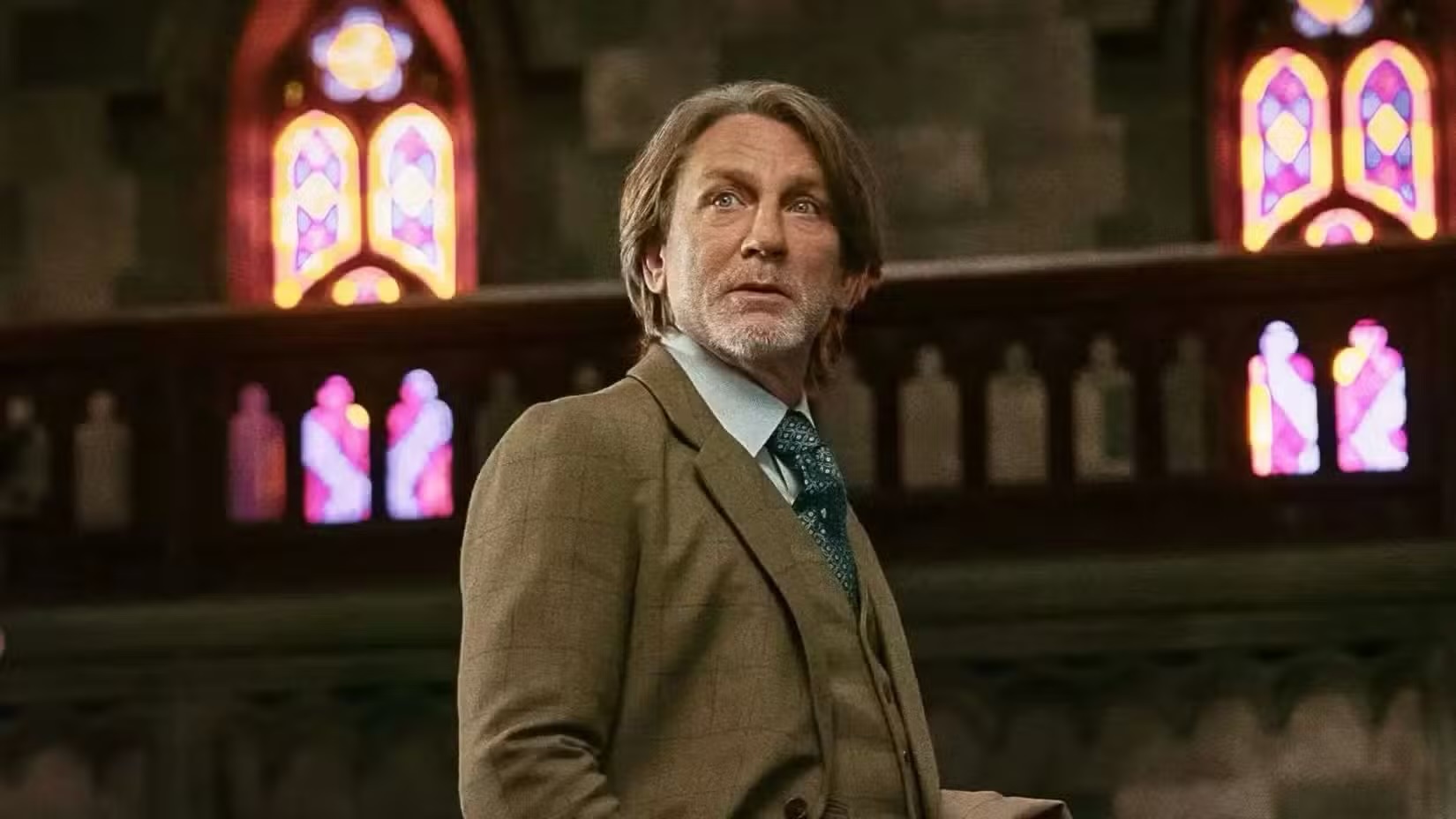
We’ve been following the story of our protagonist, a kind-hearted priest named Father Jud, when a man enters the church that everyone but him recognizes as Benoit Blanc. He doesn’t introduce himself by name, but the priest welcomes him in and asks about his faith. Blanc acknowledges that he’s “a heretic,” which turns into a fairly lengthy tirade against organized religion in general, and the numerous failures of the Catholic Church specifically. He concludes that religion is nothing more than storytelling.
Father Jud responds with grace, and he agrees with him. To paraphrase, he says that he’s right. It is all storytelling, but the stories explain things to the faithful that they need to understand, things that they couldn’t understand otherwise. And as he’s speaking, the sunlight through the stained glass window gets gradually more intense, until he’s bathed in golden light.
It’s not particularly subtle. But I don’t mind that one bit, since it’s an idea that deserves to be driven home as plainly and directly as possible. Until that point, all of the characters we’ve meet who were (or more accurately, claimed to be) faithful were duplicitous, corrupt, manipulative, blindly desperate, gullible, in denial, angry, judgmental, and possibly even insane. When Benoit Blanc, the franchise’s genius detective who’s never wrong about anything, gives his take, it’d be easy to assume that the movie was very deliberately making its point.
So while it was blunt and even a little corny to turn up the God Rays on Father Jud, it was nice that the movie had the freedom and confidence to declare, See, this guy gets it. That multiple things can be true: religion is often used as a tool for control and division, but the values at its core need not be dismissed as meaningless hypocrisy. That it is possible for the genuinely faithful and the adamantly atheist to show grace to each other, without calling each other heretics or gullible saps.
Later in the movie, the same effect is used on Benoit Blanc as he’s having his own “Road to Damascus moment,” when he realizes that grace need not be strictly divine, and it’s something we can extend to each other, even, or especially, the ones least deserving of it.
It didn’t hit me as hard as it would have ten or twenty years ago, since my own faith has faded into what I’d call “optimistic agnosticism.” But it’s always struck me as annoyingly arrogant how so many people — many of whom have been actively harmed by organized religion, and have reason to be angry about it — will simply refuse to consider that the faithful can find value in something that they don’t connect with at all. It takes a kind of humility to acknowledge that we simply can’t know everything. So I liked seeing Benoit Blanc being forced to acknowledge that while he is always right, he’s not right about everything.
As for the rest of the movie: it’s got all the great performances you’d expect from a Knives Out movie, actors enjoying themselves hovering in a space that’s not exactly over-the-top, but definitely isn’t sane and grounded, either. It’s often funny, while rarely going for outright comedy. And even though it’s a more straightforward murder mystery, it’s still a well-told one, dispensing all of the clues in a way that makes them stick in your mind without being so obvious you’ve completely solved the case with 45 minutes still left on the clock.
The main targets of its ire this time (after billionaires and rich racist white families) aren’t just organized religion, but more the people who use a platform like organized religion to sow division, anger, mistrust, and self-righteousness among people. It’s a call to get back to the basics, to refuse to play into efforts to divide us, and to recognize what’s really important.
There’s another really effective scene in which Father Jud and Benoit Blanc are urgently pressed for time, and Jud is on the phone with a woman to get a crucial piece of information. After several failed attempts to keep her focused finally result in a promise that she’ll get back to them, she sheepishly asks the priest to pray for her, and she describes the crisis she’s going through. He ends up staying on the line with her for what seems like several hours, and even Benoit Blanc is left to wait patiently in another room as night falls. Acknowledging that some things are even more important than solving a murder mystery.