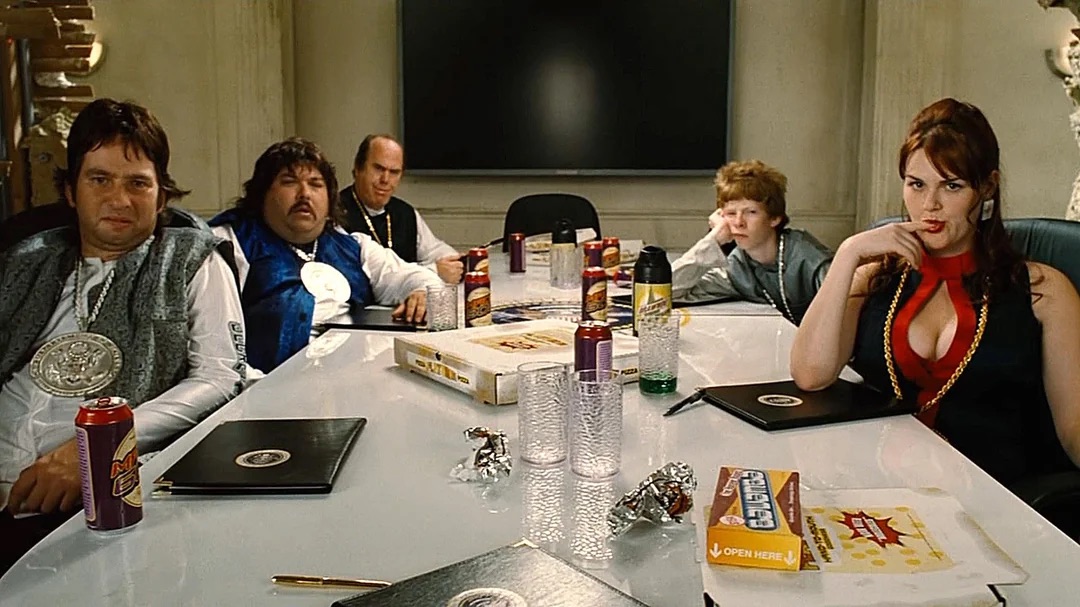
There are a couple of topics in pop culture that I shouldn’t have strong opinions about, and yet I do. And every time they come back up, the impulse of I disagree with someone on the internet overwhelms my ability to fight back. One of them is that “Baby It’s Cold Outside” is not a Christmas song about sexual harassment, actually, and that’s a hill I will most likely die on.
The other is how Idiocracy isn’t actually about eugenics. In fact, it says the exact opposite of the thing that people most often complain that it’s about.
I saw this mentioned yesterday, and my first response was to helpfully direct the person to the Source of All Human Knowledge, this blog, where I already addressed the issue directly and decisively.
The problem with that post is that it’s unnecessarily argumentative, and I just come across like a big jerk. But while I was trying to formulate a less asinine and arrogant way to explain it, I realized that this not-particularly-insightful movie somehow just keeps getting more relevant to me. In fact, I think I was defending the movie while still not fully understanding the extent of what the movie was saying.
(Not to mention going off on a tangential tirade against “explainer” videos and the like, while I was attempting to give the definitive explanation of a movie).
Idiocracy comes right out of the gate with a narrator explaining its “problematic” premise: high IQ people stop having children, while low IQ people have too many children, which eventually results in a complete breakdown of society. We see a far-off dystopian future where everyone is obsessed with consumerism, vulgarity, inanity, all the worst aspects of 21st century society, magnified by thousands.
But it also comes right out of the gate mocking its own premise. The “high IQ” couple we’re shown at the beginning, who put off having children for the sake of their careers, eventually discovering its too late for them to have kids, are awful people. Irredeemably self-obsessed, focused on keeping up appearances, surrounded by increasingly ostentatious displays of conspicuous consumption.
They are absolutely not presented as models of proper society. And (slightly) more subtly: their offense isn’t that they’re not having “enough” children, since it’s clear they’d be pretty bad parents.
At the same time, we’re shown the “low IQ” family, who’ve had several children and are expecting more, and their lives are absolute chaos. Just like with the couple, their IQs are displayed clearly on screen. The last time I tried to explain Idiocracy, I said something about how you see it’s not actually about IQ, but about “differences in socioeconomic status and therefore….”
Which was also missing the point, since they’re not presented as models, either. They’re bad parents, being irresponsible by having more kids than they can handle, and it’s weird to be making excuses for them.
Ever since I first saw the movie, I always took this to be an example of its absurd, lowbrow comedy and its broad, shotgun approach to satire: just say everything sucks, and eventually you’ll hit the right target. But what I didn’t appreciate is that it was mocking its own premise, as it was presenting its premise. It was showing how absurd it would be to look at these two families and assume that the key differentiator between them was something as arbitrary as their relative IQs.
Which I guess is itself is part of the satire? Say something confidently enough, delivered with an authoritative narrator voice, and people — including me — won’t think too hard about it?
In any case, that’s really what the entirety of the movie is about, rejecting its own stated premise. The protagonists, played by Luke Wilson and Maya Rudolph, are the most thoroughly average man the army could find for its experiment, and a woman that they presume no one would expect anything from, because she’s a prostitute.
When they reach the future, everyone either looks to him for leadership, or rejects him for “sounding gay,” because he’s so smart. Several times, characters treat him like a genius because his IQ is so unbelievably high. President Camacho himself looks to him for guidance, because his genius plan for saving America’s crops is to irrigate them with water instead of an energy drink. And that turns out to be smart enough to qualify him to become the next President of the United States.
He and Rita have the solutions everyone is seeking, not because they’re brilliant or even exceptional, but just because they use common sense. It’s certainly nothing that’s attributable to IQ, and certainly not to genetics.
Characters keep saying how smart they must be, on account of their high IQs, but the people who keep saying this are the same people who’ve made “Ow! My Balls!” the most popular show on television.
To interpret Idiocracy as having any kind of “pro-eugenics” message requires believing that it says everything it has to say in the first 10 minutes or so, and then does nothing but riff on that for the rest of its run time. It means believing that a movie can’t introduce an absurd premise specifically for the purpose of mocking that premise.
So if I’m so confident as to what Idiocracy isn’t saying, then what is it actually saying? Honestly, for a long time, I assumed that it wasn’t saying much of anything. It was a broad, cynical-to-nihilistic satirical comedy, making fun of how much society is intent on dumbing itself down, but not offering anything resembling a solution.
As much as I’m annoyed by people using the movie as shorthand for the most vapid social commentary — I bet they didn’t intend Idiocracy to become a documentary, am I right?! — I have to admit that it wasn’t until I became so thoroughly disillusioned by the past two years that I was able to get a handle on everything it’s saying.
To put it bluntly: why did I watch the movie and without question assume that I was one of the childless, high-IQ types the movie was gently mocking, instead of the tasteless and vulgar low-IQ people that the movie was savagely mocking?
In total, I’ve probably got more in common with them. I will often compromise on my conscience for the sake of convenience, I’m pretty easily influenced by ads, and I’ve got a consumerist streak. Plus I obviously like lowbrow media, or else I wouldn’t have found Idiocracy interesting enough to write two blog posts about.
But more significantly: I’m often content to think of things as being problems for other people to solve. People smarter than me, with more expertise than me, who are more capable to understand everything that’s at stake and required for a solution.
Which in itself isn’t a bad thing; a complete lack of respect for expertise is the cause of a shocking number of immediate crises. But it gets to be a problem when a valid respect for expertise calcifies into a baseless respect for the establishment. And when “other people are much better equipped to handle this than I am” calcifies into “and therefore I am absolved from having to do anything.”
Honestly, I still think that Idiocracy is just okay, but I am starting to think that it had more subtlety than I ever gave it credit for. It’s overtly a snobs vs slobs movie, and it so thoroughly eviscerates the slobs that it’s easy to miss the fact that it’s mocking the snobs at the same time. It’s easy to misunderstand satire if you’re one of its targets.
Mostly based on Mike Judge’s other movies, I think it’s thoroughly a populist movie. Since the movie was released, even the word “populist” has been redefined, especially by political commentators, to be derogatory, referring to exactly the types of people that populate Idiocracy‘s future America. The redefinition hasn’t been as clumsy as the attempts to redefine “woke” or “diversity,” but it’s been no less effective.
I mean populist in the true sense: based in an optimism that everyone is capable of doing good things, and we don’t have to rely on an establishment or an elite to do everything for us. We’re capable of thinking of ourselves.
If you’re offended when Idiocracy says that intelligence is inherited, and that people with high IQs not breeding enough will cause the downfall of society: good! You’re supposed to be offended by that! It means you’re at least part of the way towards getting the underlying message: the people in this version of the future aren’t actually stupid. They’re willfully stupid.
Generations of being influenced by the media, corporate marketing, politicians, and cults of personality have resulted in this version of society. And at every step of the way, they chose to be lazy and unquestioning, giving all their trust and attention to whatever was the loudest, most sensational, and easiest to understand.
But if you know that intelligence isn’t an indicator of actual aptitude, and standardized IQ scores even less so, then you should be able to recognize that everybody in this future society had the capability to do good and make things right. But several of them insist that they just can’t, on account of their being so stupid. They look to a genius to fix the problem, even if that “genius” was himself a thoroughly unexceptional and unambitious person.
Strictly in terms of politics: it’s easy for me to look at the movie and say, “Yes obviously, it’s making fun of the people that would later turn out to be MAGA types.” After the last couple of years, it’s also easier for me to recognize, “Oh wait, it’s also making fun of centrist liberals, who expect all of our problems to be solved just as long as we have the right people in charge.”
Whether that was actually the intent of the movie, I don’t know. For all I know, it might’ve just been a broad, cynical satire that didn’t aspire to saying much of anything beyond “boy the 21st century sure sucks, huh?” But it sure seems telling that Idiocracy is the one movie that keeps feeling more and more relevant over the years.
What makes it feel most relevant now is that for seeming so cynical and even mean-spirited, it actually said a lot about the value of collective action, individual ability, and the refusal to keep othering people. Setting yourselves apart from others, even if you believe you’re being complementary by doing it, means you’re perpetuating divisions that might not be relevant or even need to exist.
And it’s a reminder to have a healthy respect for intelligence and expertise, but not at the cost of abdicating all of your own integrity and responsibility. Blaming those people for causing all the problems and waiting for our people to swoop in and fix everything. Eternally saying “somebody should do something about all the problems” and then going to social media to complain that they just keep happening.