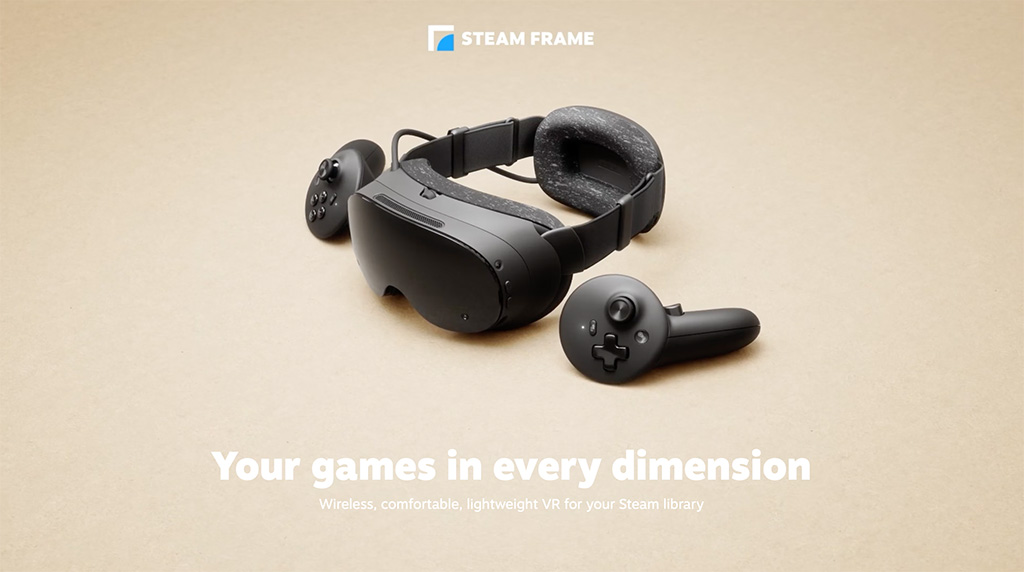
“Don’t put all your hopes into a headset, Chuck,” I hear the voice saying. “It’ll break your heart every time.” And I get that, imaginary voice, but this time is different.
The thing that stood out to me more than anything else with Valve’s announcement of new Steam hardware in early 2026 wasn’t that any of it was some mind-blowing vision of the future. It was that it was all so practical. It seems like every choice they made was the right one, both for customers and for Valve’s bottom line.1Apart from maybe the choice to release new hardware right when tariffs and RAM shortages are making prices impossible to manage or predict, even for companies buying components in bulk. Crossing my fingers that they somehow figure out how to give everything a reasonable price.
The Steam Frame headset was the part that most interested me, as somebody who was absolutely dead-set convinced that VR games would be the future, who’s been disappointed as the years pass and that keeps turning out not to be the case at all. It gives me the vibe of people who’ve been burned before on the typical release cycle of a VR headset: initial excitement, waning interest as the friction gets to the point of making it not worth the effort, and eventually wondering where exactly you last left the thing and whether the batteries in the controller have corroded.
A while ago, I was having an online conversation with a friend, and he made the perfectly valid point that if VR was ever going to take off, the Quest 2 would’ve done it. Facebook/Meta was in a unique place when they released it, both having Croesus-level stockpiles of money and a boss who was intent on launching Second Life As Global Marketplace.
Even if you were only mildly curious about VR, the Quest 2 was priced at a point that was not that much more than an impulse purchase. It’s got an unprecedented install base (according to Qualcomm via Wikipedia, at least 10 million units were sold as of November 2021). But even that level hasn’t seemed to convince enough people that VR as a medium is worth caring about.
There have been several successful games targeting the Quest, but not the huge, must-have title that will generate a big enough wave of interest to finally lift VR out of its niche.
Apple’s Vision Pro was never going to sell at huge numbers, because it wasn’t intended to. It was pretty clearly intended to be the first step into expanding VR and AR into a much wider audience beyond people interested in games. The tech in it is amazing, but the idea was to establish a platform that could eventually sell at iPad-level numbers (even if not iPhone-level), once the tech inevitably caught up with the ambitions of the first model, and it became lighter and affordable.
But that focus on making it a “lifestyle product” ended up doing even more harm than the price, in my opinion. It’s way too cautious about doing anything “too immersive” or allowing direct interaction with digital objects; its AR tracking tech that’s already ground-breaking on the iPhone is hobbled on the headset, probably because of overheating; it’s too expensive to attract developers interested in making a wide range of stuff; and it’s not exceptionally good at much besides watching movies. If you’re not that interested in watching a Metallica concert or walking across a canyon on a tightrope and feeling like you’re really there, then there’s not much for you.
And the PSVR 2 kept the focus on games, and it was pitched as an accessory for a device where players likely already had an extensive library. But it wasn’t backwards compatible with PSVR games, and it wasn’t great for playing flat-screen games on a virtual screen (I didn’t even know whether that was an option until I just did a search, since I’d never heard any comment about it), and it didn’t attract much interest from developers wanting to make a standout VR experience for it. It was positioned more as a new platform instead of an accessory for the PS5. Plus, it required a cord; sometimes the most boring things cause the biggest problems.
So just in terms of positioning, I’m optimistic about the Steam Frame:
- It’s steadfastly not some general-purpose device. It’s for playing games. That’s not insightful business analysis, or anything; it’s right there explicitly on the main page.
- You don’t have to build a new library for it, because the goal is for it to play as much of your existing Steam library as possible. Meaning all the existing Steam VR games, the “flatscreen first” games that also have a VR mode like No Man’s Sky and Star Wars Squadrons, and (almost) every game from your library on a big virtual screen.
- It doesn’t require a cord and ideally, can stream wirelessly with better reliability than using your home WiFi.
- It’s presumably positioned so that Valve doesn’t need it to sell beyond the existing niche VR market for it to make sense for them. It doesn’t need to be a blockbuster.
That last point is pretty important, because it eliminates the “wait… what’s the catch?” hesitation. A friend of mine dismissively described the Steam Machine as “a vanity project,” but I think that’s both apt and complimentary for the Steam Frame as well.
Years and years ago, some people at Valve decided that VR was really cool and that more should be done to make it consumer-friendly, and it’s been a going concern in the company ever since. They do it because they like it, and they can afford to keep doing it. So they don’t need to establish it as a whole new platform, or a flagship product for a future vision of online services, but just as another way to play games in your Steam library.
It’s not even that they sell both the razors and the blades. They’ve made a metric asston of money selling the blades, and they can sell the razors for a little bit of profit as well.2I’m not sure how Apple’s model fits into this analogy, maybe sell a super-expensive multi-function razor and expect blade manufacturers to flock to it without much a big enough market to make it financially viable, just for the love of shaving?
Which might seem like it’s only beneficial to Valve, but their “hey, it might not ever have a huge audience, but why not be the best at it, anyway?” approach to VR resulted in Half-Life: Alyx, so I think it’s working.
For as long as I can remember, VR devotees have been saying “sure, tech demos and small experiences are really neat and show the potential, but as soon as a AAA-caliber VR game is released, that’s when the medium is really going to take off!” Half-Life: Alyx is that.
And the medium didn’t really take off as a result, but I never got the impression that that was ever the intention. It was clearly a showcase for the Index controllers, but it didn’t require them. And it does require Steam VR, but that’s freely available to anybody with a Windows machine. It was never pitched as a killer app for the Index, or even for Steam, really. It felt more like the killer app for the general concept of VR games.
It’s worth pointing out that it’s structured as individual chapters in a connected story, giving the player natural stopping points that don’t feel like interruptions. The idea of “a huge, sprawling, AAA-caliber VR game” sounds good until you remember that for anybody but the most hard-line VR devotees, it gets pretty tiresome wearing a headset for more than a half hour or so at a time. I don’t want a VR experience that will absorb me for hours; I want something that I can play for less than an hour at a time and think, “that was pretty bad-ass.”
So my prediction and hopes for the Steam Frame are:
- It’ll sell to the core, niche audience of VR devotees who already want the hottest headset of the moment, and just that audience will be big enough for Valve to consider it a success
- It’ll also sell to people like me, who’ve mostly lost interest in VR gaming after the Quest 2, skipped the Index and the Quest 3, and are ready to upgrade as long as it means not having to rebuild a game library3And not having to keep using Meta products, which probably isn’t enough of a selling point on its own but let’s be honest, it really is
- It might attract some people who really do want to play Hades 2 on a huge virtual screen while everybody else in the house is using the TV. Seems unlikely to be enough people to make a significant difference in sales, but what do I know?
- People will get reacquainted with the existing library of Steam VR games, and that plus being able to play a ton more flatscreen games will make it more obviously day-to-day useful
- They’ll discover or rediscover more recent VR-first games like Ghost Town, which have Quest and PSVR versions as well, and choose to get it on Steam because it’s more future-proof
- A wider variety of games, and the ability to be mostly agnostic about the target platform and even whether the game is designed for VR at all, will get people thinking of the Steam Frame as “a device for gaming” instead of just “that thing I play Beat Saber on.”
- The relatively low barrier of entry for Steam will encourage more developers to target Steam VR, and smaller and more experimental games will become viable again.
The last part is the most appealing for me, not just as somebody who’d like to put out a weird VR experiment without having to deal with the Quest, but as somebody who has more fun with the shorter, weirder games in VR than the ones that try to be massive blockbusters.
To their credit, Meta has put significant effort into supporting developers wanting to bring stuff to their platform, both financially and in terms of support. There’s a detailed guide for releasing stuff both natively and to run streaming from a PC. But just for me personally, I appreciate any time I get to spend not thinking about Android at all. And while I haven’t yet released anything on Steam before, the overwhelming impression I get is that it’s straightforward enough that it’s practically a no-brainer.
Based more on vibes than any practical experience, targeting the Quest still feels like “we’ve got to make this worth the effort.” Steam feels more like, “eh, why not release it and see what happens?”
Smaller games feel better for the future of the medium overall4Assuming, as always, that there actually is a future for it, since the games that go big — we have to sell over a million copies to make targeting VR even worth it — inevitably have to play it safe. Part of why I lost interest in even following VR games on YouTube is that the video host would always be super-excited to announce a groundbreaking new game, and then the footage always looked exactly the same, firing rifles or bows-and-arrows at robots.
And maybe it’ll even kick off a trend where the bigger games go back to including an additional “VR mode” even if it’s not their primary target. Maybe the additional development investment will be written off by the marketing potential of more interesting videos of streamers freaking out over your game in VR.
None of this requires the Steam Frame to sell ten million units, or for there to be a Fortnite Except It’s VR-level mega-hit, both of which seem a little counter-intuitive. Everything we’ve ever seen in games suggests that you need huge market penetration and a Mario-level flagship game to have any kind of lasting impact.
But that’s exactly what makes me optimistic here. Basically, Valve doesn’t need the Steam Frame to be a massive seller, since Steam is their business, and any sales benefit Steam. Developers don’t need a massive hit to justify the cost of VR development, since Steam’s low barrier of entry makes it an attractive target, and the lack of exclusivity makes it possible to target other VR platforms as well. And consumers don’t have to rebuild their game library from scratch — assuming they haven’t spent the last few years going apeshit in the Quest store — but will still have a ton of potential stuff to play with on day 1.
I already knew from experience that the most important aspect of a headset is reducing friction as much as possible — no setting up external sensors, no establishing your play space boundaries, no cords getting in the way, and as light and comfortable as possible. I’d thought that the Vision Pro had cleverly addressed many of those issues, just by making the headset “AR first” so that you always see your real environment, and not requiring controllers.
What I hadn’t fully appreciated was how much of the friction comes after you’ve owned the thing for a while, and you’re having to figure out what to do with it and/or what to make for it. If Valve manages to get the pricing right, they may have announced exactly the product VR needs to become interesting again.
Not necessarily with mind-blowing new technology for the stuff we think of as VR, like displays or haptics; or with a flagship game, because they already made that; but just by making good decisions, like the additions to Proton to get games running on more architecture, and the emphasis on wireless and streaming tech to make it as platform-agnostic as possible. All things to reduce friction, barriers to entry, and, I’m hoping, an ethos of opening things up and making them fun again.