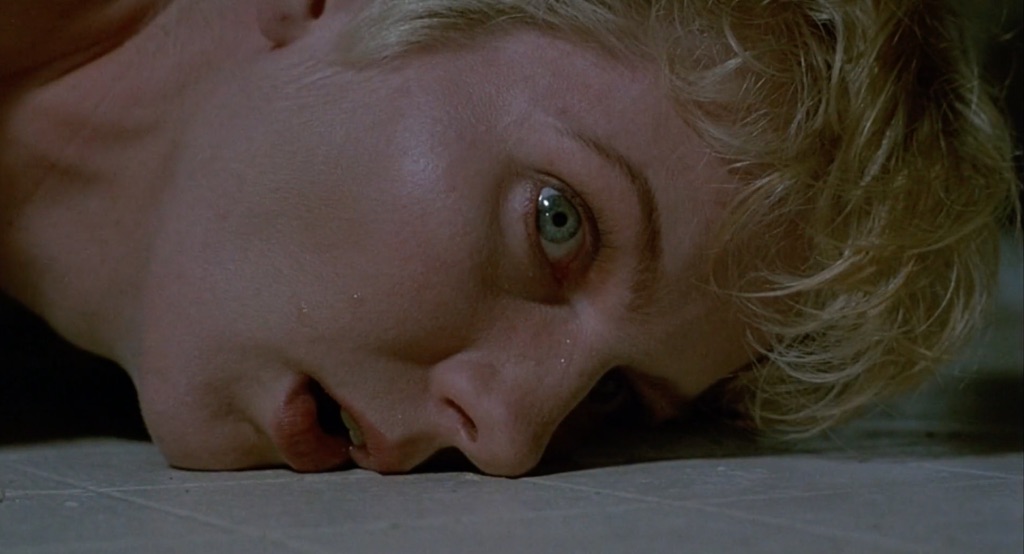
Going into Psycho II, I made sure to make clear how much disdain I had for the idea of even trying to live up to such an undisputed classic. I gave it a pass only after it was clear that they were showing proper reverence for the original, and that they were more interested in continuing the story than trying to live up to it in terms of filmmaking.
Watching Psycho III, I was reminded of Hitchcock’s extended trailer for the original movie. It takes full advantage of the persona that had been well-established on Alfred Hitchcock Presents, starting with a jaunty theme and his style of straight-faced opening narration of each episode, that almost always included some macabre gag. He deadpans his way through a tour of the murder scenes, teasing the horrific events that took place at each one, stopping himself just short of saying too much.
In other words: I have a tendency to take Hitchcock way too seriously, concentrating on the Master of Cinema bit and forgetting how much he was also a showman and master manipulator.
So while Psycho II was a pleasant surprise, both for having clever ideas on how to continue the story and for being careful to pay homage to the original, Psycho III feels like it really gets the original. Not just how it felt to audiences 20 years after its release, but how it might’ve felt in its original context. And most surprising of all was how much I enjoyed it.
The movie picks up just a months after the previous one, and it’s about Norman Bates’s obsession with a young woman who arrives at the Bates Motel and by a bizarre and unfortunate coincidence, happens to look nothing like Marion Crane.
Maybe that’s not being fair to Norman1I mean, she doesn’t even have the same hairstyle, though. She looks a lot more like Christina Crawford than Janet Leigh., because the opening of the movie does an extended riff on Vertigo, priming us to take it in stride when a guy falls hard for a doppelgänger.

In any case, she looks similar enough for Norman to get imprinted on her, at least. And his new real mother doesn’t like it one bit.
The situation isn’t helped at all by his new sleazy assistant manager Duke, played by Jeff Fahey with the idea of “What if H.I. McDunnough, but hot?” and frequently shot like this:

Duke is trash. He’s also perpetually horny and he mistreats women, so it’s a good thing he’s in Psycho III, which is a very horny movie. But while Psycho II just seemed to be hinting at psychosexual frustration in an outdated and almost even TV-safe way — everyone calling it “making love,” implications of the kinds of lurid things that are going on in the motel now that it rents rooms by the hour, a doomed teenager sneaking into a murder house with his girlfriend and only making it to second base — the third movie is eager to go there and explore it.
It’s pretty hilarious when we get to see how Duke has transformed his room of the motel into a sex palace for one-night stands with local barflies. He’s been hard at work making collages from nudie magazines and pasting them on the walls, and somehow he’s managed to find colored bulbs for all the lamps. Women can tell he’s bad news, but they still can’t resist the temptation to enter his den of passion, where he’s always playing cartoons on the TV for some reason.
Having Duke at the Bates Motel sets up this interesting dynamic that plays with the audience’s sympathies, and even turns Norman back into a kind of anti-hero. Psycho II started with the baseline assumption that everybody would constantly be thinking of Norman as one of the most famous horror movie murderers, so it milked the ambiguity of “has he really reformed, or is that impossible?” for everything it was worth. Psycho III can’t really do that.
We know from the start that the hasn’t reformed. His introduction leans hard into images of the motel and the house in decay and neglect, with Norman surrounded by death. He’s poisoning birds so he can taxidermy them, and as far as I could make out, eating peanut butter from a jar with the same spoon he uses to stuff the insides. All while having visions of when he stuffed the body of his mother, who’s now residing in the upstairs bedroom. He’s unambiguously unwell, and it’s really driving home how hard Reagan-era budget cuts limited the availability of social workers to be assigned to recently-released serial killers.
But Duke is such a piece of garbage — and unlike Toomey from the last movie, he’s surface-level charming, instead of instantly unlikeable — that the contrast makes you think of Norman more like the way he thinks of himself: a quiet, awkward, and repressed, but overall polite and respectful man. An identity completely separate from his insane and domineering mother.
Because Psycho III comes right out of the gate with the weirdness turned to maximum — the opening shot is a black screen with a woman screaming, “There is no God!!!!” — a lot of it plays out like a surreal coming-of-age story starring a man in his early 50s. The relationship between Norman and not-Marion plays out like a budding romance between two shy and awkward innocents, instead of two deeply repressed people who are mentally unwell. At a dinner after they get tipsy from having wine that neither of them have been allowed to drink before, Norman invites her to dance and teaches her the box step.
Even the pianist can’t help but be charmed by the sight of them, and the movie cuts away to show him looking on approvingly, in what is my single favorite shot in all of Psycho III:

The core relationship in Psycho II never felt sexualized to me, for several reasons. The most obvious is that Mary (Meg Tilly’s character) is introduced as a co-worker with boyfriend troubles, both of which immediately put Norman in the friend zone. In the original, we’re introduced to Marion in her underwear after a rendezvous with a still-shirtless Sam Loomis, inviting the audience to think of her as an adult woman who has sex out of wedlock!
Did audiences really still think that way in 1960? Or is that just a modern interpretation, which invariably infantilizes previous generations as being repressed and naive? People have spent so much time analyzing Psycho that I spent years being told that even the sight of a flushing toilet was shocking and risqué for the time, so it’s near impossible for me to tell how much of that is accurate and how much is like the stories of people fainting at the sight of an oncoming train.
In any case, Psycho II was less interested in exploring sexual repression as it was in building up the suspense and tension around people in danger. Even in the scene where someone is watching Mary’s body double coming out of a shower, it feels set up to emphasize how physically vulnerable she is, instead of sexually vulnerable. The nudity seems more like a movie from the early 1980s playing around with how much they can get away with showing now, instead of actually digging into what any of it means.
Both of the sequels are filled with notes to Norman from his mother, calling women sluts and whores. And yet in Psycho II, they somehow always read as general-purpose gendered insults instead of sexual ones. It’s always ambiguous where the notes are coming from, or even if they actually exist, so they seem to be written more for shock value than to actually mean anything. “Don’t take it personally. Mother calls every woman a whore.”
But when Norman’s mother in Psycho III calls a woman a slut, she really means it.

It’s really interesting, because the easiest take on Psycho III is that it’s just lurid, melodramatic, trash. Dispensing all of the manipulative craftsmanship of the original, and the clever whodunnit twists of the first sequel, in favor of turning the franchise into a weird mid-80s slasher movie. Everything that was suggested in the original is now made explicitly obvious, all of the subtext is now exploitative text.
And yeah, Psycho III was undeniably capitalizing on the trend in slasher movies — the Friday the 13th series, which was also about a murderer with an unhealthy relationship with his mother, already had five installments by this point — but I think it was clearly commenting on them as well. I don’t think it’s simply a case of clumsily making implicit ideas more explicit, but using them as a baseline to take them further.
As a counter-example: in Gus Van Sant’s awful and truly unnecessary remake of Psycho, he made sure to add sound effects to the scene where Norman is looking at Marion through a hole in the wall, to make it clear that he was masturbating. That’s a case of making the implicit explicit while adding nothing.
When there’s a similar scene in Psycho III, the camera spends a long time lingering on Norman looking at the creepy painting that’s covering the hole in the wall. It shows two dark, brutish men abducting a nude woman in the forest.2It looks like a creepier, more dark-gothic remake of the one in the original, which just gets a glimpse. As he stares at it, it transforms: the men look even more sinister, and they’re looking more directly at out of the painting, at him. The woman’s expression of distress has changed into a smile, an image suggesting not just consent, but temptation.

There’s a tendency to interpret horror movies, and the entire genre of slasher movies in particular, as cases of filmmakers unwittingly telling on themselves. All of their prejudices and hang-ups are encoded into the movies, ready for modern audiences to come in and decode them into the various symbols and cliches like “the virtuous final girl” and “horny teens punished for their transgressions.” And then turn them into self-aware riffs on those ideas, like Scream and The Cabin in the Woods.
Psycho III feels like it was commenting on those while they were still happening, before they were being regularly deconstructed. It makes it clear that its targets are repression, and the objectification and mistreatment of women, while also making it clear that it’s condemning them, not just indulging in them. It’s still manipulating the audience’s sympathies — because by this point that’s become a key part of the franchise — but it also includes enough outsiders to remind us how none of the residents of the motel or the house are the “normal” ones.
For one thing, there are simply enough women characters, and they’re given just enough agency, that they’re allowed to remain distinct personalities instead of collapsing into symbols. (“Personalities” instead of “characters,” since this is still Psycho III, after all). Even the characters that come right out of a slasher movie, and who might as well have “VICTIM” written on their foreheads, are given enough time to establish how completely random and unprovoked the violence against them is.
The movie seems to make a point of distinguishing between a healthy attitude towards sex, vs repression, sexual violence, and exploitation. For a lot of the runtime, the motel is being taken over by a bunch of loud, rowdy adults in town for a homecoming event. Like this woman, who thinks it’s hilarious that her bear boyfriend just invited her to twirl on his baton:

And one of the VICTIMs that I mentioned earlier would seem to fit perfectly into the horror movie cliche of “woman punished for the sin of being sexually promiscuous,” but I had a hard time reading the movie as being complicit. She’s the most explicitly sexualized of any character, but the scene doesn’t seem to blame her, so much as it emphasizes how much Duke is an asshole for treating her like a prostitute. And her nudity afterwards seems so matter-of-fact that it’s treated like an inconvenience. Unlike the nudity in the previous two movies, for instance, which felt like the filmmakers were experimenting with just how much they could get away with.
It’s possibly the oddest thing about this very odd movie, because I’m so used to slasher movies serving up simultaneous sex and violence with a shrug of, “we’re just givin’ the people what they want, and you’re complicit, or you wouldn’t be watching.” And this whole sequence looks like it should be exactly that. But in the context of this movie’s overt theme of sexual repression, it ends up feeling like a vehement rejection of the whole idea. It doesn’t feel like indulging your voyeurism, but rejecting it. Essentially equating you with Norman’s mother, for seeing any sign of sexuality in a woman as sinful and something that deserves to be punished.
Because Perkins was directing, it’s tempting to theorize that the reason I didn’t find the female nudity in Psycho III as pandering as most slashers, is because all of the Male Gaze was focused on Jeff Fahey. And I admit I like to imagine that Perkins was slyly playing on the way Hitchcock was infatuated with Grace Kelly and Tippi Hedren by filming Fahey the same way. But the obvious fact is that it simply wouldn’t work the same way, even if he weren’t introduced to the movie in a scene that ends with his sexually assaulting a woman. The baseline for what’s considered acceptable male sexuality is just different.
But even if that wasn’t part of the intent, I do firmly believe that Perkins knew exactly what he was doing with this movie. I really like this quote that was included with the Wikipedia entry on the movie:
“I liked how wild the script was, and how tight it was at the same time. It’s the perfect blend of the reasonable and the unreasonable. I’ve always been looking for a project to direct with which I have an affinity with the subject and characters. I felt this would be a good script for an unknowing director to take on because the scenes were so well written, they directed themselves.”
It’s unnecessarily self-effacing for Perkins, because the script absolutely would not have worked for anyone who didn’t fundamentally understand the original Psycho, the character of Norman Bates, and the reason that movie was such a phenomenon.

A quick shot of Norman’s mother warning him of impending danger, for instance. Psycho II would never have included something like that, because it was playing it too safe. It’s funny how quickly I went from accusing that movie of the most outrageous audacity for even trying to continue the classic original, to concluding that it didn’t go far enough.
Part of the reason I’m including so many screenshots from the movie3Apart from having watched it from a friend’s Plex server, which doesn’t black out still frames like every other Mac media player does is because it so frequently feels like it’s trying to present an original, surreal image. And it’s full of homages to Hitchcock, but it’s more interested in getting across how they felt, instead of just doing a simple remake.
A huge part of why it feels so weird is the amazing soundtrack from Carter Burwell, full of odd electronic noises, creepy chanting, 80s rock, and even turning into a bouncy synth pop tune over the end credits. This was in the middle of doing music for Blood Simple and Raising Arizona, and proves how Burwell is a master at recognizing how the lines between suspense, horror, surreality, and comedy are all blurred. It’s a reminder of how much Bernard Hermann’s soundtrack for the original is memorable just for being so weird.
It’s an essential part of how Psycho III mashes it all up and has fun with it, without it ever quite descending into camp. I’m not going to claim that it’s a multi-layered masterpiece; it doesn’t have anything that works with as much restraint and nuance as the “we all go a little mad sometimes” from the original, for instance.
But it does embrace the entirety of the original, the parts that make it a classic and the parts that Hitchcock was eager to have fun with. It was never intended to be a deep and thoughtful examination of repression and mental illness4Which I guess should have been abundantly evident from the title, in retrospect; it was intended to be shocking and surprising and pull people into the theaters to see what all the fuss was about. I love the movie, but I frequently forget how it was basically “elevated trash,” and not the least bit ashamed of that.
Psycho III understood that bringing the original into the 1980s meant preserving both the experimental filmmaking and the lurid exploitation. I was surprised that the previous movie was any good at all. I’m even more surprised that the third — and as far as I’m concerned, final — movie is not only a fascinatingly weird horror movie on its own merits, but made me have a greater appreciation for the original, by being less reverent of it.