I don’t know if I’ve ever felt so acutely unemployed as when I realized I’ve spent the day watching back-to-back Piranha movies.
Anyway, after being disappointed by Piranha 3D, and a little unsettled because I’m not sure whether I’ve seen it before, I decided to go back and watch the original, which I’m certain that I haven’t seen. I would’ve been too scared in the 1970s, and then after that, too scared that it was as bad as it looked.
It’s been well established that kids growing up around the time I did were taught to be terrified of killer bees and quicksand. But I remember the fear of piranha — or as pronounced by exactly two of the characters in this movie, piraña — being just as strong. It was the kind of primal and completely irrational fear that putting even a finger into any natural body of water would end up with me pulling up a gristly bone.
That fear is what Piranha was trying to tap into, but also I think we’re all aware of what Piranha was really trying to tap into: the unprecedented success of Jaws.
The aura around this movie has grown over the years to the point where takes on it are all over the place, ranging from a straightforward “this was a parody of Jaws,” to “how can you even suggest this is like Jaws, this is doing something completely different tonally and thematically.” And neither one is accurate. It’s not an outright parody (or if it is, it’s not a very good one), but it doesn’t try at all to hide what it’s doing, either.
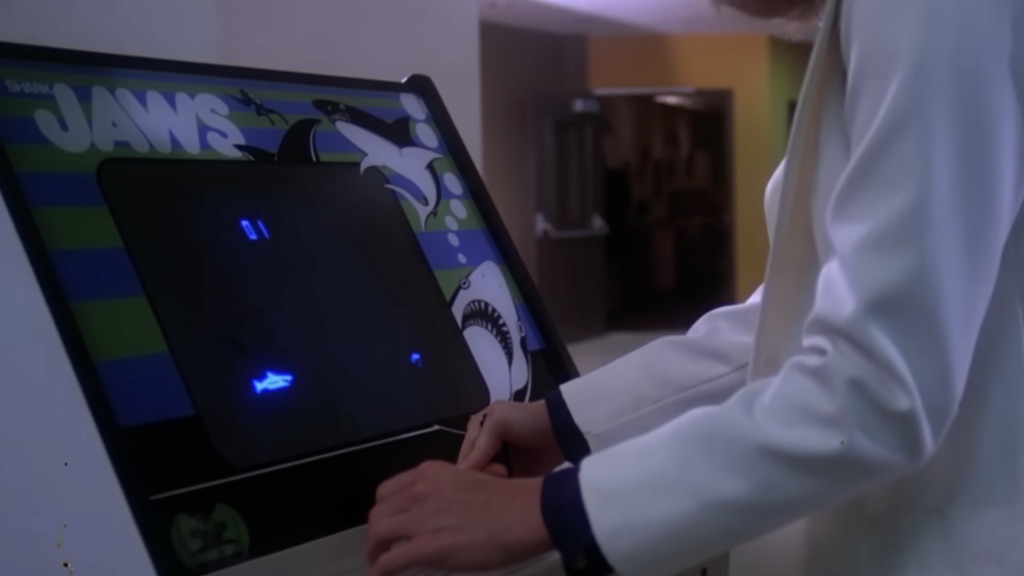
If you weren’t tipped off by the opening, which has a couple of young people encountering something in the water during an illicit nighttime swim, then they have one of the main characters playing a Jaws video game in an airport at the end of the opening credits. I wonder if people got too attached to the idea that this was a Joe Dante & John Sayles collaboration like The Howling, and forgot that it was a Roger Corman production like, well, everything that Corman was producing around this time.
All through the opening, I started wondering if Piranha was a hidden gem that I’d been missing out on all these years. I have a tough time classifying it as a “comedy,” since it’s never particularly funny, even by late 1970s standards. But it did feel like everybody was having fun with it.
And in a sequence in a military research lab, when one of our heroes sets off the entire disaster, there’s a stop-motion creature wandering around. Phil Tippett was credited as creature designer and animator. It had me intrigued at the idea that this might turn into a very different kind of movie than what I’d been expecting. Unfortunately, it’s never seen again.
The only creatures in the rest of the movie are the piranha themselves, which are only shown in chaotic, super-quick shots as they’re chewing through ropes or children’s legs, butting their heads into swimmers, or leaping from the water to bite the face of a camp director. All the while making a weird buzzing, swarming sound, maybe to make the audience associate them with killer bees?
And the rest of it plays out like a very late 1970s movie for the most part, with a summer camp, and small-town jails and chases in cop cars, and a military-led conspiracy. Again, I don’t get the “comedy” label, since it’s more flippant than funny, but it does lean hard into the can’t-trust-the-government-or-big-business angle.
There are a couple of funny moments. I did like the deadpan delivery of: “What about the piranha?!” “They’re eating the guests, sir.”
And earlier, there was an exchange between the two leads as they’re hatching a plan to escape from a tent guarded by an army officer. “You know, distract him.” “What if he’s gay?” “Then I’ll distract him.” That’s the kind of joke I don’t remember seeing at all in the late 1970s, and it feels ahead of its time. It’s the point of the whole extended gag, but it doesn’t seem judgmental, either. Back then, the media was reluctant to casually accept that some people are gay and it’s no big deal. Maybe I just wasn’t seeing this kind of movie back then, because the scene culminates in the briefest-of-brief flash of the main character’s breasts.1Or more likely, her body double’s.
But those are literally the only two moments that I can think of that feel original or transgressively funny. The relationship between the two leads is kind of charming, and I like how she takes a more commanding role over the action, instead of just being his sidekick. But the rest of it feels oddly safe, leaving me to wonder what exactly this movie was trying to do.
I doubt I’m going to be blowing any minds when I declare that Jaws is much better than Piranha. But I don’t know if I would’ve appreciated how much better it is, if I hadn’t rewatched it recently, in a theater, for its 50th anniversary. I feel like its reputation — and the oversized reputation of Spielberg’s later movies — has grown so much over the years that it’s dulled everyone’s collective memory of it. I know that I remembered the key moments, and I always thought of it as a classic, but I’d forgotten just how well those moments work in context.
Just the opening scene, which Piranha plays off of, for instance. Piranha has a woman take her top off, and then the scene plays out with the two young people2Funny aside: I’d originally had “the two of them getting bitten,” which made it sound like I was talking about her breasts getting bitten and panicking and then being pulled under water. I didn’t feel much of anything. The opening of Jaws, though, is still genuinely, viscerally, horrifying. She’s alone in the water. She gets pulled under. You can feel the panic. She almost makes it. I had completely forgotten how much I felt it.
And Jaws is genuinely funny, much more than I’d remembered, and with different types of humor than I’d remembered. And its mayor character is broad and memorable, but ultimately feels like a real character. Piranha‘s closest equivalent is a resort owner played by Dick Miller, and he’s more of a caricature.
Based on what I’d been hearing for years, I got the impression that Piranha was ultimately an “elevated B-movie.” A creature feature made by filmmakers with genuine talent, who were playing around with genre conventions. So I’d expected it to be more of a deconstruction, or a self-aware parody, or even just an unabashedly transgressive take on the “safer” summer blockbuster from a few years earlier that inspired it.
But I think Jaws even does that better, honestly. At its core, it was a contemporary take on monster movies. Its characters are larger than life, which might be easy to forget since they so quickly became archetypes. I have to wonder whether our collective memory of Jaws has become like my impression of Psycho, where I regarded it as a classic for so long that I forgot that, at its core, it was kind of a trashy and manipulative suspense thriller.
I didn’t dislike Piranha, and I actually liked it better than Piranha 3D, even though it doesn’t come anywhere near as close to delivering on the promise of gruesome monster attacks. But I think I have the same basic criticism of them both, which is that they have a lack of sincerity that feels grating. They both feel like they’re playing with the idea of a movie, and it would’ve been a lot better if they’d just made that movie.