There’s a particular clip from the He-Man and the Masters of the Universe cartoon that has been used a lot in memes. It’s one where Skeletor escapes into a mirror, and then he reaches his muscular arm back through and smashes the mirror behind himself.

I was watching the new Masters of the Universe movie waiting for them to reference this, since I could not think of a single meme or pop cultural reference about He-Man from the past 43 years since the show was created that the movie doesn’t reference. It plays all the hits, repeatedly.
Didja ever notice how all the characters were weirdly hyper-muscular and sexualized for a cartoon aimed at children? And how it was all kinda gay? And how all the characters had really silly names, like Fisto and Ram-Man? And how characters would stand in a circle and lean back and belly-laugh at the dumbest non-jokes?
And you know that there was an entire scene set to the song “What’s Up?” The people sitting behind me and laughing were delighted that the movie had made such a clever reference and that they recognized it.
So I was disappointed that there wasn’t a mirror to be seen anywhere, especially not near Skeletor. Until I realized that the movie itself is kind of like a manifestation of that meme: it’s silly and it makes no sense, and it bends reality around itself for the sake of a visual, and I think it’s really dumb but at the same time I’m not 100% certain that I don’t also think it’s kind of cool?
Masters of the Universe felt a little like my vague, layman’s simplifed understanding of quantum mechanics: any time I tried to make sense of what I was observing, it would collapse. As if it were folding reality into itself, leaving behind such a vacuum that I’d swear I felt my ears pop. For a lot of it, I was simultaneously thinking, “I hate this, and I want to go home,” and also shrugging, “Well, I don’t hate it.”
It never really commits to being a comedy — or at least, I’m giving it the benefit of the doubt that it wasn’t committing to that, since it’s never particularly funny. Just like it seems like it’s going for camp, but never completely commits to that, either. Alison Brie as Evil-Lyn was the most baffling; I kept waiting for her to start camping it up, because I know for a fact that she’s a master at taking it just to the point where it’s intolerable and still making it work. Here, it seems like she was ordered to play it straight.
I often got the sense that they were going for a vibe like Dungeons and Dragons: Honor Among Thieves, but were so far removed from having any genuine attachment to the source material that they were treating parodies of it as the source material.
Almost all of the humor feels like an SNL short stretched out to over two hours in length: like a 2020s parody of, say, Scooby-Doo, where the gags are about how Shaggy was probably a stoner and Velma sure reads as a lesbian. It doesn’t even feel like a copy, but like people who simply aren’t aware that Cartoon Network was already making those jokes back when they were too young even to be watching Cartoon Network. It’s not pop culture eating itself; it’s pop culture eating the waste from previous generations of pop culture eating itself.
As an example: there’s a bit where Teela and Prince Adam are leaving Earth and returning to Eternia, and their version of hyperspace is a super-colorful rainbow spiral, and the soundtrack plays guitar-heavy rock that’s immediately evocative of the Flash Gordon soundtrack, and I thought, “Yes, finally! I am getting into this!” I later found out via the end credits that it’s not a guitarist mimicking Brian May, it’s actually Brian May.
In the scene just before that, Adam has been captured by the police after stealing the sword of power from a toy collectors’ store (and don’t worry, they include every single stereotype of guy who’d be in a toy collectors’ store), and one of the cops says something like, “Nice sword, Highlander.” A belabored and not at all funny joke from the other cop follows, but I shrugged and thought “fine, you get half credit for that gag.”
But later, in a climactic scene, we see the heroes assembled and marching forward into battle, in a scene reminiscent of Thor: Ragnarok, which was already referencing countless other movies. And the song “Princes of the Universe” from Highlander plays. At length. Is it a reference to Highlander? Or is it a callback to its previous reference to Highlander? Why is a movie about Masters of the Universe making a reference to Highlander, a movie which came out after the cartoon had already ended? It seemed to be a never-ending spiral of references on references on references, descending into a singularity of nothing.
But also: there’s no denying that that’s a great song. There’s pretty much nothing you can show, set to that music, that won’t end up feeling at least a little bit bad-ass.
The movie is full of moments like that, where trying to make any sense of what they were saying would cause them to collapse into nothingness. Which was to be expected, of course, since the source material is empty. Anyone who claims that there was ever any substance at all to He-Man and the Masters of the Universe is engaging in some serious revisionist history. I was there.
I was probably a few years too old to be watching it, but I still watched it, and everyone realized that it was about as vacuous as kids’ programming had yet been able to achieve. Unapologetically, even shamelessly created explicitly to sell toys, its moral messages clumsily tacked on in an attempt to satisfy the last vestigial bits of conscience remaining in Reagan-era television. From the start, it was a pastiche of images and ideas from existing fantasy and sci-fi, with nothing at its core.
But the cartoon did have one thing going for it, which the movie does not. It was earnest. The kind of soulless earnestness that comes from making 30-minute-long toy commercials, but the cartoon at least took itself seriously. It wasn’t constantly winking at the audience.

Dammit, He-Man, I am trying to make a point here. Anyway, the Masters of the Universe movie doesn’t even have that. There’s no sense of its committing to its own story, and no sense of affection for the source material. Instead, it just feels embarrassed by its source material, and desperate to make sure you understand that it’s in on the joke.
The movie is fine having characters named Skeletor and Evil-Lyn, with no comment. But it also has characters named Fisto, Ram-Man, Trap-Jaw, and Mekaneck, and it refuses to just let that be a thing. So it has the conceit that they’re all names that Adam came up with as a 10-year-old, which I guess is kind of clever.
So they all take grievous offense at his calling them such silly and even inappropriate1If you love nostalgia, you’re going to love remembering back to 15 or so years ago, when people still thought it was hilarious that a kids’ toy line had a character named Fisto! He fists people! Can you even believe it?! names. But still, they refuse to ever tell him their actual names. Because they don’t have actual names, almost certainly because Mattel wouldn’t allow it. So instead the movie just stubbornly keeps making what is essentially the damn “maybe you’d prefer yellow spandex?” gag from X-Men over and over again. They’re going to make a movie based on He-Man toys, but they’ll be damned if they don’t constantly remind you that they think it’s dumb.
That sense that the movie dislikes its own characters carries throughout, and not even in the fun Paul Verhoeven sense. Almost all of the characters in this movie hate each other, or at best are constantly irritated by each other. I could never tell who I was supposed to be identifying with or rooting for. Except for Adam, who is supposed to be both the bumbling fish out of water and the chosen champion of Eternia, so even he is forced to stay irritating for far too long, even after he becomes a hero.
“So why did you subject yourself to that, Chuck? You’d already used the movie as an example of everything that was wrong with Hollywood and 21st-century pop culture in general. What did you expect?” That’s an insightful question, and the truth is that I blame this video that said the movie was actually pretty good. Not entirely; honestly, I rarely agree with Nando’s take on movies, as he tends to be a lot more forgiving of stuff that I’m finding increasingly intolerable. But there was one clip that he showed, which won me over.
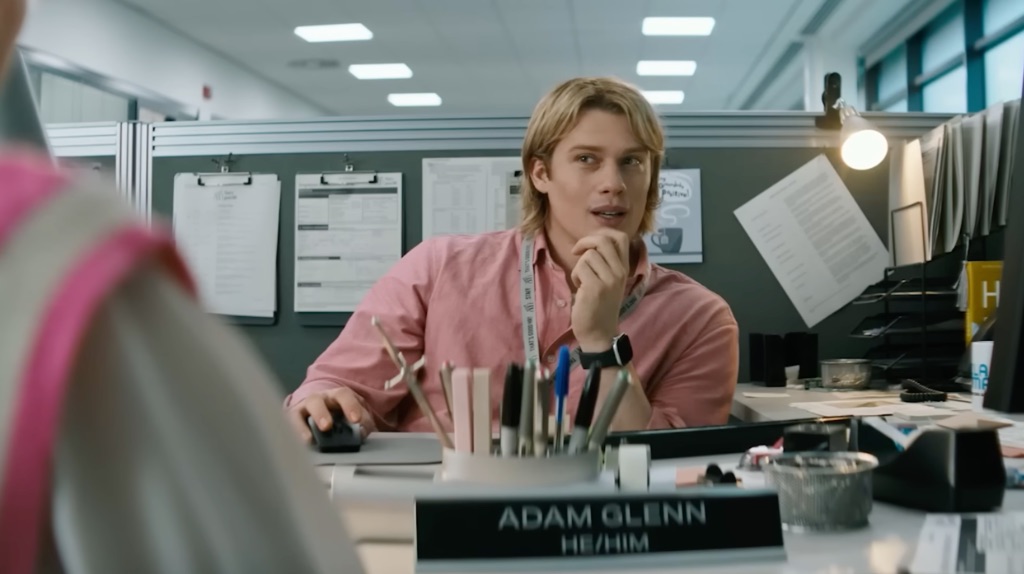
It’s Prince Adam at a desk on Earth, and he’s got a name plate that reads “ADAM GLENN HE/HIM.” And that’s actually a more solid gag than I would’ve expected from this movie. Not brilliant, but enough to make me think, “Okay, you’ve got my attention.” Plus I’m online enough to enjoy it as a shot fired in the inevitable culture war that right-wing dipshits will try to Barbie up around this movie to ride the wave of its media attention.
In the movie, Adam works in HR for some stereotypically soulless company, with Sasheer Zamata as his cartoonishly politically correct boss. And like everything else in the movie, it’s one gag that conceptually has potential, which then repeatedly has any shred of cleverness ruthlessly beaten out of it. It’s all presented as ludicrously touchy-feely nonsense, where everyone says “dialoguing” instead of “talking.” And all of that carries on well into the rest of the movie, with Man-at-Arms not able to talk about his feelings, and Teela calling Cringer a pussy, and a cartoon version of Skeletor over the end credits at a presentation board that reads “Villains Monologue, Heroes Dialogue.”
But like Barbie, Masters of the Universe tries to say something about gender, even though it never quite commits. It shows Adam’s roommate tearing up while watching The Notebook and then trying to hide it. Adam goes to a gym wearing a sweatshirt with a cute kitten on it. It all feels like it’s poking fun at the entire concept of a hero called “He-Man,” and asking the audience to consider what it really means to be a man, but too embarrassed to definitively say anything of substance about it. The one part that I thought worked, where it seemed like the movie was going to redeem itself in the final act, was a scene where The Sorceress explains to Adam that she chose him specifically because of his compassion, instead of just being a powerful warrior.
And then He-Man makes a half-assed attempt to talk it out with Skeletor — who, multiple characters including himself have already pointed out, exists solely to be a villain — and then ends up just punching him until he explodes.
I didn’t like Barbie, because even though I liked what it was saying, it was so painfully on-the-nose about all of it. I just wish that the newest Mattel-made movie about a toy had been willing to make such a commitment. This movie was never going to get too deep or nuanced with the idea, but that’s exactly why I think it would’ve been valuable for it to say something — anything — about masculinity. Because the basics just aren’t that complicated. Being a man is about more than just physical power and gender signifiers: there, see, it’s easy. As it is, I couldn’t ever tell if the movie was actually making fun of Adam for wearing a pink shirt, or mocking Skeletor for being at least a little bit gay. (He makes repeated references to He-Man’s muscles and the sword dangling between his legs, etc., because that’s funny I guess?)
Which reminds me of the other reason I went to see the movie, against my better judgment: to see if it appealed to my prurient interests. The cartoon was broadcast during a formative time in my development, and most of the appeal for me apart from the lasers and spaceships was that it had a lot of muscley guys not wearing very much. Masters of the Universe somehow manages to be less distractingly sexualized than the Thor movies, which seems to me to be missing the entire point of the Masters of the Universe.
At least the actor playing Fisto was kind of hot. Which made me appropriately nostalgic for a time when I didn’t understand why a toy was making me feel weird.
Still, I didn’t hate the movie. Except for all the parts that I did hate. I liked young Cringer, who spoke with a kid’s voice; that was hell of cute. And I liked The Sorceress, because I like Morena Baccarin in anything, even Deadpool. I liked that the English actors inexplicably spoke with Brooklyn accents, especially how over the course of the movie, James Purefoy transformed into Peter Falk from The Princess Bride. I liked seeing a really colorful movie that didn’t feel like I was being punished for having rods and cones (like, say, Super Mario Galaxy). And yes, having Brian May on guitar evoking better movies will always work for me.
Which ultimately, I guess, makes this a fitting adaptation of He-Man and the Masters of the Universe. Because I can’t point to one thing that’s particularly good, and a lot of stuff that is objectively bad, but hell, I’ll watch it anyway. Why not?
I think the other thing that compelled me to see this was that it feels like a death rattle for this kind of movie. I’m hoping (probably too optimistically) that with public opinion souring on the repetition of the MCU and Star Wars, and the diminishing returns on franchises built solely on nostalgia, that we might be seeing the end of movies that are targeted just at us GenXers and Millennials. Designed for nothing other than to say, “Remember that thing you liked when you were younger?” I wanted to watch this movie ride off into The West to diminish, because Masters of the Universe makes me hopeful for a near future where we can say “they just don’t make movies like that anymore.”
Comments
One response to “Masters of the Universe, or, He/Him-Man”
I enjoyed the film as dumb popcorn fodder.
On the ending subject of IP franchise fatigue, the end credits upset me a little with its sequel baiting. It reminded me a bit of Ryan Reynold’s Green Lantern where the movie’s ending told you the plotline that they would have rather done and left a lot of questions of “why didn’t you just make that
movie instead?”
All of He-Man’s deepest worldbuilding was in spin off She-Ra. There’s definitely a gender joke there that 10 year old boys didn’t care if the world lore of the toyline made sense or had any real depth but 10 year girls did.
It’s also a weird artifact of TV writers being at weird places in their lives. JMS (John Michael Stracynski) best known now for Babylon 5 is still credited as the creator of She-Ra for being in the lucky position to be head writer on the spin-off at an early career point.
So yeah I came out of the movie feeling like the team signaled that they really wished they were making a She-Ra movie and both Amazon and Mattel told them they had to do a He-Man movie first because she’s just “the spin-off”. (Despite the Netflix show making it abundantly clear that she can hold attentions for an entire series arc with no direct involvement of He-Man.)
But also it does say some things about me that I care way more about She-Ra than He-Man and could just be projecting that on the ending which may have easily just been Mattel and Amazon requiring Avengers-style sequel bait.