Evidently, the climactic stunt at the end of Police Story — where Jackie Chan as Chan Ka-kui leaps from an upper-floor balcony in a mall and slides down a light fixture to the ground floor — had already become legendary by the time they were making the sequel. I know this because in one of the beginning scenes of Police Story 2, Ka-kui’s supervisors are dressing him down for how much money the finale of the last movie cost the city government. “Uncle” Bill scolds him, “Why not take the stairs?”
It’s my favorite gag in the movie, but it’s also one that felt oddly out-of-place for being self-aware, right after its predecessor had been so unashamedly silly.
The sequel picks up right after the ending of the last one, with Ka-kui getting demoted to traffic duty after having done so much damage in his last run-in with drug dealer Chu and his goons. And while Ka-kui is on the scene directing a traffic backup around an accident, a fancy car pulls up next to him and his girlfriend May, and who do you think is in it? Chu and his goons! He’s been given a “compassionate release” from prison, because he had a bunch of doctors sign statements that he only had three months left to live. Chu’s right-hand man, the bespectacled bully John Ko, makes some menacing threats suggesting that they know where Ka-kui and May live, and they’ll be looking for revenge.
To its credit, Police Story 2 doesn’t just repeat the exact same template as the previous movie, but with bigger stunts. Unfortunately, it seems to be trying to follow the template of a late 1980s police procedural. As if it’s aspiring to be more like a John Woo movie, or even a western crime drama.
I was reminded of the experience years ago of having my mind blown by The Heroic Trio, which is absolutely batshit crazy and wonderful, and then following it up with its sequel The Executioners. That movie is a dour, melodramatic, post-apocalyptic story that seems to take itself far too seriously. And you can absolutely sympathize with the quandary of having assembled three obscenely talented Hong Kong superstars in one movie, and wanting to do more with their talent than just make another live-action cartoon. But doing so sucks out all of the energy and commits the even worse sin with their talents: it’s pretty boring.
Police Story 2 definitely doesn’t take itself as seriously. It’s got corny gags with “Uncle” Bill having severe and smelly gastrointestinal problems, Charlie Cho as henchman John Ko chewing the scenery as a menacing but cowardly thug constantly begging to have his glasses punched out, and a deaf-mute explosives expert (Lai Keung-Kuen, who also happens to be a martial arts expert) who uses RC cars filled with explosives and larger, more lethal versions of those snapping firework noisemakers. But still, there are long stretches of the movie where you’re just impatiently waiting for Jackie Chan to start mugging the camera and kicking dudes again.
The action set pieces are still pretty spectacular, with some fantastic choreography. Highlights are in a restaurant facing down Chu’s thugs, an extended sequence that manages to use every single piece of equipment on a children’s playground, and of course the finale in a multi-story industrial building. And because explosives are involved, there are a few pretty spectacular explosion sequences, one of them doing a good job of building up the tension over several minutes, as you get the sense of exactly who’s in danger.
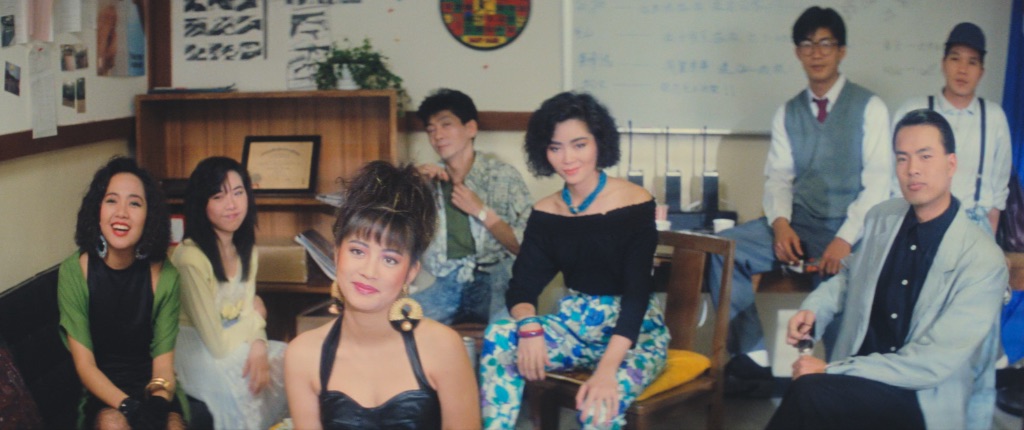
And the police procedural stuff is made pretty weird and charming. We’re introduced to the police force’s surveillance team, which appears to be made up entirely of fashionable young hot models, male and female. We get to see three of the women interrogating a suspect, knowing exactly how to use a combination of charm, sex, and violence to get maximum results. The surveillance team’s HQ is a late-80s high tech marvel of flashing lights and computer displays. They have a van for field work, with an ad for Canon cameras on the side, the lens of one being a hidden super-camera.
Another charming moment with the surveillance team is when two of them are on stakeout duty, and the approach of the suspects’ car turns it into makeout duty. The woman says, “Looks like it’s your lucky day.” The man replies, “Yours too.”
So there’s a lot that’s fun in Police Story 2, and I enjoyed it. Even if I didn’t enjoy it as much as the first one, or the third one, which is one of my favorite movies of all time. But I also couldn’t shake the feeling that it was under pressure to be something that it’s not. I’ve read that Jackie Chan returned to Hong Kong to make Police Story after a bad experience in the US making The Protector. Among other issues, he felt that the movie wasn’t playing to his strengths, casting him in a more serious buddy cop movie instead of taking full advantage of everything that makes him unique even in Hong Kong cinema. And I get the vague sense from Police Story 2 that for all of its weird charm, it’s still aspiring to work like Hollywood movies did at the time.
And it’s kind of a drag, because it seems like something that was endemic to Hong Kong cinema — or all around the world, most likely — and Chan in particular. You’d have these movie stars and directors who had been churning out dozens of amazing (and, to be realistic, less-than-amazing) movies per year, becoming recognized as superstars. But they still felt like they had to make it in Hollywood to be truly successful. That working with those budgets and that level of international cachet would mean leveling up.
Even though we can now see in retrospect that Hong Kong had been at least a decade ahead of Hollywood, and it took American audiences forever to catch up. I remember the wave of Asian and US co-productions that came through after Quentin Tarantino popularized the older movies with his “homages,” John Woo and Chow Yun-Fat’s collaborations became known here, and especially after Crouching Tiger, Hidden Dragon became a hit. There was a vibe that finally, Hong Kong cinema had been elevated to be artful and meaningful instead of just a collection of action sequences stitched together with broad comedy or melodrama. But the reality, of course, was that they never needed to be “elevated.”
So many of the stars and directors and stunt choreographers were absolute masters at what they do. For the Police Story movies, Chan’s collaboration with cowriter Edward Tang took the form of Chan devising the big stunt set pieces, and Tang coming up with a story that would incorporate all of them. American audiences, especially throughout the 80s and 90s, too often condescendingly dismissed that as shallow. “Mindless action.” In retrospect, it’s clear that it was anything but; it was playing to their strengths. Delivering on the things that Jackie Chan and his team were the only people in the world capable of doing.
As I mentioned, I’m still just barely getting up to speed with Hong Kong cinema history, having only seen several of the classics, and then only after they’d been repackaged and repurposed for American audiences. There are definitely big parts that I’m missing, not to mention missing the context of the stars’ longer careers, and just how much cross-pollination was going on between markets and between filmmakers. But it’s especially remarkable now to see how Hollywood’s cultural and financial dominance was actually made for a very narrow and specific taste, instead of being globally appealing as we’d always been led to believe. I may not have fallen in love with Police Story 2, but I would absolutely choose to watch it before any of its contemporaries coming out of the US.
Finally, there is one element of Police Story 2‘s script that I really, really appreciated. But describing it would ruin the fun surprise if you haven’t seen it, so I’ll save it for after a break and a spoiler warning.
Because Police Story 2 starts by reminding us of Chu and his henchmen, and has repeated story beats implying a sinister, city-wide conspiracy with super-rich Chu targeting Ka-kui and May for revenge, I spent the bulk of the movie speculating on how the explosion-and-extortion plot was going to end up with the reveal of Chu pulling all the strings.
So I really loved the moment when Ka-kui finally makes his way towards a showdown with Chu… and learns that he had nothing to do with it. He’s dying in bed, and what’s more, he’s completely broke. Even better, his scenery-chewing right-hand man hasn’t been acting out of loyalty or revenge, but has in fact just been Rudy Giuliani-like, debasing himself for a big payout from his corrupt boss that was never going to come.
I liked it for being a twist that I genuinely hadn’t seen coming, but also for adding to the overarching “eat the rich” theme in a couple of movies that had been heavy on the “trust your superiors, trust the government, trust the police” idea.