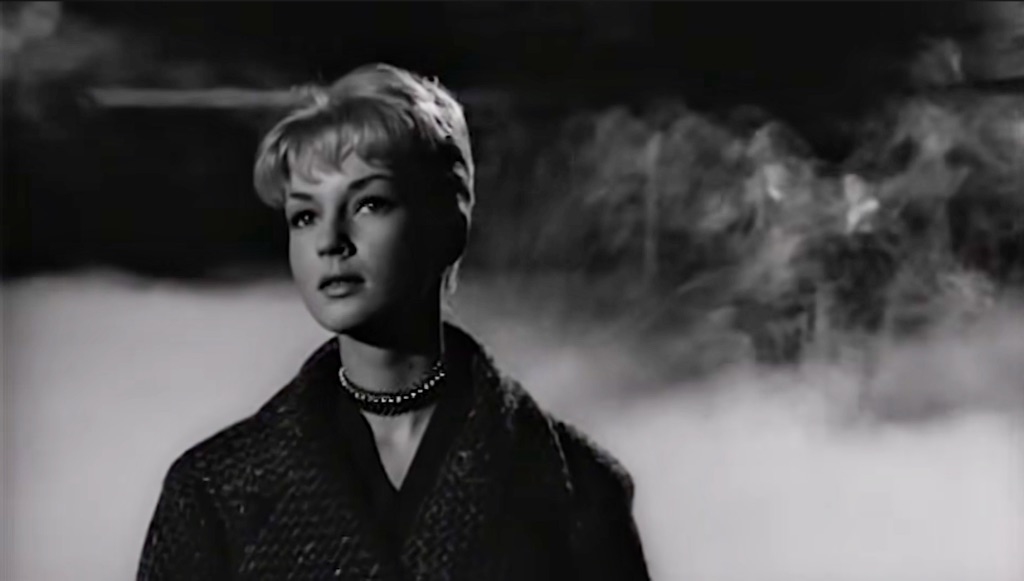
In the most recent episode of my new favorite series, Widow’s Bay, a couple of teens are watching an old black and white horror movie on TV. Thanks to the work of recap podcasters scouring the show for details, I learned that it’s a 1960 British movie called The City of the Dead, or Horror Hotel in its US release. Since it’s (currently) easy to watch for free online, I figured it was worth checking out as a curiosity, if nothing else.
My condescendingly low expectations turned out to be unfounded, since not only is it fun and engaging, but genuinely atmospheric and artful. In retrospect, it wasn’t surprising to learn that it was an early collaboration between the producers who would go on to form Amicus Productions. They made a series of movies that American horror history novices like myself would just assume were Hammer Horror productions. I’ve only seen a few so far — including one of my all-time favorites, The Beast Must Die! — but they all have a similar vibe: something you’d stumble onto during a late night channel surfing, but which becomes a memorable and even beloved “hidden gem.”
The City of the Dead has exactly those qualities. Steadfastly old-school storytelling, with actors who seem superior to the material but are still committed to it, playing broad but never crossing into camp. The story and the performances are in service of the scares and the atmosphere — the movie has a great production design and a lot of imagery that’s more distinctive and unforgettable than its presumably modest budget would imply. Most striking here, at least in the first half of the movie, are the sequences of a lone woman walking through an old village at night in the fog, passing by strangers all dressed in black, who stop in the background to turn and watch her.
That woman is Nan Barlow (Venetia Stevenson), a college student who’s taking a class in witchcraft taught by Professor Driscoll, played by Christopher Lee. The class seems to be taught in his home, for some reason, with young students lounging on his furniture with varying degrees of interest. Driscoll is recounting the story of Elizabeth Selwyn (Patricia Jessel), a woman in a small village in Massachusetts who was accused of witchcraft and burned at the stake, calling on Lucifer to curse the village as she died.
Nan is intrigued and wants to go to one of these villages in person, to do some research for a term paper. Driscoll recommends the town of Whitewood, Massachusetts, which happens to be the setting of the story he was just talking about. He also happens to know the owner of the inn there, and even though the town has no tourism these days, Nan should have no problem getting a room with his recommendation. She says goodbye to her boyfriend and her brother — another professor who’s a “science, not superstition” rival of Driscoll’s — and sets off by herself to spend a couple of weeks in Whitewood.
Because the movie is set in the United States, all of the actors speak with an American accent. It’s seamless enough that I initially thought that it was a British production that had cast American actors, but as far as I’ve been able to tell, all of them were from the UK. Speaking with flawless accents must’ve been basic table stakes for actors back in 1960. And it isn’t jarring as you might expect to see Christopher Lee speaking with an American accent, because he chooses a refined, vaguely East Coast but not mid-Atlantic voice that suggests “self-important professor” more than “beloved British actor doing an accent.”
Unfortunately, nobody chose to try a Massachusetts accent. Whitewood is stated to be in Massachusetts, and it’s the setting for most of the movie, but I don’t recall ever getting a definitive statement on where the college is set. All we know is that it’s a long distance call away, and no matter what time of day you leave town, you only arrive in Whitewood after it’s gotten dark and foggy.
The movie does a great job delivering on that journey, even if there’s little question that it’s almost certainly all being shot on sound stages. The dark and the fog make the drive seem treacherous, and Nan even stops at a gas station to ask for directions and get a warning from this movie’s harbinger character, a gas station attendant who warns her not to go to Whitewood. Along the way, she meets a hitchhiker shrouded in fog, an older man dressed in black who happens to be headed in her direction.
You can’t read much about The City of the Dead without hearing mention of two of its more well-known contemporaries, Black Sunday and Psycho. It fits in well situated somewhere between those two, with a lot of shared images and ideas. It’s not about the gothic horror of the former, instead putting a more modern spin on atmospheric and creepy old settings. During the opening credits, there are two separate names listed for “music” and “jazz.”
And it’s nowhere near as aspirational as Psycho; this is the kind of movie where it feel as if everyone knows exactly what it is, just one of at least thirty different productions they’ll be making this year. The City of the Dead also isn’t a suspense thriller at all. It is completely devoted to keeping things moving along briskly, getting as quickly as it can to the creeps and scares that the audience came here to see.
Which means that any concerns about plausibility have to be quickly set aside. We soon learn that Nan must be spending so much time studying the history of witchcraft and hanging out with her boyfriend that she has no time left for classes in the most basic awareness of your surroundings. As she’s wandering around the creepy and clearly evil town, I was trying to roll with it, but eventually just found myself saying out loud, “Girl. Girl. Guuuurrrl.“
Another highlight was the friendly young woman who runs the local antiques and book shop, played by Betta St John, one of the cast members actually from the US. She stood out to me because she seemed uncannily like a Kristen Wiig character throughout.

The movie’s fun throughout, never demanding to be taken seriously, but too engaging to invite modern audiences to mock it. Honestly, it’s just plain delightful to see a movie that’s so completely uninterested in the idea of “elevated horror” that the filmmakers would probably mock you if you ever tried to justify the concept to them.
It’s also easy to see why it was chosen to be shown briefly in Widow’s Bay, and I can easily imagine it’s part of the regular rotation of broadcasting shown in Widow’s Bay. There’s really no hint of direct reference to it in the series — definitely not as direct as, say, Jaws or It — but lots of imagery that feels like it got wrapped up into all of the show’s inspirations.
There’s a New England town that’s been cursed since the 1700s. Menacing fog at night. A trap door leading to a secret passage. Blood sacrifices that must be made on schedule. Contemporary people clearly living surrounded by evil, but acting as if they’re oblivious to it. A local priest who’s all but given up on fighting against the evil. There are even all-caps handwritten notes in a notebook.
There’s no hint of horror comedy in The City of the Dead. And I have no idea whether it was chosen for the show with any intentionality beyond “black and white scary movie is playing on the television.” But the show does have an overall feeling that suggests the people making it would really like this movie, and recognize the cozy appeal of creeps and chills made fun and atmospheric by professionals who knew exactly what they were making.