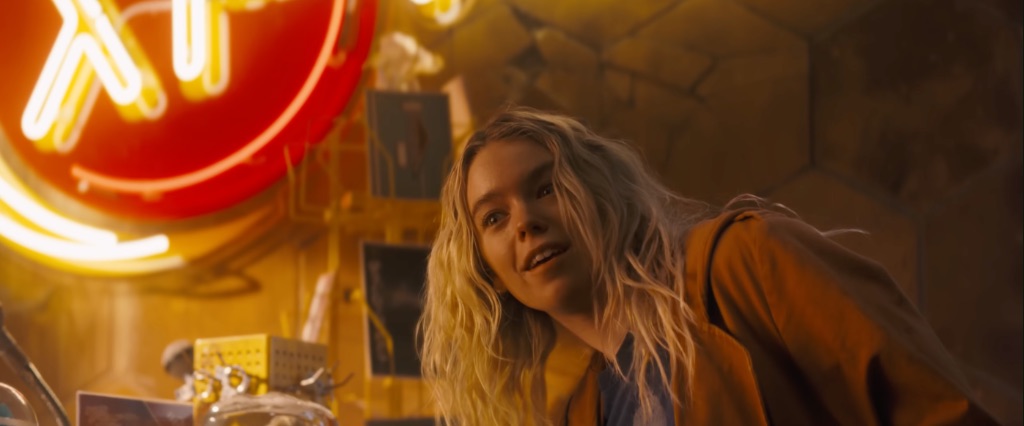
When I went to see Supergirl, they gave everybody a movie-branded copy of the first issue of Supergirl: Woman of Tomorrow. That’s a pretty bold strategy! Most of the people who wanted exactly what this movie delivers — basically, a less funny Guardians of the Galaxy movie — are probably not going to think Woman of Tomorrow is that special. And those of us who loved the comic are just going to focus on how much the movie comes up short.
It’s not bad. The performances are all good, Milly Alcock in particular; it’s suitably weird and a significant change of scenery from Superman; and there is plenty here that feels like has the sense of people genuinely wanting to do justice to source material they love, instead of just crassly building a movie franchise. But it also doesn’t do anything exceptionally well, so it ends up feeling like a mid-grade entry to the MCU.
Which is unfortunate, because it needed to do something exceptional to be able to stand out. It’s coming at a time of peak super-hero movie fatigue, but also as an early part of laying the groundwork for a new cinematic universe. As it is, it feels like if Marvel had gotten everyone hyped about super-hero movies with the release of Iron-Man, and then followed it immediately with Shang-Chi. An appealing lead actor and an interesting change of setting, in a movie that’s ultimately pretty forgettable.
I’d heard that Supergirl wasn’t going to be a direct adaptation of the Woman of Tomorrow comic, but honestly I’d expected the movie to deviate more than it did. As it is, it borrows the same premise, characters, and many of the exact same scenes, but changes them around in ways that, more often than not, don’t work nearly as well. And it adds Lobo.
The specific changes from the book are pretty interesting, but going into detail about any of them would require spoilers. Overall, though, the whole movie feels like a perfect example of how really good ideas get whittled down over the course of an adaptation. Some things were undoubtedly concessions made to studio execs or marketing teams, but there are almost as many examples of good choices. I probably would have made the same choices, in the same situation. Choices that each make sense on their own, but have this cascading effect of making the end result much less powerful and effective.
Everything is Brown and Gray
This is especially noticeable when you look at the art of the comic, which manages to make even desolate, ravaged worlds look like high fantasy. It’s also noticeable when compared to Superman, which felt so bright and colorful1Even though a significant part of it is set in the Arctic!, almost as if it were a direct rejection of the way Zack Snyder depicted everything in the DC Universe.2And it’s even noticeable compared to Masters of the Universe, which proved you don’t have to be an inspired or even good movie to still be colorful.
As a deliberate contrast to Superman, it makes sense. This movie’s whole purpose is to establish Kara Zor-El as a distinct character, instead of just “Girl Superman.” I really liked this spoiler-free review of Supergirl from Jenna of Go Read Some Comics, partly for calling out the long and surprisingly complicated history of this character.
Originally she was conceived as basically “Superboy, but for Girls” and she was given a back-story of the type that was constantly being used during the silver age — um, actually, there was another survivor of Krypton, Superboy’s teen cousin! — but becomes super dark and tragic when you try to translate it into more grounded stories. That’s meant people have never known quite how to handle the character, ranging from just a Superman surrogate, to someone so traumatized and angry that she’s constantly on the cusp of becoming a super-villain.
So there’s an implicit mission statement for this take on the character: all of Superman’s powers, but darker, edgier, and more realistic than optimistic. That extends to the overall look of the movie. I have to wonder whether there was some good old-fashioned Hollywood BS that was wary of its looking too much like The Marvels as well. Can’t have all these super-hero movies about women, after all!
Lobo is There
Leaving the movie, I realized I didn’t mind the presence of Jason Momoa as Lobo; I just couldn’t figure out why he was there. Beyond the obvious facts that he has preternatural levels of charisma, and that he basically looks 90% like Lobo right out of the box. And he nails the character, such as it is. Getting across all the swagger, but without ever once feeling like he’s trying to steal the show or become the true star of Supergirl.3Contrast with The Rock as Black Adam for an example of how you can be an appealing actor with a ton of charisma but still not work as a movie anti-hero.
I don’t know the whole story, but I’d still bet almost anything that he’s in the movie because James Gunn wanted him in the movie. He’s not really an obscure character, but he’s difficult to use, especially when people don’t get what he’s about. But he is a great example of how big and varied and weird the DC universe is, once you get outside the three or four most familiar characters in the Justice League.
As I understand it, he was intended to bring a little bit of the 2000 AD feel to DC Comics: a satire of the grimdark trend, like a much more subtle Deadpool. But it was too subtle for DC audiences of the 80s and 90s, who embraced him for being exactly the thing he was meant to satirize.
In any case, he doesn’t do much for the plot of Supergirl, and frankly gets in the way, but it makes sense why he’s there: he’s an example of everything Kara isn’t. What makes her strong isn’t her power set or her indestructibility, and what makes her appealing isn’t her cynicism or sardonic wise-cracking.4Although I admit I did really appreciate her calling an alien “Squidward.” It’s her drive to do good, an idea instilled in her by her parents, and one the movie keeps repeating.
The problem is that there’s not space for him in this story. He’s too big to be just a cameo; that would’ve been more fun, but would’ve just drawn attention to how brief his screen time was. As an armchair screenwriter, I can imagine hitting harder on the scenes with him and Ruthye, both to make her understand how she doesn’t want to be turned into a killer, and to make her appreciate how different he is from Kara. But they chose not to give any of his scenes any real depth, presumably to keep him feeling like chaotic fun.
So instead, the scenes with him involved, and the finale, just devolve into being… well, Zack Snyder-esque takes on the DC super-hero movie. Gray slugfests where the stakes aren’t really character-based so much as how much Kryptonite you can throw at the hero to make the fight longer.
“Truth, Justice, Whatever”
Supergirl basically assigned itself two jobs: to establish Kara as a unique character and where she’ll fit into this new version of the DC universe, and to adapt Supergirl: Woman of Tomorrow. I don’t think it did a great job with the latter, but I was very pleasantly surprised by how well it did the former.
I’d feared the worst, especially after seeing the trailer. The brief cameo at the end of Superman was a lot of fun, and it had me looking forward to seeing an entire movie built around the character. But the more I thought of it, the more I wondered: what character? She was really little more than “intergalactic super-powered party girl who loves her dog,” and how is that interesting for more than a few minutes?
Then the marketing for the movie started picking up, and it had the vibe of needlessly undermining everything that made Superman such a pleasant surprise. Optimism and fearless corniness? Nah, pure early 2000s edge is the real punk rock! This is a wild child who gets drunk and goes to mosh pits and gets in bar fights!
Krypto is even pissing on a copy of The Daily Planet with a picture of Superman on it! Can you believe they went there?!
Not to mention the weird decision to play up the “Kara as Star Lord” connotations, having her listen to James Gunn-approved music on a vintage iPod with orange foam headphones. The whole movie seemed deliberately trying to drum up Guardians of the Galaxy nostalgia, seemingly unaware that this movie wasn’t nearly as funny, or even that one of the key ideas of that whole franchise is that Peter Quill isn’t as cool as he thinks he is.
It all gave the feeling of a movie that was trying too hard to be cool. Exactly like the people who were either unwilling or unable to pick up on the irony of a character like Lobo.
And it seemed especially at odds with the version of the character in Woman of Tomorrow. That story used the premise of True Grit, transported it to a high fantasy/sci-fi setting, and recast Rooster Cogburn as a more mature version of Supergirl. One who was distinguished from Clark Kent not just based on age and gender, but motivation. She couldn’t be driven by optimism, because she had seen far too much evidence that the universe is deeply unfair, and it was full of banal, careless, random evil. She doesn’t do good because she believes people are inherently good; she does good because there’s simply not enough good in the universe.
It was a fantastic way for the comics to take a character I’d never cared about5I got into comics around the time of Crisis on Infinite Earths, and they’d already run out of ways to try and make sense of the character, so they just wrote her out of existence, and made her not just interesting, but a new favorite. You can totally understand why they’d choose this story to drive her DCU origin. But they could never have worked the same.
The comic is trying to make a solid, “adult” version of a character from decades of continuity that includes a super-horse that is secretly a special cursed boyfriend, and has Kara flying to the end of the universe to outrun a magic ball. The movie is trying to introduce a character who only arrived on Earth a couple of years ago. They’re at completely different stages of their lives, both in the fiction and outside of it.
So the movie is a story of Kara finding herself and finding her home, grafted onto a story that was about a different version of her who had already figured that stuff out. And the best way it represents this is with her super suit.
Unlike Woman of Tomorrow, Kara Zor-El in Supergirl doesn’t wear the super costume for most of the movie; she’s in her jacket (from the comic) and street clothes. There’s a flashback scene to Clark giving her the costume and explaining that it’s designed to stand out as a visual symbol, to let people know instantly that they’re there to do good. This comes along with memories of her parents telling her that she needs to do good. She doesn’t have to be nice, and she doesn’t even have to be kind, but she needs to do good.
Possibly my biggest problem with Supergirl is that it treats Krem of the Yellow Hills as the main villain, the character at the center of our heroes’ story, the main obstacle that they have to overcome. Woman of Tomorrow treats him more like True Grit treats Tom Cheney: more of a MacGuffin than a villain. A symbol of that random, banal, unmotivated injustice that fills the world. It’s not simply that defeating him won’t bring any sense of justice or satisfaction, it’s more existential than that. Our hero defining her story in terms of him would do nothing but diminish her.
So the movie somewhat undersells — and later, frankly, undermines — its best moment: the moment when Kara chooses to put on the suit. To stop seeing herself as a person with no people and no purpose, but to declare who she is and why she exists. She chooses to do good.