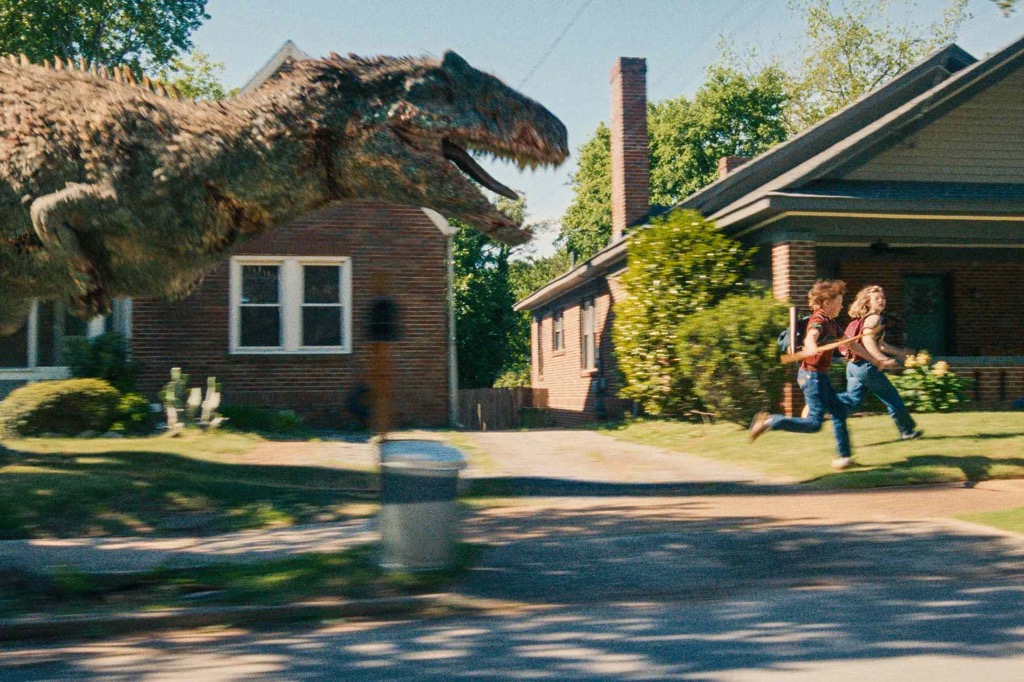
The one moment that changed my impression of The End of Oak Street was during the end credits. The man sitting next to me turned to the person he was with and said, “That was such a good movie.”
I’d been sitting in the theater practically fuming over what a bad time I was having, mentally deducting a half-star from my rating for every grievance, doing the “whatever, I guess” gesture whenever the movie made a decision I didn’t like1Killing characters, putting animals in peril were both at the top of the list, getting angry at the movie for wanting the image of dinosaurs in suburbia without knowing where to go with it, getting angry at myself for expecting something different. All while surrounded by people who were just sitting there the whole time enjoying themselves.
To be clear, it wasn’t a case of my heart growing three sizes, my realizing I’d been a big ol’ grumpus, and deciding to meet the movie halfway and appreciate it for what it was. I’d gone in expecting the “fun romp” that I keep seeing people describe it as, but I thought it was a nearly relentless downer. Bad stuff is already happening before the really bad stuff starts happening. And then it gets worse, as it piles more and more onto these not-particularly-likeable characters.
I also frequently see it called “Amblinesque” or “Spielbergian,” and I totally get why people say that. But it either feels deliberately opposed to including any of the elements at the core of an early 80s Spielberg movie, or just unconcerned with how those movies work beyond what happens at the surface level. The comparison that kept popping into my mind was Close Encounters of the Third Kind, except if it was entirely about Richard Dreyfuss’s character’s familial dysfunction, or a single mom panicking over her toddler’s abduction.
It was almost entirely humorless, except for one scene that worked well, which ends with Denise (Anne Hathaway) taking a polaroid picture of Greg (Ewan McGregor2Who I like a ton, but was doing such an odd American accent that I wondered if he was going to be revealed to be a Starman or something). I’ve already seen lots of people calling that scene out in a I can’t believe they went there! or A Spielberg movie could never doing that! sense, and I mean, calm down, Beavis.
Spielberg could have done that, he just almost always chose not to. Go back and watch Jaws again, and see how that movie is funnier than you remember, since it injects light-hearted moments throughout the drama and tension, when they’re most needed. Go back and watch Jurassic Park again, and be reminded how much of it is “we are incredibly stoked to see dinosaurs” before it turns into “dinosaurs are horrifying.”
For that matter, look at how the movies are structured as action movies. Jurassic Park is the closest analog to The End of Oak Street for obvious reasons, but even as a monster movie, that ostensibly has curmudgeonly leads3Although good luck making Sam Neill unlikeable in anything. Even in Event Horizon and In the Mouth of Madness, I was still rooting for him on some level. I haven’t seen Possession yet., there’s never a sense that the characters are in a hopeless situation with no clear objective they’re trying to achieve. The bulk of Oak Street has characters who can only guess what happened and have no solid idea of what to do next.
While I’m griping, look at how the movies that Oak Street references use camera flourishes like dolly zoom and split diopter. It’s always used for maximum impact: this is the moment where Brody realizes the beach isn’t safe. This is a crucial moment to focus on two characters simultaneously, and the surreality of seeing both in focus is what draws attention to what’s being said or shown. Oak Street, meanwhile, uses split diopter all over the place4I didn’t notice any of the already-overplayed dolly zooms, for what it’s worth, including an entire scene where every shot uses it. It was especially noticeable since last week, Teenage Sex and Death at Camp Miasma got a laugh from a Burbank theater audience for using split diopter in an unnecessarily mundane scene, for humorous effect. In Oak Street, it just pissed me off.
So hearing the person next to me make a simple declaration of how much he enjoyed the movie didn’t make me enjoy the movie, so much as make me nostalgic for a time when I would’ve been a lot more likely to enjoy a movie like this. Back in my phase where I thought Spielberg was too schmaltzy and corny, and I would’ve been more on board with a movie that delivers on the image of “dinosaurs in a suburban American neighborhood” even if it didn’t have a clear idea of where to go with that image.
That would’ve probably been around 1982, which is when The End of Oak Street is set. And from the start, I really appreciated how much the movie fully commits to the bit of being a period piece. It all feels like I remember it. Bikes and libraries and collect calls and family dinners and polaroid cameras. Everything is kind of brown. Even the songs used: there’s a scene that plays “Valerie” by Steve Winwood, which is an immediate sense memory of the early 1980s for me. Because it’s in this downer of a movie, it plays when a miserable teenager gets into the big family car in the garage to sing along to it and cry.
I realized that the movie is so good at conveying the sadness of the early 1980s in suburban America, which is almost always depicted with neon bright colors and leg warmers and cassette tapes and having enough money to spend all your time in malls. Oak Street reminded me a lot of It Follows, which might seem like a fatuous observation, but it’s not for me — for some reason, I conflated It Follows with Don’t Breathe when the two movies came out, and I mistakenly thought David Robert Mitchell was the writer/director of the latter movie. But It Follows also did a phenomenal job of capturing that feeling of deep melancholy that comes with nostalgia for adolescence. I was always at least a little sad back then, but I wish I was back there.
That’s why I want to be clear that all my gripes aren’t actually an accusation that “the people making this movie didn’t understand how 1980s Spielberg movies actually work.” I believe they’re all deliberate choices to do something that evokes the golden age of Amblin Entertainment, but is trying to do something different.
As further evidence for that: I spent much of the movie wondering (since it doesn’t use opening credits) who did the music, since it was often jarringly over-the-top and weirdly tonally “off.” At the end, I saw that it’s by Michael Giacchino, and whether you like his music or you don’t, it’s very very hard to make a convincing case that he “doesn’t get the movie.” The effect in The End of Oak Street is that it often feels exactly like what a movie in the early 1980s would do with its score, even if it didn’t quite work with what the scene was actually showing.
I won’t be so reductive as to declare that “the dinosaurs aren’t the point,” because they most definitely are, but I will confidently declare that when the movie jumps straight to the horror without giving us the scenes of characters being awestruck by the majesty of non-threatening herbivores, it’s for a reason. I’m not even sure that it’s consciously deliberate, but it still felt very intentional.
That intent, I think, is not to present a version of what action/thriller/monster movies in the 1980s were like, but what the 1980s were like. Those movies, no matter how much they showed people in danger or meeting gruesome ends, were escapism. So when Oak Street spends so much time with a family in the early 1980s who doesn’t know why terrible things are happening and doesn’t have a clear idea of how to do anything beyond survive as long as they can: yeah, that tracks.
It almost feels like an anti-nostalgia movie, a rejection of the conservatism that’s built into nostalgia. A reminder that no, things weren’t actually better back then. That the teenage girl in a car crying and singing along to “Valerie” isn’t just a needle drop, but a depiction of someone who was already feeling overwhelmed before dinosaurs started ripping apart her neighbors.
There are other ideas that are suggested throughout Oak Street, initially reading as the kind of character development that would flesh out an 80s monster movie before it gets to “the good stuff,” but here feels like commentary on the decade itself. Faith and religion vs science, presented as a question of optimism vs hopelessness. The slow thawing of gender roles that had been frozen for decades. Classism and wealth inequality, with kids wondering what private school must be like, and the literal goal for the story being a rich couple’s house at the top of a hill.
There’s even a suggestion that the idea of small town neighborhood community — which so much conservative nostalgia likes to emphasize as the backbone of a better, happier time — was more performative than genuine. There are plenty of neighbors casually killed off in the backgrounds of shots, but the camera seems to spend an unusual amount of time following one nuclear family — almost identical to our main characters, although not white — that we can only assume drives off to meet their doom. During the movie, I wondered “why is this frustrating downer of a movie drawing attention to them, which just leaves us wondering why we should care less about them than our main characters?” By the end of The End of Oak Street, I almost felt like the movie was staring at me intently with hands steepled in front of its face, asking, “Why indeed?”
It took me too long to realize that the title The End of Oak Street was a double entendre about more than just a cul de sac. But it wasn’t until the movie was over that I got the third, hidden meaning, that it was the end of a neighborhood community as well.
So I still can’t say that I liked The End of Oak Street very much, but I do think it does a lot of really interesting stuff with the whole concept of nostalgia, and the escapist thrillers it so clearly evokes. I still hate the split diopter, though. Even if it was drawing attention to itself for a reason, it was still way overdone.
(Also there’s one more observation about the ending that I think is kind of interesting, but it’s a major spoiler. Don’t continue until you’ve seen the movie, which I still think is worth seeing, even if you’re only interested in a monster movie about dinosaurs attacking suburbia and nothing more).
First, a digression about Anne Hathaway before jumping right into spoilers. I always give Allison Williams credit for being eager to play deeply unlikeable or at best flawed characters, but I’ve got to give credit to Hathaway for doing similar. She seems to be comfortably in a position where she can get top billing in a movie, and be almost completely unconcerned with the fact that there are lots of people who just plain dislike her, whether it’s irrational or not. At this point in her career, and especially with Oak Street, it seems like she’s not just accepted it but embraced it. She doesn’t have to be likeable to keep getting roles; she’s free to focus on who the character is.
Which might be a long-winded way of saying that I really disliked Denise through much of the movie, but I can totally see why it was the right choice.
Through at least the first half, I got the sense that we’d picked up the story at the point where she was already irredeemably bitter. You could totally understand how she’d gotten to that point, but even knowing that didn’t make me feel sympathy so much as, “Read the room, ma’am. It’s the 1980s. Everybody’s got shit they’re dealing with, and they’re trying to keep it together.”
That’s why I think saying “Amblin movies wouldn’t show dinosaurs fuckin’!!!” is shallow, beyond just the obvious. The more interesting things they wouldn’t show: gender roles that obviously left women feeling repressed and unfulfilled, but also overwhelmed men who felt like total failures if they couldn’t be the sole providers for the family. Teenagers struggling with their sexuality during a time when the media refused to even acknowledge that gay people existed beyond the broadest of stereotypes. And bona-fide legitimate economic anxiety.
Not “economic anxiety” in the sense that The New York Times and other corporate media have used it all throughout the 21st century: as a euphemism for bigotry and selfishness. This is real economic anxiety, the early 80s variant that had middle-class people seeing all of the wealth going to the ones living lavishly on television, but not trickling down like it was promised to. All while feeling that it must have been a personal failure on their part, instead of the truth that all the safety nets of benefits and community support had been taken away without replacement.
That’s all why I think the ending of The End of Oak Street isn’t as silly or shallow as it might seem initially. Again, back during the golden age of Amblin Entertainment, it’s the kind of happy ending that I would’ve mocked relentlessly as being hopelessly corny and undeserved. Everybody lives! Even the dog! And plus they’re rich now, because Denise has been lauded as a hero and written a best-selling book! Even dad is out there, very much alive, and barbecuing like he promised! And the daughter’s there with her new girlfriend and everybody’s cool and happy with it!
Well, okay, not everybody lives. That Latino family piling into their station wagon, for instance, including the young daughter looking at dinosaurs out of the car window, which almost definitely eventually ate her. The bully kid trying to defend his little brother with a broken arm. None of the son’s or daughter’s school friends. None of the various cats that get eaten. It’s actually only the people that Denise knows or likes enough to call.5Collect, which I thought was a nice touch.
Since there are so many indicators of wealth mentioned throughout, antagonists who reveal exactly why they’re being antagonistic, and a climb to the top of a hill where the wealthy librarian’s family lives, with the deus ex machina conveniently blinking just outside their multi-story home, just a leap-of-faith away, it’s hard not read it as a commentary on wealth inequality.
The kind of commentary that an 80s dinosaur movie wouldn’t go into, both because it got in the way of the action and made everything feel like a big downer, but also because it’s just not the kind of thing that media in the 1980s openly acknowledged. If a non-drama even showed characters who were “working class,” it was almost always used for background character development, and it almost never was an obstacle once the action started. At best, it was a goal for them to achieve, a reward for making it through the end of the adventure. That’s the surface-level reading of the ending of The End of Oak Street: this harrowing adventure brought the family together, made them realize what was truly important, and their reward for surviving was wealth and comfort.
Knowing that David Robert Mitchell is from the Detroit area, I have to wonder how much that was a deliberate connection he was drawing. Seeing an entire neighborhood just wiped out with no warning and no explanation, and only a few people lucky enough to be able to make it out alive and become wealthy in the process.