This post will have spoilers (to varying degrees) about:
- Teenage Sex and Death at Camp Miasma
- The End of Oak Street
- Sleepaway Camp
- Wes Craven’s New Nightmare
- Rear Window
When I wrote about Teenage Sex and Death at Camp Miasma, I’m not sure that I made it sufficiently clear how much I loved the movie. I really think it’s something special. Every idea it presents can spin off into a dozen other, even deeper ideas. But the really remarkable thing is that for as dense as it is, it’s still fun, open-ended, and non-judgmental.
And most remarkable of all: it’s about feeling as much as, if not more than, thinking. It’s not presented as a puzzle box for the viewer to solve, to decipher its one true meaning. Writer/director Jane Shoenbrun almost certainly had a concrete idea of what every image, every line of dialogue, and every moment was intended to represent, but they also seem adamantly opposed to declaring that their version is the “correct” interpretation.
I emphasized that it was “meta” mostly to repeat a joke that’s in the movie. But it is still my main criticism: I kept feeling like I was just on the cusp of really deeply feeling the significance of something, when the movie would present a moment that drew attention to its own artifice. It seemed like being shown something that was profoundly personal and then being kept safely at arm’s length right as I was about to internalize it.
The “meta” joke comes from Kris insisting to a bunch of Hollywood types that her vision for the Camp Miasma reboot was not meta like New Nightmare from horror master Wes Craven. And it’s both a good gag — a clever bit of self-referential humor — and is also completely true. Neither Kris’s Camp Miasma reboot, nor Teenage Sex and Death at Camp Miasma itself, are meta like New Nightmare, since they’re not all that concerned with functioning as a horror movie, and they’re not that concerned with establishing what’s “real.”
I admit I’ve only seen New Nightmare once, and I honestly wasn’t paying much attention. But even when it starts blurring the lines between reality1Like having John Saxon go from playing a fictional version of himself, to playing Nancy’s dad, the “reality” of the movie, and the fiction of the Elm Street series, there’s still a strong sense of which layer is which. I don’t think it’s a shallow movie — you can pretty easily see how it’s got commentary on the franchise, the people who made it, the fans, and the consequences of its fame — but it does feel like the meta-fiction is primarily there to be the premise for a new Elm Street installment. (Or more accurately: to be the premise for Wes Craven to talk about the Elm Street series).
When Kris insists that Little Death is very real and lives underneath the lake, watching everyone, that’s essentially when the movie turns itself inside out. She’s so adamant that it’s not a meta-gimmick, and the depiction of Little Death’s “lair” is so earnest and unsettling, that it suggests it’s not only real within the world of her reboot, but that it’s real within the movie itself. Possibly even real with our world.
The sequences that follow are dense with opportunities for interpretation. It felt as if the entire movie up to that point had been setting up these ideas, and then the conference call, which seemed to be the moment of Kris’s epiphany, started a process of putting all of those ideas in motion. Ideas that range in scale and scope from commentary on how horror movies work, how we watch them, and how we talk about them, to the whole notion of gender, identity, how we define ourselves, and how we repress our true selves.
The idea of Little Death watching through the air vent calls back to an earlier conversation with Billy about filming the movie, and that enigmatic look in her eye in Camp Miasma’s famous scene2And final scene, for all we know, since there’s never any indication of what happens in the movie afterwards: that classic idea that horror movies make audiences simultaneously the voyeur and the participant.
The idea itself is practically Cinema Studies 101, but even when I’ve seen movies that convey it viscerally — Rear Window‘s shot of Raymond Burr looking directly into the camera might be the most famous and effective example — it’s still remained an idea to be intellectually processed instead of really felt. When put into the context of a woman shedding her inhibitions and actually feeling desire instead of just writing it down in a notebook, I got the full impact. And I finally got the significance of Kris’s earlier movie being described as “Psycho from the perspective of the shower curtain:” neither the killer or the victim, but a passive observer removed from everything.
I got a similar jolt of recognition when Kris finds herself as the Final Girl inside the horror movie, stripped to her underwear and a nightshirt, and she’s delighted to realize that it’s finally happening. It calls back to an earlier scene where she’s topless and wearing a skirt, and nervously and awkwardly presenting herself to Billy. Here, though, her reaction suggests that she’s not presenting herself as a woman in peril, a helpless object to be looked at, but as an active participant in a thrilling experience. It’s a clever way to say not that the phenomenon of the Male Gaze doesn’t exist, but that it’s not always the only thing that’s going on. She finds it freeing and exhilarating. It’s a more profound take on the “dance like nobody’s watching” cliche: being preoccupied with how she’s being perceived would’ve distracted from the dangerous joy of it.
Even in the sequences that are broad and silly, which play out like an extended SNL Digital Short, it’s calling back to one of her first conversations with Billy. When Kris is asked to tell Billy about herself, she describes herself as queer, mentions her girlfriend and her girlfriend’s boyfriend, and then talks at length about her work. Billy points out that she’s said nothing about herself. Now, we see Little Death come in and dispatch all of the people who’d been the dominant forces in her life while still leaving her unfulfilled, stripping away the surface layers of her identity to leave the part that’s really her.
And the scene in Teenage Sex and Death at Camp Miasma that I think is the most realistic, the one with all of the layers of artifice stripped away, is the most surreal. It’s when Little Death finally comes for Kris, and he stabs them both with his spear. Sure, it’s slasher movie murder as a metaphor for orgasm, that surface-level interpretation that you might’ve been expecting from the moment you heard the killer’s name. But all of Little Death’s kills that we’d seen up to that point had been either perfunctory or over the top, a fake head rolling off of a fake body, with a geyser of fake blood spewing out of the neck. This was the one scene that tried to make it all look real.
It’s also the one scene that really broke through the fourth wall for me. As the camera held on Kris as her mouth filled with blood, I was wondering “how did they do that?” Not the usual sense of remove you get from watching a movie and wondering what kind of “movie magic” they used to pull off an effect. Really wondering “How did Hannah Einbinder do that, without drowning?” and the longer the scene went on, feeling a little concerned for her safety, even though I’ve been seeing clips from the press junket on Instagram. It was unnerving, and perfectly right for a moment that’s all about someone who’s no longer watching things happen to other people, and is instead experiencing them for herself.
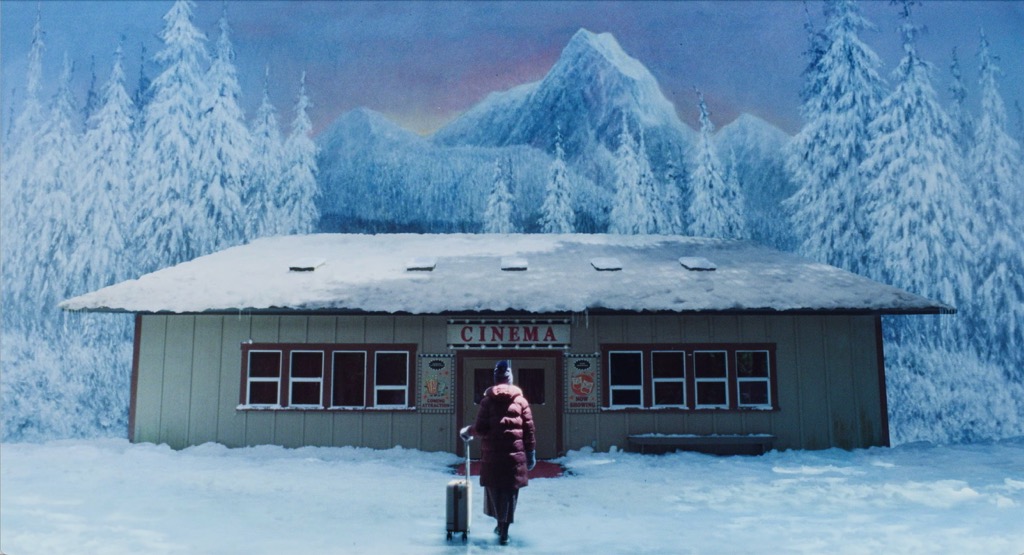
I think it was only possible because the movie was filled with reminders of its own artifice, constantly drawing attention to the fact that none of it was real. It starts with a shaky cam POV shot that’s on a movie set. It has the weird freeze frame and cross-dissolve when Kevin McDonald’s character finds an old, dusty VCR in a closet. And most visibly: the camp itself, which is simultaneously a real summer camp that was used as a movie set and is now being used as a movie set. It’s all shot with Wes Anderson-level symmetry, and there’s an elaborate matte painting of snowy mountains in the background. A shot of Kris and Billy later on, walking in front of the matte painting, seems deliberately set up to show you the brush strokes.
That’s what I’m talking about when I say that Teenage Sex and Death at Camp Miasma is so “meta” that it feels like it’s keeping me at an arm’s length away. It’s also because the movie is so dense with ideas that it always feels as if it’s trying hard to make you understand something. But I also think that it’s an essential part of what this movie is trying to do, since so much of it is about that process of watching a movie. Any movie, but especially a slasher movie.
The only reason I’d compare it to The End of Oak Street is that it’s the movie I saw most recently. But I think that they do have one significant aspect in common, which is that they reference a specific style of movie and use that style to make (what I interpret as) a larger commentary.
It’d be easy to read Oak Street as just a “they don’t make ’em like they used to!” homage to the golden age of Amblin Entertainment, and for all I know, that actually was the entirety of its intent. But I couldn’t avoid feeling like it wasn’t just evoking the early 1980s, but commenting on them. Reminding us of the pitfalls of nostalgia, the fact that even horror and thriller movies of the time were escapist fantasies and not documentaries, and maybe even reminding us that the Reagan era planted the seeds of all of the problems in America we’re seeing today.
But it never reads as a parody or deconstruction of 1980s movies. It leaves the fourth wall completely intact — even if you’re looking at it through a split diopter — and never draws attention to the fact that it might be telling you something more than “dinosaurs are attacking this family.”
So my gut reaction leaving Teenage Sex and Death was wishing it could’ve worked the same way, without that level of remove.
I don’t think it’s a didactic movie; in fact, that’s a huge part of why I love it. You can tell that it’s dense with ideas, but I never felt like it was insistent that I watch it the right way, or that I make the right interpretation, or that I was being given a lecture about cinema studies or queerness or the intersection of the two. In fact, I was amazed at how deft it is at side-stepping the usual pitfalls of a meta-movie. I didn’t get the same feeling of self-satisfied cleverness that I got from The Cabin in the Woods3Which I also love, to be clear, and it didn’t fall into the spirals of self-awareness that collapse in on themselves, like a lot of self-referential works do. It just felt joyful and personal, a filmmaker using everything at their disposal to share their love of horror movies with the audience.
But I still wondered whether I’d have liked it even more if Billy hadn’t felt like a caricature. Or if Kris hadn’t felt so much like a stand-in for the filmmaker. Or if any of the aspects of the slasher movie had felt like an actual slasher movie. So much of the movie is about feeling it instead of getting it, so I wished there weren’t that level of distance. Where I was watching a slasher movie, instead of having Schoenbrun show me how slasher movies make them feel.
After letting the movie marinate for a couple of weeks, I’m not convinced that would’ve been possible without robbing it of its relevance or its impact. That feeling of total immersion that I’d thought was missing was in fact part of the movie’s message, at least how I interpret it. It’s me wanting to be able to split up the movie into what’s “real” and what’s not. But a key part of the movie is the assertion that none of it is real; it’s a movie. And drawing clearer lines between fiction and reality within the movie’s own fiction would’ve robbed it of its power.
Part of it is in how characters are identified or, significantly, not identified. Sarah Sherman’s character is never given a name, but identified on Kris’s phone simply as “Your Agent.” We learn later that Kris is on her phone as “Your Client.” It’s a running gag about how she’s Kris’s closest collaborator on a new creative project, but their relationship is purely transactional.
One of the participants in Kris’s Zoom call with the Hollywood execs is simply named “Queer Assistant.” It calls back to Kris’s earlier assertion that she knows she’s a “diversity hire,” and she’s been brought onto the project to rehabilitate the franchise’s image, since the first installment at least was so overwhelmingly transphobic. But it’s also notable that that assistant is the only person in the call apart from Kris who’s actually well-versed in horror movies. They’ve been hired based on their queer identity instead of their talent or their knowledge, the aspects that are actually personal to them.
That hit home with me, because I’d been guilty to some degree of doing the same thing. I went into Teenage Sex and Death with at least some thought of “I’m about to be educated about the transgender experience.” Even though I was excited by the prospect, it’s reductive and othering. Seeing Schoenbrun first and foremost as a Queer Filmmaker, instead of a huge horror fan, which is probably closer to their true self. And, ironically, the part that I most easily related to.
But as it turns out, I was educated. Just not in the form of a lecture, but in the form of another movie fan showing me how they felt, in a way that let me feel it, too. Among the many ideas in Teenage Sex and Death, one of the most obvious ones is addressing the question “How can any socially aware movie fan, much less a transgender movie fan, feel any kind of affection for a movie like Sleepaway Camp?“
When I first saw Sleepaway Camp, I was trying to appreciate the campy, nonsensical, charmingly inept trash that I’d expected. The movie where a kid responds to “Eat shit and die” with “Eat shit and live,” and where a girl is killed, somehow, by having a curling iron shoved up her hoo-ha. But it was difficult to enjoy it even as camp when there was so much bad taste, like pedophilia, homophobia, and a girl being killed by having a curling iron shoved up her hoo-ha. Oh and also, the premise that raising a boy as a girl would turn them into a psychotic serial killer.4I’m realizing that I’m undermining my own attempt to present a mature and thoughtful essay about the nature of objective vs subjective reality in cinema, and in particular how it relates to the intersection of gender and identity, by repeatedly saying “hoo-ha.” The young woman was killed by having a curling iron shoved up her cooch.
If you take even the slightest step back, it’s an odd reaction: attempting to draw lines between acceptable and inexcusable in a genre that is all about depictions of violent and gruesome murders. Enjoying horror and thriller movies at all, especially slashers, requires the understanding that nothing you’re being shown is real. So any intellectual interpretation of them — like the decades worth of essays examining them to draw out recurring themes of misogyny, racism, transphobia, homophobia, xenophobia, or even political anxieties — requires a careful gerrymandering of the material into pockets of reality and fantasy. “I can excuse all the murder, but I draw the line at racism.”
One of the things that Teenage Sex and Death does so well is suggest the absurdity of all that, while still not giving objectionable material a pass. It can often seem like being a fan of horror, especially trash horror, means shrugging off any larger questions of social responsibility, and declaring that anything goes. “It’s supposed to be offensive! Stop being so uptight and let Eli Roth make all the movies!” But the scene from Camp Miasma with the counselors talking about the origin story of Little Death does a pretty great job of skewering transphobic attitudes. And not even by responding with great offense, but by drawing attention to just how stupid and absurd it all sounds.
The implication is that the objectionable material is still in there, and surrounding it with all of the other transgressive aspects of horror doesn’t make it any less objectionable. But also, it’s not the only thing that a viewer can take away from a movie. And enjoying it doesn’t mean condoning it, any more than it means condoning murder. Horror demands to be experienced first, and then processed or intellectualized later.
And I think a big part of what makes the movie feel so joyful instead of judgmental is that it transforms Little Death’s origin story into their super-power. I initially thought it was oddly specific for the story to emphasize the detail of the camper who lived even and odd days as different genders, and especially to visually illustrate it as clumsily as a movie from the Camp Miasma era would. But by the end of Teenage Sex and Death, when we see Little Death’s existence under the lake, and we take it in the context of everything else, it implies a wonderful kind of expansiveness and inclusiveness. There’s a loose implication that they are a sort of deity, having both male and female aspects, representing both creation and destruction, and encompassing all aspects of existence.
Part of that read comes from the extended murder scene set to “A Long December.” I definitely can’t claim that I understood that scene, and for all I know, it might have been intended to be purely abstract. But the song has a feeling of regret and hope, the repeated suggestion that things will get better. And the scene doesn’t focus on the kill effects like an actual horror movie would, but on Little Death and their movements through the room. It’s all in slow motion and it’s graceful, and it’s the only time we see their face when they’re in the costume. It feels like they’re doing it not out of malice but out of obligation. This is what they exist to do. And in most slasher movies, the killer’s motivations aren’t known until the very end, if it all. For most of the movie, they’re more like a force of nature. Getting top billing and often being the most memorable character, but having no role apart from watching the main characters and then killing them.
Teenage Sex and Death at Camp Miasma is full of overt imagery suggesting that it’s all about a sexual awakening: snow melting, an icy lake melting to free the serial killer who’s a metaphor for orgasms, winter suddenly turning into spring.
But it’s also full of imagery that goes even wider, suggesting a more expansive ideas about experiencing the entirety of life to the fullest. All of the junk food and candy treated like a celebration of sensual experiences without worrying about their nutritional content. And appreciating a trashy horror movie for the visceral experience of watching it, without treating it as if its message were the only reason for its existence.
It deliberately blurs all of the lines between what it treats as real and what it treats as fiction. Billy describes her infamous scene in Camp Miasma in a way that makes it bafflingly ambiguous what was real: she not only speaks as the character, but she describes the scene as if it were her first sexual experience, not as if she’d been an actor filming a character’s first sexual experience.
I was confused by how I was supposed to read that scene. Was she just an actor describing the character’s mindset in the first person? Was she speaking as a young actor, and suggesting that there was sexual abuse on the set? Were the lines blurring between movies and reality, and the actor was becoming the character, like John Saxon in New Nightmare by horror master Wes Craven?
Or had the entire movie been telling me that I was too focused on how I was supposed to read the scene, trying to parse out reality from fiction within a work of fiction, instead of focusing on the feeling that was being described? Of being both observer of her life and participant in it, and the moment when the two merged into one? She was describing the one moment in the film that Kris had never been able to explain, but still resonated with her so deeply that she loved the movie despite its flaws. It was the one moment that felt the most real.