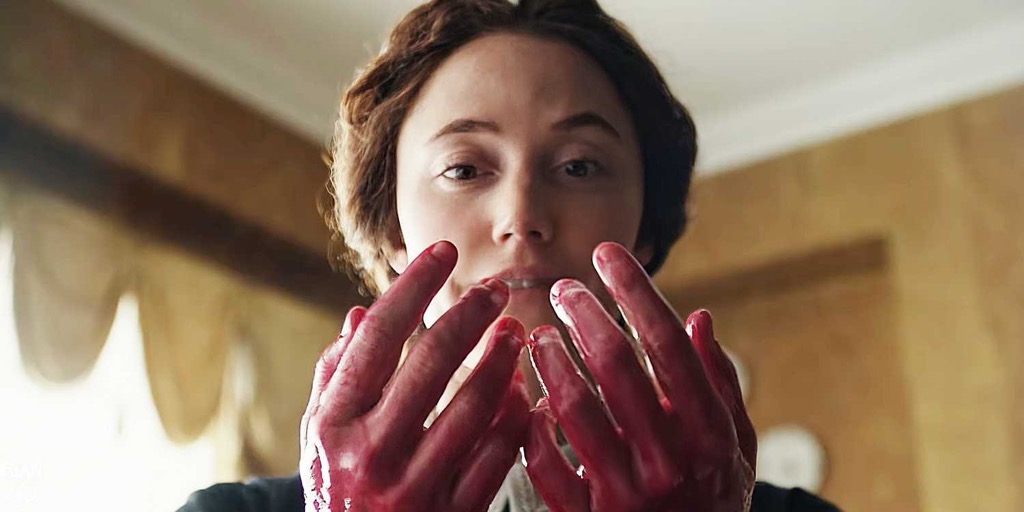
I really enjoyed the book Victorian Psycho, so my heart sank when I found out that a movie adaptation was already in the works. So much of what makes the book special is the specificity of Winnifred Notty’s viewpoint. She’s not purely chaotic, and she’s not calculating and manipulative, either. It could have been nothing more than lurid horror or broad satire without the understated and matter-of-fact way she observed and described everything.
But there were two points in the movie’s favor: one is that it was being adapted by Virginia Feito, the book’s author. The other was that Maika Monroe had been cast as Winnifred Notty.
I’ve only seen two of Monroe’s movies, It Follows and Longlegs, but just those were enough to turn me into a big fan. Not only does she embrace genre movies, she has the presence to command your attention without making choices that are too showy, and aren’t true to the character. Both of those movies require her to play variations on “numb,” and she plays the part with a kind of thoughtful stillness that is, somehow, captivating.
And I think she’s great in Victorian Psycho, to the point that it’s tough for me to imagine any other actor who’d have been able to pull it off.1Jessie Buckley comes to mind, but everything I’ve seen her in gives me the sense of a very good actor. Monroe always seems to be the character she’s playing. She spends much of the movie with a kind of wide-eyed, almost drunk expression, as if she’s taking everything in and letting it all wash over her. Occasionally, she takes on the mannerisms of Data from Star Trek, reminding us that every bit of behavior that seems “normal” has been carefully observed and practiced in private.
That means that she’s inscrutable for much of the movie, especially in the beginning. Without being able to listen to her thoughts, you’d think that she was alternating between periods of clarity and psychotic episodes, instead of operating at a constant level of observation and compulsion, while putting on an act of Victorian propriety when it’s necessary. Which means that voice-overs are pretty much a necessity, which means that I’m very glad Feito adapted her own book.
I normally hate voice-overs. Even when they’re done out of affection for the source material (like in The Life of Chuck), they always seem like a crutch and a cop-out. In this adaptation, I was pleasantly surprised that Feito wasn’t at all precious about her own work, getting the chance to see her favorite passages committed to screen. Instead, she carefully chooses the voice-overs based on how they function, and the essential pieces of information that get across. And they’re mostly limited to information that can’t really be conveyed any other way. After the characters have been established, they’re a lot more sparing, and she chooses a more cinematic moment to get across the idea.
One key example is when Miss Notty is introduced to the children of the Pounds family for their first lesson, which is, appropriately, about knowing the difference between right and wrong. After she asks a question and is met with only silence from the children, we hear her in voice-over matter-of-factly declare that she suspects the children are both idiots.
It’s crucial because Miss Notty adamantly doesn’t believe that any of these people are her superiors. My favorite description in the book is when she meets the family and describes them as “disappointing.” At the same time, she’s not really an anti-hero, and she doesn’t believe that everything she does is right. She acknowledges that there’s an evil inside her, and she has a line later on (in voice over) where she says that she doesn’t know if she swallowed the darkness, or it swallowed her. But she treats it as a part of who she is, along the same lines as her gender or her social class.
That idea is reinforced with dialogue in the same scene, where the daughter Drusilla, the only member of the Pounds family with any sense of the injustices and evils of Victorian society, asks whether Miss Notty thinks it’s unfair that people of “lower classes” are fated to live such miserable lives. Notty answers that it isn’t unfair; it’s just the way things are.
So I was more or less content to treat the voice-overs as a necessary evil, handled about as well as they could be. But the scene where we first see Miss Notty murder someone took the voice-overs and made them cinematic. After a sinister and beautifully-shot setup, we see the flashes of violence punctuated by solid blackness, only hearing Notty’s matter-of-fact observations about what’s happening. It’s really effective, selling the idea that she frequently loses time and acts purely on impulse, even when she’s doing something that was clearly premeditated. And that her mind has a kind of clarity and impartiality, making her an observer of her own bizarre actions as much as everyone else’s.
Feito and Monroe don’t deserve all the credit for making Victorian Psycho work, of course. There’s a lot of great and varied imagery throughout, cutting abruptly between moments of period drama and moments of insanity. I was especially impressed that it’s not simply the same visual tics repeated over and over again. You can never predict how the next psychotic break is going to be visualized, and it’s always jarring and interesting. One of my favorites used lenses2I’m assuming; it might have been more of the movie’s very sparing but effective use of visual effects. Another highlight was when she was looking into a fireplace and saw demonic-looking runes just barely perceptible in the sparks. to put Notty in the center of the frame as she’s traveling through the house, will all the perfectly straight lines of the wainscoting being twisted into curves and spirals.
One of the best and strangest scenes in the book has Notty giving in to one of her compulsions concerning the naive Miss Lamb, and I thought the movie did a fantastic job of depicting a moment that I’d have thought would be completely inscrutable without voice-over. It’s perfectly shot and edited, being both surreal and tense and disorienting, and culminating in a bizarre and suspenseful peek-a-boo with a crying baby. And only at the end of the scene, a perfectly-chosen matter-of-fact voice-over.
And while Maika Monroe understandably has to do most of the heavy lifting, all of the performances are excellent. Everybody involved seems to understand exactly what movie they’re making, which is especially remarkable when the performances have to range from naturalistic to broad3Like for instance, the horrible high-society dinner guests.. Jason Isaacs is particularly good as Mr Pounds, actually improving on the character from the book. He doesn’t feature quite as prominently as in the book, but he makes the most of every moment. From casually and matter-of-factly describing his father abusing him as a child, to a queasy scene of sexual assault in which he actually delivers a pitch-black funny line.4It’s when she calls him “father” and he says, “You don’t need to say that.”
That scene is another example of how this is a confident adaptation. I’d been concerned that the movie was being too sympathetic to Mr Pounds, and it had cut out his whole lecherous subplot. But it’s all consolidated into one scene, and it works well.
I still think I prefer the book to the movie, but Victorian Psycho is a pretty great example of how to adapt an extremely “interior” book into a visual medium, keeping all of its most important ideas intact. It’s far less violent than I’d expected, especially in the way it depicts the climactic night. I’d expected that to be the key set piece of a movie version, so I was pleasantly surprised by the movie’s restraint.
Another great image is when Notty is climbing a staircase in the house during one of her episodes, and she looks up to see that the ceiling has been replaced with a swirling view of the entire galaxy. It’s surreal and disorienting, but it’s also a powerful image to underscore one of the story’s key themes: we’ve all been dropped into this existence with no understanding of how it works and why we’re here, and all we can do is make sense of it the best we can.
While again, Victorian Psycho doesn’t make Miss Notty the hero, it does seem to believe her claim that “I’m the sanest person I know.” It doesn’t suggest that she was a product of her upbringing, but that her psychosis makes her one of the few people who can see Victorian society for what it is. Built on racism, cruelty, misogyny, classism, all passing itself off as politeness, civility, and Christian righteousness.
Leave a Reply