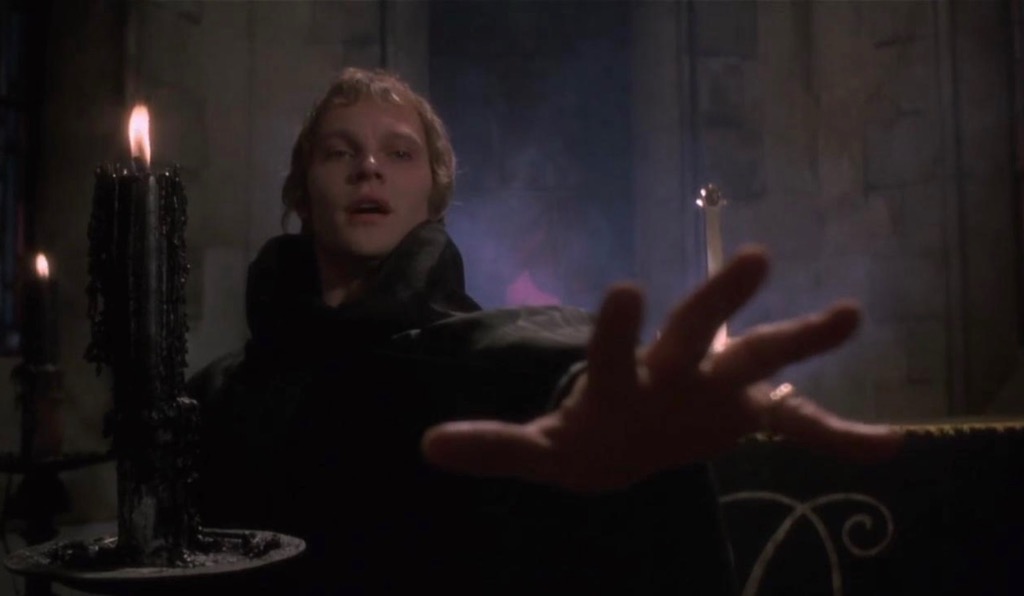
Even though they’re not the least bit scary, I really, really like the Hammer movies about Dracula. I love how the colors are all super-saturated. I love how the lighting is perfect throughout, so everything seems super-sharp1And I’m not just talking about the fangs and silver daggers, lol!. I love how Christopher Lee and Peter Cushing seem simultaneously like they’re slumming and like they’re putting every last bit of their talent into it. I love how Lee’s version of Dracula has all the swagger and pomposity but invariably finds himself going bug-eyed and running away like “oh geez I’m in a pickle is this the end of poor Dracula?!” I love how they never have enough ghastly white make-up to cover up his five o’clock shadow.
But my biggest disappointment with them is probably the same thing that most other people find upsetting: their version of Dracula never lives in a time when he could visit Walt Disney World, which opened in 1971. Thankfully, they finally addressed that in Dracula A.D. 1972. (Spoiler: he doesn’t actually go to Disney World in this movie. But I still felt better knowing that he could have if he wanted).
This one starts with the Count in 1872 in a last stand against Van Helsing on an out-of-control carriage through a London park. The sequence ends with Dracula getting a wooden wheel spoke right through the sternum. Fortunately for him, there’s a creepy guy who grabs Dracula’s magic ring and a bunch of Dracula dust, and he buries it all just outside a church graveyard.
Fast forward exactly 100 years, and we’re with a cringingly straight-edge gang — err, group — of youths who apparently like to party at mortified rich people’s houses, dancing and making out to some of the corniest “rock music” from a featured band that’s about as hardcore as The Lovin’ Spoonful, making a run for it just before the fuzz shows up. They meet up at a bar called The Cavern where they drink coffee and Coca-cola right from the bottle (with straws).
Riddled with caffeine and trying to come up with a new thrill, they listen to their new friend Johnny when he suggests they all visit an abandoned church down by the embankment that night at midnight, so they can all conduct a black mass. You know, for kicks. Some of the kids are reluctant, but they’re convinced that they don’t have anything to be suspicious about with good old Johnny Alucard.
The black mass scene is actually really cool. Johnny’s gotten shrouds for everybody to wear, and he’s got a modern reel-to-reel tape player for music and sound effects.

After things go badly, there’s a surprisingly sophisticated edit that I wouldn’t have expected from a Hammer movie. Some characters are talking about the first victim and deciding she must be all right, and we get a smash cut to a shot of her body as some little kids discover it.
It would be easy to expect too much from the promise of Dracula A.D. 1972 and come away disappointed. Dracula never once sets foot in a nightclub, although the one they do show a lot of would be perfect for him, with purple lighting and a lot of gothic-looking metalwork. And it does very much feel like a bunch of men in their 40s and 50s trying to be trendy and connect with the youth. Our most important young person, Jessica Van Helsing, spends much of the movie dressed as a hippie milkmaid, and in one scene is wearing a tunic with a patch that reads “Have A Nice Day” with flowers.
But if you’re interested in seeing a Hammer take on the whole Dracula formula but in early 1970s London, I think it delivers. The movie seems to be more interested in mimicking detective stories and police procedurals than London youth culture, so there’s a lot of cop show music with a horn section and rhythm guitars going heavy on the wah-wah pedals. Peter Cushing as Van Helsing’s grandson, old-man running through the streets of London as Mannix-style music plays on the soundtrack, is A-number-one as far as I’m concerned.
I also love a moment when Van Helsing, the expert on the occult and lifelong scholar of the lore of Count Dracula, needs to draw a diagram to figure out the cunning cipher behind Johnny’s surname.

It’s especially great when he’s talking to a police detective later on and casually says, “By the way, his name is Dracula backwards,” like it’s totally obvious and the detective should’ve already figured it out immediately.
So no, Dracula A.D. 1972 doesn’t quite live up to the movie you might think of when you hear the title, since it’s more interested in being a contemporary iteration of the Lee-and-Cushing movies than updating the formula in any significant way. But cool vampire hunters and Van Helsing descendants chasing Count Dracula throughout the 1970s would be coming just a year later. Peter Cushing walked through the streets of Chelsea (clutching his side and stopping for breath every few minutes) so that Blade could run.
Leave a Reply