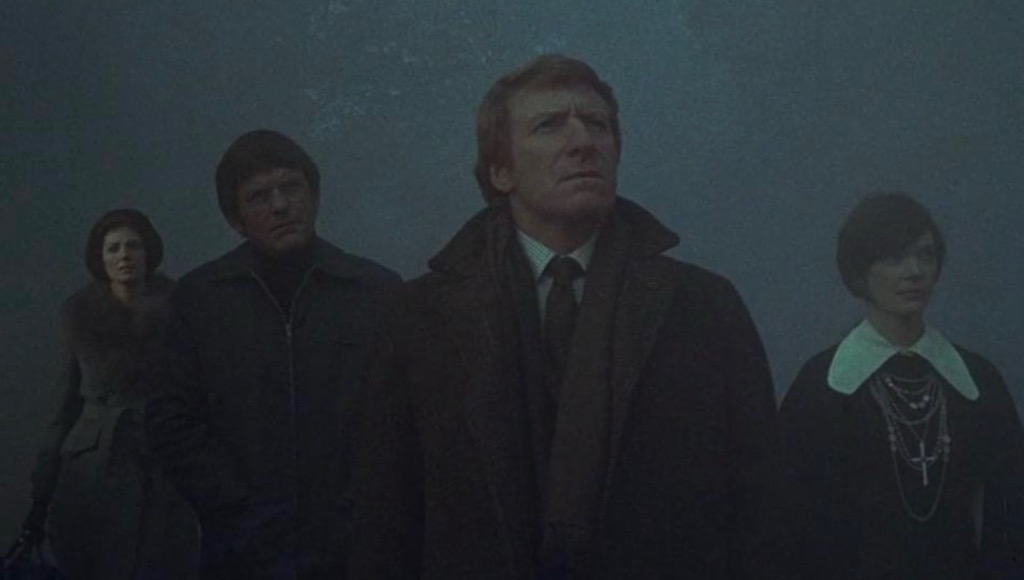
There’s one image from The Legend of Hell House that I must’ve seen at an impressionable age, because it’s been seared into my brain as the definitive image of Hammer Horror. Four very 1970s, very British people approach the imposing gates of a gothic mansion shrouded in fog, and look up at it with steely resolve to find out what’s inside.
I figured that I must not be the only one to be so impressed by it, since Edgar Wright referenced it in the beginning of his trailer for Don’t.
One issue is that it’s not a Hammer Horror movie, at all. And for that matter, it turns out that the most British of British people in the cast, Clive Revill, is from New Zealand. And also, I was incorrect in my assumption that it was probably good.
The premise is that a dying man hires a team of experts to investigate “the Mount Everest of haunted houses,” the Belasco House, to get definitive proof of the existence of life after death. One of the experts is a physicist named Lionel Barrett, who attends with his wife. There’s also Florence Tanner, a young “mental medium,” who happens to be a devout Christian and believes it’s her duty to help guide spirits to heaven. And Ben Fischer, a “physical medium,” who was the only survivor of a previous attempt to investigate the house.
The screenplay is by Richard Matheson, who was adapting his own novel. (Relocated from Maine to England, with “Benjamin Franklin Fischer” now only called “Ben”). It feels very much like a product of the wave of horror novels in the 1970s, that tried to give more modern, contemporary, and adult (read: psychosexual) takes on classic horror stories, offering a scientific take on the supernatural, and a combination of psychological horror and old-fashioned scares.
Which all means that this is a movie where one of the characters has sex with a ghost, believing it’s the only way to guide its spirit to rest. Later, Dr. Barrett is examining the damage done to his gigantic EMP machine and says, “Thank God she didn’t know what to smash,” which I thought was ironic, since she clearly did.
Maybe it works better in the book. In the movie, it just seems to have a very strong idea of what it wants to be, but just can’t bring that to the screen. Dr Barrett is supposed to be the skeptic, but it’s a very mushy idea, since he’s there to do “sittings” where the mediums make contact with whatever energy’s in the house, so he can study the ectoplasm and see objects flying around of their own accord. He just doesn’t believe in ghosts, which felt like a very odd place to draw the line.
To its credit, having a team that’s all completely on board with séances and objects moving around is a nice change of pace from the usual haunted house story. When Miss Tanner has a ghost fling a blanket on her, she reacts more with annoyance than with shock or disbelief.
I also get the impression that the book goes into more depth with the characters’ mindsets being influenced by whatever entities are in the house, tapping into their fears or insecurities and making them do things they normally wouldn’t. In the movie, this just gets reduced to some clunky dialogue in circular arguments that get repeated several times, and the physicist’s wife getting super horny.
Maybe the resolution of the movie works better in the book as well, because it sure as heck doesn’t in the movie. I’m still frankly stunned that it was as dumb as it is. If you’re watching The Legend of Hell House for the first time, stop at around the 30-minute mark and try to predict the dumbest resolution for the story you can think of. The real one is even dumber than that, I guarantee.
But I still can’t hate on this movie too much, for a couple of reasons. First is the soundtrack, which was credited to Brian Hodgson and Delia Derbyshire. Derbyshire was a pioneer in electronic music who’s most well known for arranging the theme to Doctor Who. The score of The Legend of Hill House mostly consists of weird electronic gasps, sighs, and moans that break through the silence at opportune moments. It gives the whole thing a creepy, contemporary feel in a way that the images alone wouldn’t. These are very much people from the 1970s inside a very gothic and very haunted mansion.
And the main reason is just vibes and atmosphere. That image of the group approaching the front gate stood out in my mind because the movie is full of some great imagery. The group walking in front of the house in fog, with everything shot from a low angle. The group entering the dark house, shot from the inside with the people silhouetted against the solid gray light of the threshold. Roddy McDowell’s huge eyeglasses. Pamela Franklin’s wardrobe, which especially at the beginning looks like a mash-up of Mod and Puritan.
The Legend of Hell House sure feels like it’s going interesting places, for about half of its runtime. Then the illusion gets shattered, as you realize it’s actually just going around in circles. And then you wish it had kept going around in circles instead of dropping its finale on you. But at least there’s an attack from a black cat puppet, which is a lot of fun.
Leave a Reply