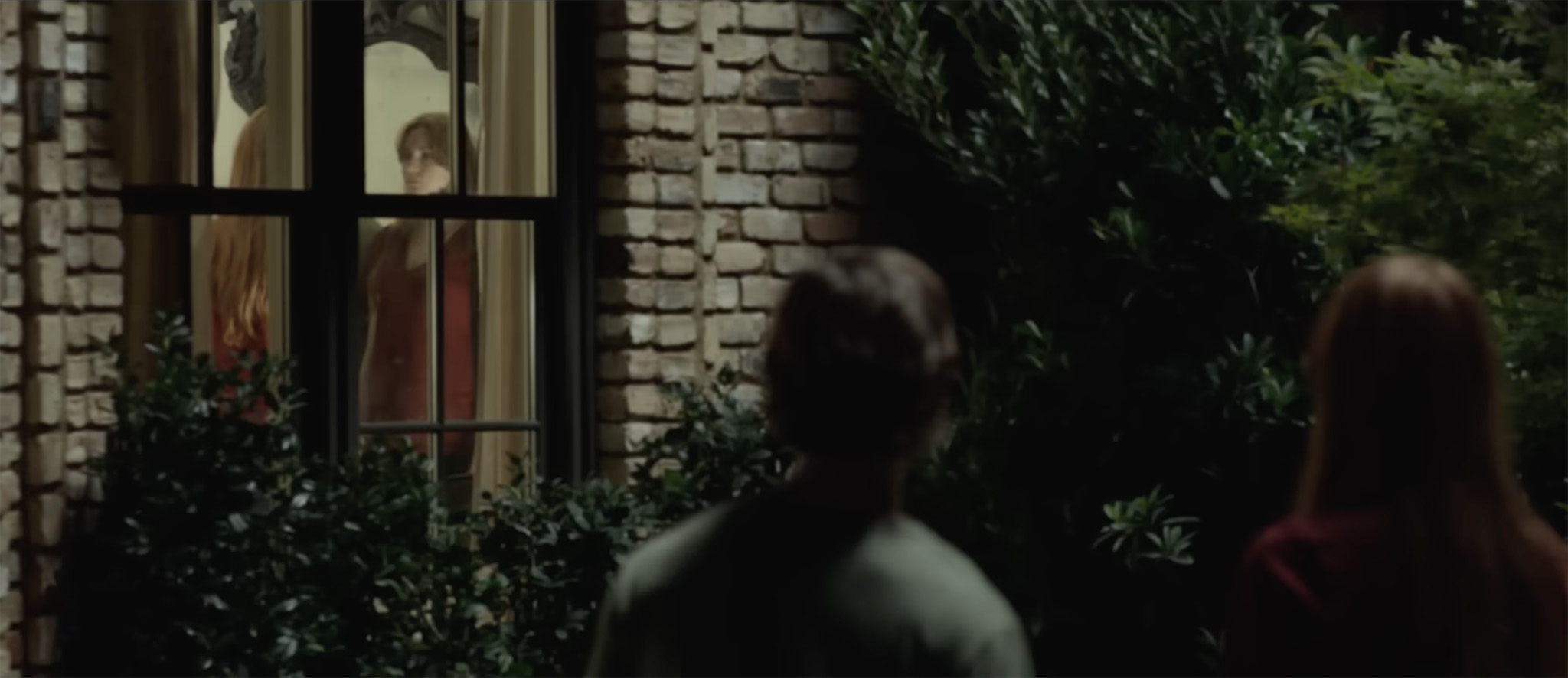
I remember that when I first saw the trailers for Oculus, I decided I wasn’t going to see it for two reasons: one was that it suggested teeth trauma, which is second only to eye trauma in the thing that will guarantee I won’t go see a horror movie. The other was that Karen Gillan’s American accent seemed forced and off-putting.
After seeing it, I can say that Gillan’s accent, and her performance, are flawless; I was just being a jerk frightened of change after seeing so many seasons of Doctor Who. And there is some teeth trauma in the movie, but the parts of it that I could see between my fingers didn’t seem too explicit.
And in total, it doesn’t even matter all that much, because it blends in with all of the other trauma in the movie, and there is plenty of it. Oculus is definitely not what I’d call a fun horror movie.
It’s an extremely effective one, though. In addition to having to watch several scenes through my fingers, I had to pause it several times and get up and walk around for a few minutes, anything to help put off watching more of a situation that was only going to keep getting worse. It’s kind of relentless.
That intensity is especially remarkable when you realize — probably only at the very end of the movie — that the story itself is pretty much a straightforward, even lurid, horror story: a family buys an antique mirror. The mirror makes the parents go insane and threaten the children before they’re both killed. Years later, the now adult children put the mirror back into their childhood home, with the intention of documenting the full powers of the mirror to prove that everything that happened to the family was the mirror’s fault, before destroying it for good.
A huge part of what makes Oculus work so well is that it’s structured as two parallel timelines, showing us more of what happened to Kaylie and Tim as kids while we’re seeing them try to execute on their plan as adults. As our main characters grow more under the influence of the effects of the mirror, the flashbacks get more frequent and more disorienting, as if they’re happening at the same time.
It’s very similar to what Mike Flanagan would later do in The Haunting of Hill House. So you could see Oculus as a trial run for that series, where he would later build on ideas of ghosts as metaphors for past trauma and a story structure of interwoven timelines, while adding some Lake Mungo influences for fun. But in the series, the parallel timelines were mostly used in the same way that they were in Lost: building up multiple hours of intrigue by suggesting mysteries from the past that would pay off in the present, or vice versa.
In Oculus, they’re used entirely as foreshadowing. We find out pretty early on what happened to the family, both in the initial flashback and in Kaylie’s matter-of-fact description of it for her video. So there’s little mystery as to the end of the story, just our minds filling in the details of what must have been happening in the moment. And every time we become aware that we’re in a flashback, we know that we’re going to see something horrible. We’re just left wondering how much of it we’re going to have to watch.
There are other really clever moments of foreshadowing on a smaller scale. One involves a band-aid, and another involves changing light bulbs while being on a strict schedule of remembering to eat. Both are horrific. (Or at least, I assume so; in each case, the second I realized what was about to happen, I was watching the back of my hand).
Oculus starts with a flashback, and then several scenes showing Kaylie acquiring the mirror and then reuniting with Tim after he’s released from a mental institution. It’s at least 30 minutes in before we get a sequence where Kaylie describes all the details of her plan to a pair of video cameras, and then she goes through the history of the mirror, holding up photographs of the people she believes died as a result of being near the mirror.
My annoying armchair filmmaker kicked in at that moment, thinking, “They should’ve just started with this scene. This is a perfect way to establish the premise and get us hooked early, so we can then go back to the flashbacks with more context.” And apparently, that’s exactly what Flanagan did in the short film that inspired the feature version of Oculus: filmed the entire thing as “found footage,” with a man in a room with a haunted mirror and a plan to destroy it. Flanagan passed on attempts to turn the short into a feature unless he was able to direct it, and it didn’t use found footage.
This was exactly the right call, because it adds a couple more layers of tension to the story, as if the existing one weren’t tense enough. Adult Kaylie and Tim have different takes on what happened, with Tim’s entire sense of stability based on the assumption that it wasn’t supernatural. Meanwhile, Kaylie has been our protagonist, but now we have to question whether she’s an unreliable narrator. Has she been driven mad by her unprocessed trauma, believing in connections that don’t actually exist, and seeing things that aren’t real?
Even though the video recordings don’t drive the final movie like they apparently did the short film, they add a huge amount of really effective creepiness. We see the brother and sister doing things that they have no memory of doing, doing things that contradict what we already saw in the movie, or we see things in the video camera that aren’t actually happening. There’s a cool moment where we see Kaylie on the screen of a laptop talking to the camera, even though she’s clearly not there in the room at the moment. It’s not staged as a shocking moment and doesn’t even dominate the scene, but it’s a creepy way of reminding us that because we’re seeing everything from the perspective of the protagonists, we have no way of knowing how much or what we’re seeing is actually “real” or not.
It’s also fun to see more of the details that would become Flanagan’s signature moves: playing around with story structure, spooky characters with glowing eyes, and of course the inclusion of Kate Siegel.
Most of all, though, Oculus feels like an original project from a filmmaker who loves horror and loves filmmaking. Most of the movie is shot in such a straightforward way that it’s disarming; there aren’t really any attention-grabbing flourishes or gimmicks that I noticed. Instead, it lulls you into a false sense of security that you’re just watching a movie that’s going to turn into a ghost story any minute now. And then as you’re trying to process what parts are metaphors for generational trauma or abusive homes or our sense of self-identity, you realize that it’s been layering on this feeling of inescapable dread. Eventually, you start to wonder whether you can trust anything that you’ve seen at all. It keeps its ideas and metaphors simmering underneath, but ultimately, it feels like it’s delighted to not be “about” anything more than a scary and unsettling horror story.