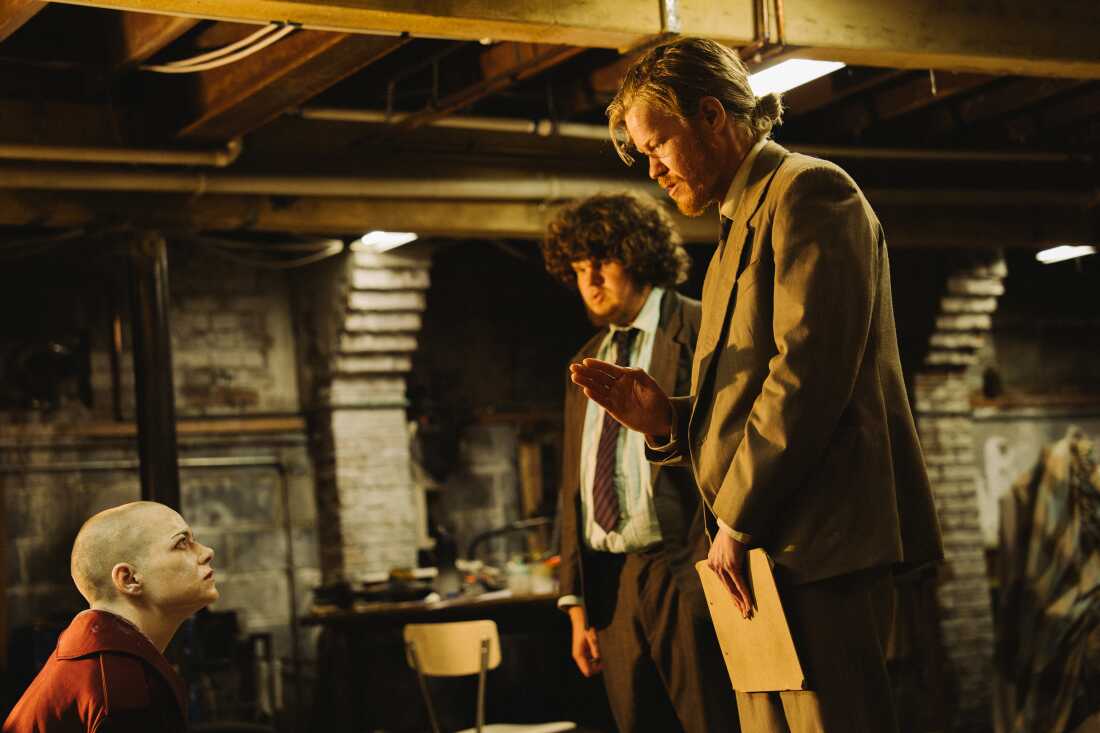
Bugonia is a black comedy horror thriller, a label that might suggest that it has a consistent tone, when it’s actually more like wild shifts which prime you to expect that literally anything might happen next. It’s got a moment of gory slapstick that was one of the most surprising laugh-out-loud moments of anything I’ve seen this year, and it’s also got several scenes that made me more intensely uncomfortable than any horror movie I’ve seen this year.
I probably should’ve expected that, since Poor Things, the only other Yorgos Lanthimos-directed movie I’ve seen at this point, often seemed to take pride in casually throwing in things that were gross or uncomfortable. In that movie, it had a thematic purpose — it’s all about finding wonder and beauty in a world that’s often cruel and brutal — but it more directly felt as if it were eager to make it clear that it wasn’t going to be pulling any punches. I think it’s actually used to better effect in Bugonia, where it illustrates modern society’s tendency to put an insincerely kind and compassionate face on cruelty and reckless disregard for other people.
The premise is that Teddy Gatz, played by Jesse Plemons, is a worker at a fulfillment center for a huge biomedical company led by Michelle Fuller, played by Emma Stone. Teddy is obsessed with conspiracy theories — among them, he’s a beekeeper, and he believe that the company is responsible for colony collapse disorder. He has a plan that he believes will save the planet, and he’s enlisted his kind-hearted and loyal cousin Don (Aidan Delbis) to help him kidnap Fuller. He believes that she is actually an alien from the Andromeda galaxy, and that he can force her to arrange an audience with Andromedan royalty by the time their mothership arrives back in Earth orbit, on the night of the next lunar eclipse in four days. Once on board the mothership, they’ll demand that the Andromedans leave Earth, which will make Teddy and Don heroes for solving all of humanity’s problems.
So the bulk of the movie is a mentally ill man holding a woman captive in his basement, pressuring her to admit to things that are clearly insane. That pressure descends into violence and torture, all while Fuller tries various tactics to take command of the situation and convince one or both of them to release her. We also gradually learn more about the trauma that Teddy’s gone through, with surreal flashbacks to his mother’s illness and experimental treatments conducted on her, and a cop clumsily trying to atone for abusing Teddy years ago as his babysitter. It’s all bleak and awful, and it makes most of the movie’s humor of the pitch-black variety.
The “meat” of Bugonia is made up of the scenes between Teddy and Michelle. He asserts his beliefs about the Andromedans and their tactics with the confidence of true conspiracy theorists who’ve spent years doing extensive research — in other scenes, the often-bizarre soundtrack plays soaring and majestic music showing how he thinks of himself as a hero who’ll be praised once his plan succeeds. Meanwhile, she’s used to being in control at all times, and being able to “dialogue,” negotiate, or threaten her way to victory in any situation. She tries multiple tactics to keep the men talking, all while maintaining a tone of practiced sympathy and compassion.
My favorite part of Bugonia — apart from the moment of gory slapstick I mentioned earlier — is a sequence when one of their “dialogues” falls apart, and we see the aftermath. While they’ve been talking, each confident that they’ve got the upper hand in the conversation, he mispronounces the word “shibboleth,” and she can’t help but correct him.1And it’s a testament to the often-quiet brilliance of the screenplay that “shibboleth” is the word they chose, since it’s an indicator of their respective social status: someone with formal and likely very expensive education vs. someone who probably read the word but had never heard it pronounced.
He’s outraged by her condescension, and he hits her, putting a shockingly violent end to the scene. In the next scene, we see the outside of the house, and his car shaking back and forth as he sits inside, screaming in impotent rage while Don stands by helplessly. When Teddy gets out of the car, Don puts a hand on his shoulder to comfort him.
It’s such a good sequence because it demonstrates how Bugonia not only navigates wild shifts in tone, but uses them to challenge expectations about the power dynamics. I think the movie mocks Fuller’s use of the word “dialogue,” instead of just “talking,” to underscore the idea of people who are saying all the things they’ve convinced themselves are true, instead of actually communicating with each other.
We’re certainly never expected to root for Teddy or sympathize with him, but the movie practically demands that we try to understand what drove him to this point. The feeling of powerlessness as our lives are destroyed by people with no accountability, and the desperation to feel that if we do enough research or take some bold action, we can actually have control over our lives again. There are several earlier scenes where Teddy is trying to convince Don that Fuller’s tears are fake, to try and exploit their pity, and there’s a very real sense that he’s trying to convince himself as much as anyone else that he’s doing the right thing.
Meanwhile, Fuller should by any measure have all of the audience’s sympathy, but she seems Zuckerberg-like in her inability to convince anyone she is really a human being. She’s so thoroughly immersed in corporate speak and insincere compassion, that even when she tries to relate to her captors instead of antagonizing them, it still reads as a manipulative power play. It’s far from the most upsetting thing in the movie, but it’s still an intensely discomforting manipulation of our sympathies to see a kidnapping victim saying exactly the things she should be saying in a horrific situation, and feeling little beyond “I don’t trust her.”
And as a capper to that sequence, Don’s reaching out to comfort Teddy is a sign that he’s possibly the only character in the entire movie who still understands what it means to be human.
For much of Bugonia, I had the sense that it was a little too clever and too arch for its own good. Its dark, or surreal, or brutal elements have a way of distancing you from the material; this movie is way too smart to be straightforward and tell you directly everything it’s about. That meant that I had no idea how it could possibly end in a satisfying way. Any of the obvious possible outcomes would feel, well, obvious.
But even though I think the movie ends well, I also think that the movie doesn’t depend on its ending. It gives you an idea of what it’s about in the opening scenes, it spends a couple of hours obfuscating and unraveling that, and then it goes back to saying “yeah, that’s what it’s about.” It’s a movie for people in a society that’s in threat of collapse, demanding that we at least try to understand what’s happening, to be less certain that we’re the only ones who have all the answers.
I wasn’t aware going in that Bugonia is a remake of a Korean film called Save the Green Planet! At least based on the synopsis2It doesn’t seem to be available anywhere for streaming at the moment, it sounds like the plot is near-identical, and the changes made for Bugonia were all changes for the better. But I don’t think this is a movie that relies on its plot or even its premise, apart from that core idea of people struggling to be convincingly human.