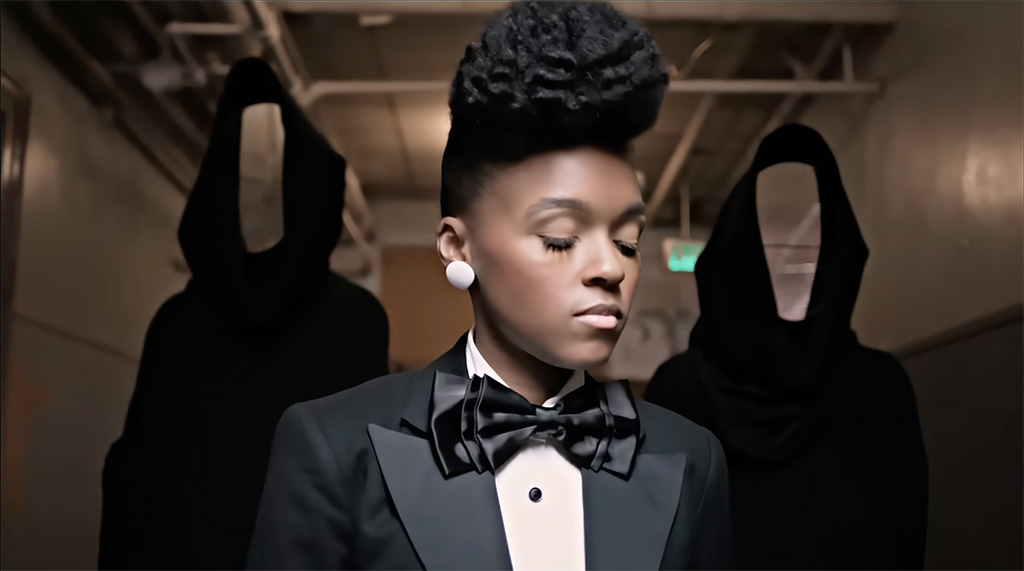
Last month, we went to the LA Haunted Hayride, where two of the non-hayride attractions were an Elvira-themed haunted house (pretty cute and fun, the highlight being a room simulating crawling through Elvira’s cleavage), and “Monáe Manor.” That was a typical low-to-mid-budget haunted house, with a music track that played throughout, and it had video screens of Janelle Monáe in various Halloween horror-themed costumes.
It reminded me how it’s been a while since I’ve re-listened to her earlier music, back when I first found out about her and instantly became a fan. Which seemed weird, since that was only a few years ago.
Haha, no, The ArchAndroid came out in 2010, fifteen years ago. For me, after watching the video to “Tightrope,” featuring Big Boi — not to mention a performance on David Letterman which culminated in helpers coming out to put a cloak around her like James Brown — she seemed to come out of nowhere as a fully-formed super-mega-star with limitless talent and charisma.
Today, the Rock and Roll Hall of Fame has been showing video clips from a recent event inducting Outkast, with interviews or speeches coming from Donald Glover and Monáe. Glover credited Outkast for making it possible for black artists to achieve success with whatever they can imagine, instead of being stuck in the typical predefined lanes.1He said it a lot more eloquently, of course. And in an interview with Monáe, she described selling CDs out of the trunk of a car in Atlanta when Outkast discovered her and cast her in Idlewild. A reminder that she didn’t come out of nowhere, actually.
The thing that still amazes me about The ArchAndroid is that for being a breakthrough major-label debut album, there’s nothing particularly “safe” about it. It’s the second of three concept albums (along with Metropolis and The Electric Lady) where Monáe assumed the alter-ego of an android living in an oppressive dystopian future where dancing and music were forbidden. It’s all over that video to Tightrope, ingeniously including all of the sci-fi world-building she wanted to do, but while feeling celebratory and joyful instead of pretentious.
With Dirty Computer, she kept the ideas of world-building but shed the alter-ego (and the uniform-like suits and hairdo), fully making all of the creativity and imagination expressions of aspects of herself instead of a character. It’s not uncommon to see an artist achieve super-stardom and live a life of performative opulence, hanging out at glamorous parties or extended vacations in exotic locations. It makes me genuinely happy that Janelle Monáe is enough of an over-achiever that she does all that plus remains weird AF. Like putting herself in ridiculously elaborate Halloween costumes and makeup every October, and putting herself in a local haunted house event.
My favorite of her songs is still from way back on Metropolis, and it’s called “Sincerely, Jane.” There used to be more videos of live performances online, but now the best one I can find is from the Sydney Opera House and has a disappointing sound mix. Her incomparable showmanship is still on full display, and I especially love seeing the string section getting in on the act. I mean come on, who else could take down the spectre of Death with finger guns, and then moonwalk across the stage for the big finale?