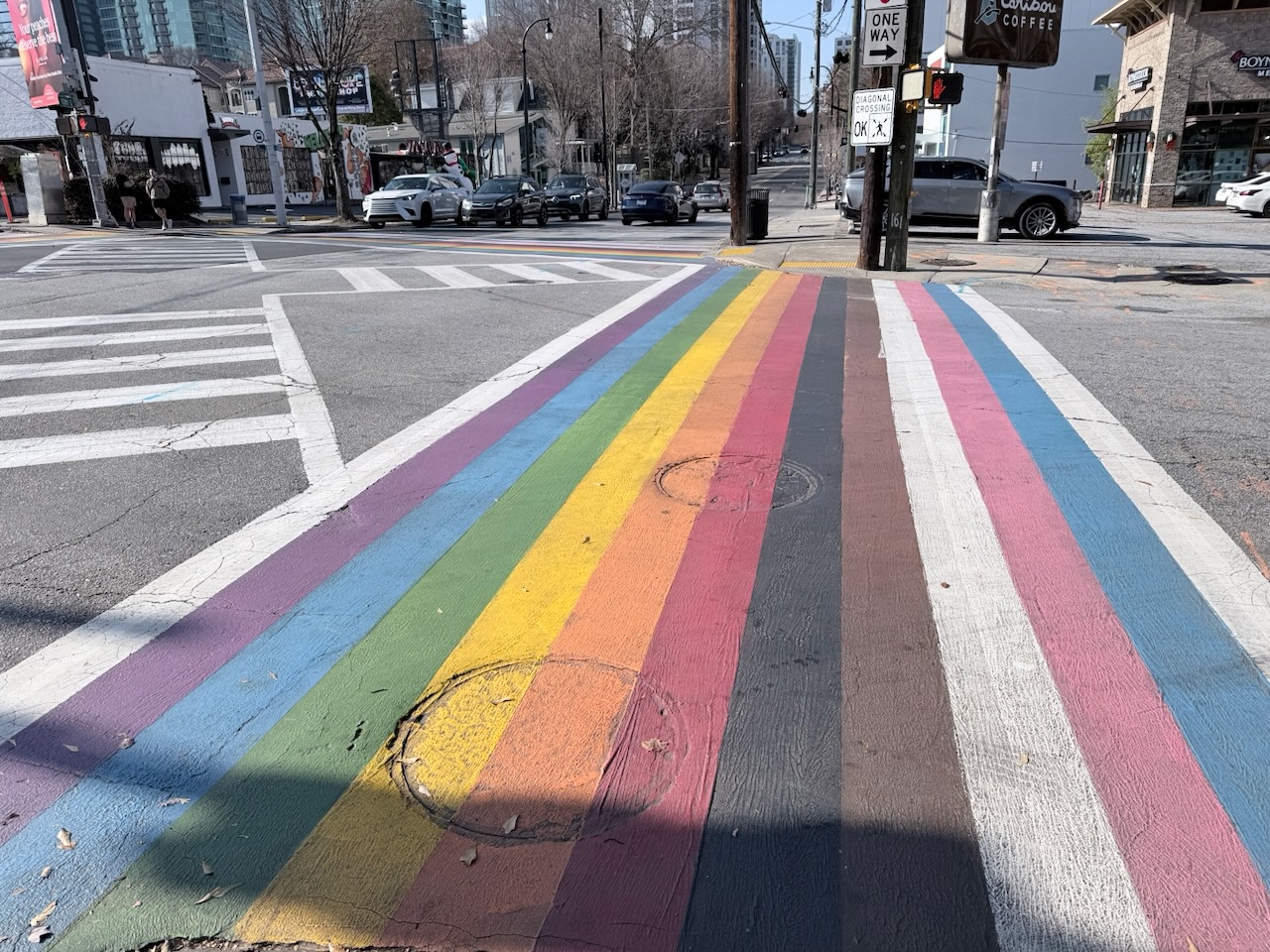
We spent the week of Christmas at a hotel in midtown Atlanta, situated right between the house where Margaret Mitchell wrote Gone With the Wind, and an intersection with pride flags painted in the crosswalks.
I knew that Atlanta has a large population of LGBT people, and it has for decades, but it was still jarring to see such an open, even mundane, display of pride every morning, in the middle of a place that I’ve always associated with repression. Shouldn’t that kind of thing remain safely contained within Little Five Points, at least?
Inside the hotel itself, there was little indication of place; it all looked like you could be at any mid-to-high-end hotel in any American city at Christmas time. Except for inside the bathroom, where there were two pieces of digital collage artwork (which I assume were in every room), combining photos of things that uniquely signify Atlanta: the Fox theater, Atlanta Falcons tickets, a pop top from a bottle of Coke, etc. One of them had the images on top of repeated text reading “Georgia on my mind,” which is fine, and “The city in the woods,” which is bizarre. I spent the first 25 years of my life living within an hour of Atlanta, and I never, ever heard it called that by anyone, ever.
But it was still familiar, in a way, since for as long as I’ve been alive, Georgia has been weirdly over-eager to make up stuff to be proud of. Why not pick “the city has an awful lot of trees?” Really it’s not that much weirder than building your cultural identity around soda, or pretending that people in the southeast are invested in professional sports anywhere near the level they’re invested in college football. And I mean, there’s not a lot to latch onto that isn’t problematic.
Especially for those of us who grew up in the 1970s and 1980s, it often felt like we’d been handed a heritage along with a shrug and a billion asterisks attached to it. You basically had three options:
- Embrace all of the heavily-romanticized notions of the antebellum and pre-Civil Rights south, while furiously insisting that the good parts can be extricated from a society and economy built on white supremacy.
- Go all-in on southern pride, paint the Confederate flag on your truck, reject any accusations from the people who just don’t get it, and gradually come around to the idea that you know when you get right down to it, maybe white supremacists had some good ideas, etc.
- Reject all of it, work to un-learn your accent, and try to build a cultural identity around the most innocuous things you can possibly imagine, like I don’t know, biscuits with gravy, or saying “y’all.”
It’s always seemed like a lot of work, trying to maintain some small level of performative Georgianess, just to have the feeling of being from somewhere. The alternative is being unmoored, a kind of blandly generic American. Is that what people from Delaware feel like all the time?
Even though I did live within an hour of Atlanta for the first 25 years of my life, we rarely went inside the city limits. We always lived in the suburbs, as the circles of white flight radiated outwards, and going into the city was either dangerous, or a nightmare to drive. The former was hugely overblown, even in the 70s and 80s, the product of white suburbanites being generally afraid of cities. The latter has always been the case, and the Atlanta area is still a nightmare to drive, even worse than anywhere I’ve been in LA.1Even the 405. Yeah, I said it.
I’ve seen a lot more of the city as a visitor, and the overwhelming impression I keep getting every time we go back is “inauthentic.” Likely at least partly due to the fact that we tend to stick to touristy areas, but also inescapable. Playing to some made-up idea of what The South is supposed to be like. Like a hack stand-up comedian doing a “white people are like this, but black people are like this” bit, where the stereotypes are either impossibly dated, or just bizarre and completely unrelatable.2For some reason I’ll never forget a stand-up set from Arsenio Hall, where he was claiming that white people carefully and fussily fold just the right amount of toilet paper, while the brothers be rolling and rolling that shit. It never occurred to me that you can just make up nonsensical stereotypes.
But over this last trip, I realized that everything that I tend to think of as “inherently Georgian” is made-up bullshit, too. Not just in the sense that all culture is made up, but in the sense that my home state has a very long history of clinging to stuff that’s just fake. All of the “Lost Cause” bullshit from the Daughters of the Confederacy. The controversy over removing the Confederate flag from the Georgia state flag, even though it had been only added in the first place as a protest against the Civil Rights movement.
There’s long been a cynical inauthenticity to all of it, like people desperate to preserve a heritage built entirely on revisionist history. Even at its most charitable, it’s clinging to an overly romanticized version of a past that most of us don’t actually even remember.
After all, if cultural identity were actually based on cultural impact, then our hotel should’ve been filled with pictures of Outkast and the movie industry. Both hip hop and film production have been Georgia’s greatest cultural contributions this century, but the city and state both seem to be stuck selling themselves with peaches and sweet tea and biscuits and remnants of a 160-year-old war that our side lost.
It was odd coming from Los Angeles to Atlanta, knowing that the city where I live is constantly giving me reminders of the glitz and glamour of the movies, while the city where I’m from is where the movies are actually being made. But it’s also not surprising, since the reason Georgia has been attracting so much production3And why it’s going to lose so much production over the next several years comes down to tax breaks and lack of identity, two things that don’t often come up in tourist brochures.
More and more often, I’ll see a movie and only realize after the fact that it was filmed in Georgia, since it’s been Vancouverized. It’s been used for decades to represent “Any City, USA,” or at least any city in the eastern half of the US, and the productions almost never take advantage of any of the things that make Georgia towns and cities unique. My own home town has a “historic” old town area, which was used for filming a TV series… but only after they re-did it to look like New Orleans.
Which is all a long, meandering train of thought leading me back to pride flag crosswalks in midtown Atlanta. Sure, they’re every bit as performative as painting “y’all” in huge cheugy letters on the wall of your Southern Fusion Cuisine restaurant, or for that matter, painting the stars and bars on your truck. The difference, of course, is that the performance actually means something, and even more importantly, that it’s not aspirational. It represents the way things really are, not the way we want them to be.
Most obviously, it was a reminder to reject the perception that it’s unsafe to be gay in Atlanta, even though I spent most of my life convinced that it was. And more significantly, to reject the idea that this is some modern invention, the result of a ton of LGBT people moving into the city. They’ve always been there; the only recent development is that they’re more free to acknowledge it. The pride flag inherently symbolizes rejecting assumptions about the way things are, and accepting that you’ve got nothing to be ashamed of.
And then more significantly than that, seeing the crosswalks kept making me think “oh, this hotel is in the gay neighborhood.” Which is itself an outdated notion. I was reminded of the Castro in San Francisco, which feels like a gay theme park, full of all the flags and signifiers of “where all the gays are,” but too expensive for most of the city’s gay people to actually live there.
The boundary is mostly imaginary. Useful as a sign of visibility, an acknowledgement that “you’re not alone,” but not a real border of any significance. I remembered years ago, while we were in Piedmont Park in Atlanta, my then-fiancé asked a passing family to take a photo of us kissing under a photo op with mistletoe, and I was mortified, but of course the family did it with no hesitation, and asked us to go back and kiss again so they could get a better shot. Meanwhile, the only place I’ve ever had strangers yell the f-slur at me was in the gay haven of San Francisco, California.
And as long as we’re breaking down fake, outdated notions, why not dispense with all of them? A lot of the things I know to be true about Georgia and Atlanta specifically are based entirely on things I heard from my parents, who lived and/or worked in the city for decades before I was born; and other white suburbanites through the 1970s, 80s, and 90s. Even if my assumptions were true at one point — and that’s a pretty big if — then they’re almost certainly out of date and irrelevant to now.
Over the past few years, such a big deal has been made over “turning Georgia purple.” I’ve always had an image of the state as being islands of progressive Democrats in Atlanta and a little bit in Athens, surrounded by a sea of repressive Republicans. But as with every other place in the United States, there’s a spectrum of opinions and viewpoints everywhere.
I never in a million years would’ve expected my actual hometown, outside of Atlanta, to be predominantly Democratic, and yet that’s exactly how they voted the previous election. Realistically, that’s because the demographics have shifted, and more non-whites have settled there; it’s not as if a bunch of conservative, small-town white people were suddenly convinced to change their minds. But even that is still clinging to the notion of borders and demographics and voting blocks, instead of people.
It all made me realize just how much my thinking has been poisoned by politics over the past couple of decades. The media dividing everyone up into districts and states and even wide geographical areas that we can all understand: this is what southerners are like, this is what The Heartland believes, these are the types of people who live in urban areas.4And then there’s also Portland. Even in the brief periods when we get a respite between campaigns and fund-raising requests, it’s so thoroughly infected the ways we think about each other that we assume it extends to culture and everyday life as well.
Over the past ten years — okay, 20 — okay, maybe more like 55 — it’s felt harder and harder to envision a way forward. It’s easy to have high-minded, vague ideas about unity and progress, but the specifics are where I get hung up; how do you show grace to the people making inexcusable decisions, enabling the people doing irreparable harm?
Remembering that “we’re all just people,” and “there are more good guys than bad guys” and the like are fine as mantras to get you through the day, but how do you act on any of it? How do you push for unity without regressing to a place where you’re just forgiving, excusing, or even enabling the perpetuation of evil?
I don’t claim to have all the answers, but one thing I’ve realized is that my respect for politicians and politics in general has been chipped away to the point of non-existence5Still a supporter of AOC and Zohran Mamdani, though!, but I’ve just shrugged and left it at that. Maybe a good first step is to ask myself: if I hate the cynicism, insincerity, and selfishness of politics so much, why do I still think of things in those terms? Why am I still clinging to ideas about what people and places are like, which were developed decades ago specifically to win an election, based on facts that are no longer relevant, assuming they were ever true in the first place? How about we all stop thinking like politicians and go back to thinking and behaving like human beings?