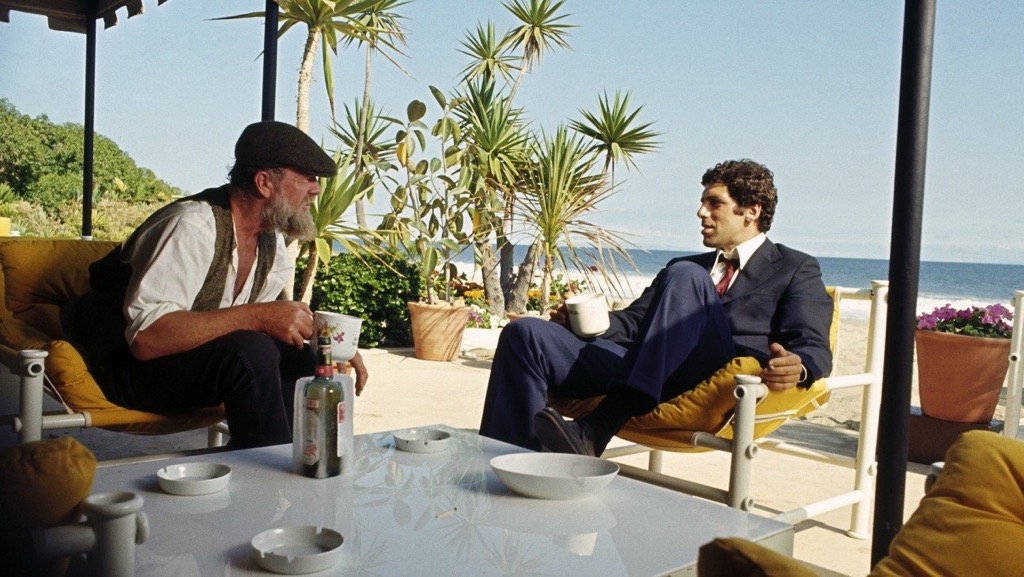
The Long Goodbye is a prime candidate for working through my movie backlog, since I’ve had it on the must-see list forever. It’s long been praised as a classic, by a lot of people I respect. It essentially created a genre of one: the contemporary neo-noir. And it’s a meandering Raymond Chandler mystery starring the coolest private detective.
But it’s also a Robert Altman movie, and that’s given me pause. I think it’s sacrilege for a film school dropout to admit it, but I’ve never had any patience for Altman’s movies.
I believe I understand the appeal: the ones I’m familiar with are mash-ups of Hollywood high concept and cinema verite. Taking something that could otherwise seem inescapably artificial, but presenting it in a style that suggests reality. Languid pacing, long shots that don’t play out as you’d expect, either starting off slow, or petering out without a conclusion, or going off on tangents, or ending without having accomplished much of anything.
And of course, all of the ad-libbed dialogue and crosstalk. If I had to choose one thing that turns me off Altman movies, it’s that.
So I can appreciate how The Long Goodbye uses the style to maximum effect. Classic noir tended to be so hyper-stylized and melodramatic that there was rarely any sense of realism to it. It suggested gritty, hard-edged, true crime drama, but always felt like fantasy. This movie gives all of that a contemporary update: not just the cars, clothes, and language, but the overall tone as well. And it does end up bringing the best of both worlds, the old-school storytelling of a twisting mystery with a naturalistic style that keeps it grounded.
And there’s a lot to like about the movie. The setting of Marlowe’s apartment, for one thing. It’s at the top of a hill overlooking the city, connected to an apartment full of pot-smoking, frequently-nude women, all of it accessible only via an elevator. Marlowe’s distinctive car makes him seem perpetually out of place, known by seemingly everyone in Los Angeles but also oddly unstuck in time. The script efficiently sets up its key points with a concision that I envy, leaving plenty of room for the scenes to drive home character and setting instead of plot. There’s a mix of tones that feels dated but rarely jarring, with bizarre bits of wackiness combined with tension or violence that make everything seem surreal.
Plus, it’s got Sterling Hayden and his beard working together in a memorable performance as an alcoholic larger-than-life writer. The character had to be at least an indirect inspiration for John Mahoney’s in Barton Fink.
In fact, the whole movie feels like a template for the Coen Brothers’ run of Miller’s Crossing, Barton Fink, and The Big Lebowski. I deliberately try to learn as little as I can about the actual making of the Coens’ movies, so as not to do anything to damage my own oversized impression of them as pure brilliance released from their minds already fully formed and perfect. As far as I know, the similarities are nothing more than their also being fans of Raymond Chandler. But it certainly feels like The Long Goodbye proved that it was possible and effective to make modern noir that blends classic and contemporary.
But I’ve got to say that I didn’t really enjoy it. I might have, if I’d seen it years ago, without having seen the movies that came after it. But in 2026, it kept feeling dated, and slow, and often just plain corny.
And the aspect that kind of surprised me: I felt that Altman’s style wasn’t just “not to my taste,” but actively worked against the movie. Marlowe’s constant muttering to himself initially seemed important to establish his character as a sardonic smart-ass, but with all the repetition, it started to feel not like “show, don’t tell,” but “show and tell and tell again.”
For instance: the opening 10 or 15 minutes are all about his interacting with his cat, his neighbors, and the people around town. I thought it was slow but really strong at establishing everything key to his character. Not just to introduce him as a chain-smoking private detective stereotype, but to show what he values and how important it is to him to help people. But all that is undercut just a short time later, when some cops are hassling him, and he gives them a complete account of everything that we just spent 10 to 15 minutes watching.
And as the movie goes on, all of the cross-talk and ad-libbing has the opposite effect of seeming naturalistic. It just draws attention to how much the actors are all performing. It’s a bit like the effect of using shaky cam in a modern movie: yes, that is how an amateur would record everything if the events were really happening, but because it’s so different from the default language and style of cinema, it draws more attention to itself.
It feels like a nitpick, but another thing that was distracting was seeing an entire scene between Mr and Mrs Wade while Marlowe was waiting by himself on the beach. By that point, the movie had established that everything we were seeing was from Marlowe’s perspective, so I spent the entire scene wondering whether he was overhearing the conversation, or if we had suddenly switched to a different viewpoint. If the style hadn’t been working so hard to present itself as semi-realistic, I wouldn’t have questioned it, and just rolled with the idea that we were third-person omniscient the whole time.
All of that, plus the slow pacing, plus the constant repetition of the theme song in different styles throughout, just left me with the sense that the movie had been hard at work undermining itself. The dramatic moments didn’t land with me because they were presented so matter-of-factly. The attempts to ground it, or give it a veneer of naturalism (if not realism), backfired because I was constantly reminded of how artificial it all was. By the end, it felt not like I’d been part of a story, but like I’d just watched a bunch of loosely-related events happen.
Still, I’m very glad I watched it. This isn’t the usual case of disappointment after seeing a movie that’s long had the reputation of being a classic. Here, I think I can see exactly what the appeal of the movie is for other people, and even more rare, I have a pretty good idea of why it didn’t work for me. It’s probably wildly inaccurate to say that several of my favorite movies couldn’t have existed without The Long Goodbye doing it first, but I still can respect that The Long Goodbye did it first.