This morning I woke up thinking about One Battle After Another. This is at least partly due to the fact that Letterboxd has launched a barrage of year-end retrospectives and lists across multiple social media platforms. And the blitz is no doubt working as it’s intended, to put works back into the public consciousness around awards season.
After I watched the movie, I declared that I admired it more than I liked it. I debated whether it was sacrilege not to include it in my list of favorite movies of last year, but then I called that list “my favorites” for a reason. My biases are built in, not just in terms of genre and tone1Although obviously, super-heroes, comedy, and horror always float to the top, but in how I expect movies to work: the narrative communicates a basic idea, and everything else is in service of that.
My overall opinion of One Battle After Another hasn’t changed that much. It hasn’t expanded or transformed inside my memory. But it has undeniably stuck there.
In particular, all of these disparate images that are part of the overall narrative, but which I remember more as individual moments, rather than as parts of a story. A woman being unceremoniously shot in the head right as she exits a convenience store. A teenager sitting in a shop scrolling through his phone while chaos is erupting around him.
And of course, the shots from a car on a surreally rolling highway, which seemed to go on and on, long after the narrative-processing part of my brain had said, “yes, we get it. We understand that this is a car chase. Let’s move on.”
Lately, I’ve become increasingly aware of my own imperfect memory, and how often the ideas or images that I’ve retained over the years have kept shifting and mutating the longer they’ve been removed from their original context.
To describe it in a less stuffy way: someone online was discussing the movie Mimic, which I don’t remember liking very much. Except for one specific scene that I thought was comically overwrought at the time, but over the years I’ve grown to appreciate it, now that my understanding of cinema has matured.
The scene has some kind of SWAT team rappelling down into a building through a skylight at night, and immediately getting wrecked by the monsters inside. At the end of the scene, a guy is desperately trying to pull his buddy back up to safety, but he’s too late. He pulls up half a body, and then the camera pulls back to show up him look up into the heavens in anguish, artfully cutting away right as he begins to scream.
People who appreciate fine cinema have probably already recognized the problem: that scene isn’t from Mimic. It is from The Relic, which is technically a different movie, even though they’re both dark blue/gray, CGI-heavy monster movies released in 1997. For what it’s worth, I remember Mimic being the superior movie, but The Relic being more fun, because it felt like it had little aspirations beyond being a cheesy monster movie, while Mimic was aiming for art.
That last idea is what made this interesting to me as more than my having yet another senior moment. (And more than just a reminder that I need to watch Mimic again). Not only was I unfamiliar with the work of Guillermo del Toro back then, but I also simply wouldn’t have gotten it back then. Mimic famously had so much interference from the Weinsteins that del Toro disowned it, but even taking that into account, I had such rigid definitions of good/bad/so-bad-it’s-good that I wouldn’t have been able to appreciate what del Toro was even trying to do.
It was only several years later that I could see how he, much like Peter Jackson and Sam Raimi, combine all of their disparate influences into a kind of melange that is almost completely unconcerned with value judgments, or “high art” vs “low art.” It’s not even as simple as, for instance, bringing aspects of B-movie horror into high fantasy adventure, like The Lord of the Rings trilogy. It’s more like taking every piece of art and entertainment you’ve experienced as a whole and synthesizing something new from that. Recognizing that we’re all walking around with this giant network of fragmented memories that are all constantly mixing with each other, regardless of their original context.
With that specific scene in The Relic, I can appreciate it now for being so impactful that I still remember it, decades later. Even though I can’t remember anything else about the movie, and even though I’d forgotten that it existed as a separate movie in the first place.
And my memory of why it’s impactful has changed over time, too. At the time, I thought it was “an unintentionally iconic scene in a bad movie that was trying to be a good movie.” Over the years, that turned into, “the iconic scene revealing the intention of filmmakers to do a contemporary take on B-movie horror.”
After rewatching that clip — in particular, the janky monster effects, and the manic, borderline-incomprehensible editing — I’m reluctant to release an official statement on intention, and declare exactly where this movie falls on the spectrum from “failed art” to “fun, self-aware schlock.”2The book is no help, either. The Relic is one of the few movies I watched after having seen the book, but the book is even more of a commercial enterprise. The authors somehow managed to out-Michael Crichton in terms of crafting something all-but-explicitly intended to be a Times bestseller with a blockbuster movie adaptation. But the one thing I can say comfortably is that it is somewhere on that spectrum.
It’s a pastiche of a certain type of movie, whereas Mimic is more like the creation of someone who counts monster movies and B-movie horror among everything that’s influenced him. Del Toro wasn’t necessarily trying to iterate on those influences, but the influences can’t help but show up in everything he makes. Ironically, The Relic is more of an imitation than Mimic.
At least in my memory. Which is the main idea I’m trying to get at here. I almost always think of movies, TV, games, all of the media that I watch or play and then try to pick apart, as being fixed in time. It was made in this context, it communicates these ideas, and even if that changes over time, that’s due to my gradually getting a better understanding of what it was communicating in the first place. Either understanding what it was trying to say at the time, or understanding how far it deviated from its intention.
But that’s not how art works.
Both The Relic and Mimic are very much products of 1997 — the color palette, the reckless disregard for whether CG or practical effects look like they’re actually present in the scene, the late-90s Dante’s Peak/Volcano trend of releasing two movies that can be easily confused with each other and converge into one movie in your memory.
But the version of me that watched those movies is still stuck in 1997, too. That guy had no clue how to read anything that didn’t fit into a familiar slot. He was still holding onto years of school asking for a single correct interpretation of art, and years of critics and reviewers giving everything a grade to define exactly how bad or good it is. (I’m still not sure exactly how he was able to appreciate the genius of Big Trouble In Little China and Deep Rising; I’m just grateful that he was).
Which is all a reminder of just how changeable and ephemeral our engagement with art is. The art itself is permanent — for instance, I never would’ve expected The Relic or Mimic to become relevant again, 28 years later — but each experience of it is locked to a specific time and context. Meaning that we’ve all got this giant network of ideas and images, bits of dialogue, vivid emotional reactions, and memories swirling around in our heads, and each person’s is as unique as the person is.
For me, it’s a signal to be more mindful that art isn’t the one-on-one communication that I like to think it is. It’s more like throwing ideas and images out into the universe, hoping that the right people will be able to reassemble them into something meaningful to them. (For my fellow computer nerds: it’s less like TCP, and more like UDP).
It also gives me even greater appreciation for artists who can tap into that. Especially David Lynch. I’ve been a fan since Blue Velvet3I’ve never gotten into Eraserhead, so that one remains completely lost on me, I’m afraid., but it’s always been with as much frustration as appreciation. I need it to make sense, even while I’m fully aware that it’s not supposed to.
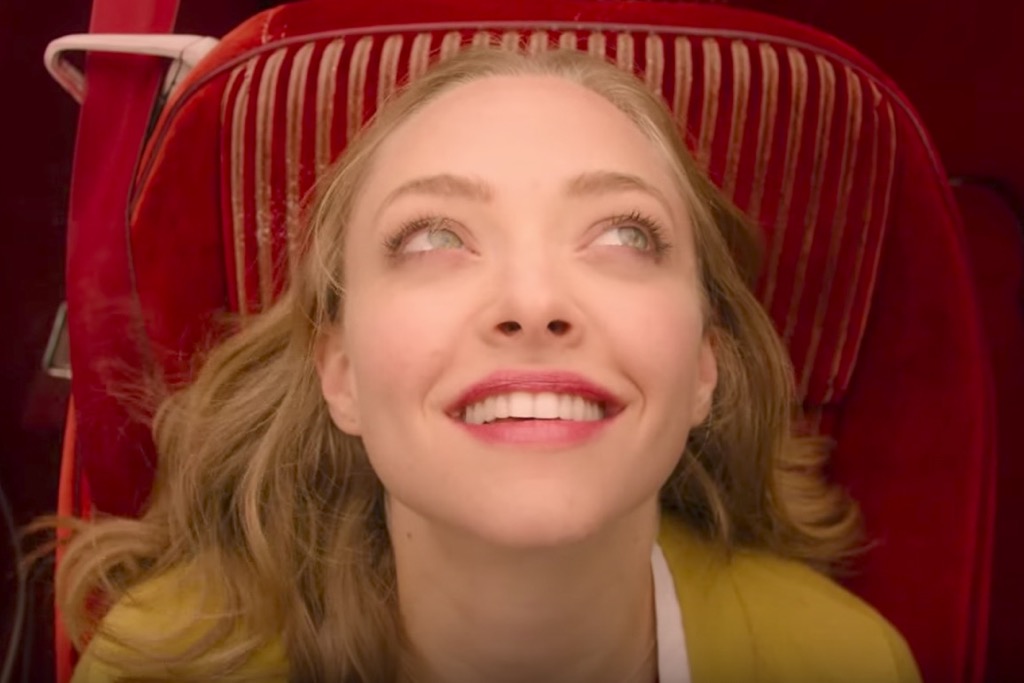
Today I saw a clip from an interview with Amanda Seyfried, and despite all the things I’ve seen her in — things that made perfect sense, and which had meaningful ideas that I was perfectly able to interpret — the image that immediately came to mind was a scene in Twin Peaks: The Return, where her character is drugged up and blissed out, riding in a convertible, looking at the sky as if it’s all new and wonderful and everything is perfect, in yet another storyline that never seemed to resolve itself.
Is the idea that Laura Palmer’s experience is cyclical? That there will always be innocents who are corrupted, no matter how much people like Agent Cooper try to save them? Is it that there’s no such thing as an “innocent,” and the idea itself is infantilizing and patronizing? Is it that all our lives are a combination of bliss and tragedy, and the beautiful thing is our capacity for wonder?
I don’t know; it could be all of those things, none of those things, or nothing at all. But it’s one of at least a dozen images from that series that I will never forget, a perfect expression of a feeling that I’d never be able to articulate. And it’s floating around in my memory, along with the rest of The Entirety of Human Expression (Chuck’s Version), largely free of context, steadfastly refusing to be reduced down to a simple this means that interpretation.
And that ambiguity is probably the exact reason why it won’t ever be reduced or diminished. My memory of context is faulty and reliable; I actually don’t remember any of the other scenes in that character’s storyline. But if I had been able to sum it all up, to get that closure of what it was intended to mean, it would likely have disappeared completely. In much the same way as the first two seasons of Twin Peaks seem to deflate if you think of them just as being about the mystery of who killed Laura Palmer.
The ambiguity isn’t necessary for making an image memorable, obviously. It’s just that Lynch had a unique gift for embracing everything that makes an image have the profound impact of a dream, and he was fearless and unconcerned with being misunderstood or misinterpreted.
Ultimately, I’ve still got my biases, and I’ll probably always prefer narrative-heavy movies and TV. But it’s useful to be mindful that that’s just one approach to making cinematic art, not the standard that everyone in the media should aspire to. In fact, it seems a little precious to be obsessing over every detail, every line of dialogue, to make sure that everything flows perfectly, and it conveys exactly the intended meaning, if I’m just going to end up forgetting most of it, anyway.