The Movie
There’s a scene in “Wuthering Heights” where Catherine is making an unannounced visit to the home of her neighbor, Edgar Linton, and his ward Isabella.
She’s been hoofing it across the moors and is now in an almost cartoonishly wild and overgrown wooded area just outside the estate’s walls. Inside those walls, the garden is equally cartoonishly well-manicured, sterile, and sunlit. The Lintons are having tea, and Isabella is describing the plot of Romeo and Juliet in great detail, while Edgar is feigning interest. When Catherine peeks her head above the wall to take a look, Isabella spots her and screams, causing Catherine to fall.
Isabella describes what made her scream: she saw a ghost! We see Cathy on the ground on the other side of the wall, rubbing her sprained ankle in embarrassment. Then Isabella goes on to say that the ghost had a terrible, hideous face, and we cut back to see Cathy — played by Margot Robbie, who famously has the least terrible and hideous face — with a “what the hell?!” expression.
The reason I like that moment so much is because it was, to me, the first real indication of just how much is packed into this movie. It’s simultaneously old-fashioned and contemporary, melodramatic and naturalistic, corny and clever, self-aware and shamelessly earnest, and it invites the audience to interpret it on as many layers as they care to.
When Isabella describes Catherine as a ghost, is that just a gag, or is it a reference to her appearing at the window in the book? Or can she in that glimpse of Cathy see her true nature — when Cathy is taken by surprise and not carefully maintaining her composure — and unwittingly foresee the doom she’s about to bring onto everyone?
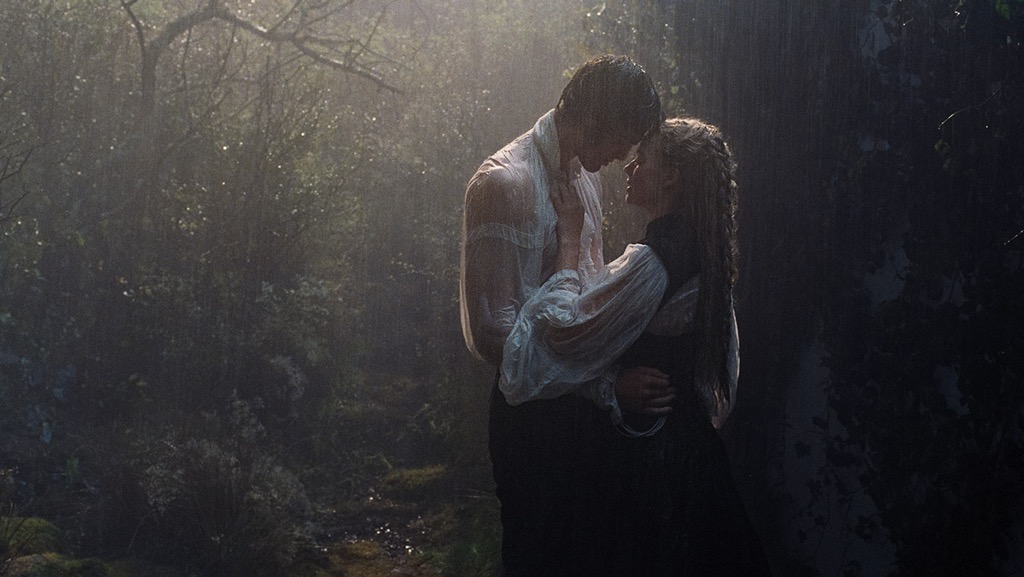
The visual design of this scene, like so much of the rest of the movie, is so heightened and over-saturated as to be almost surreal. There are shots of the Linton estate throughout that make the set design in Guillermo del Toro’s movies seem restrained and too devoted to realism. “Wuthering Heights” is overwhelmingly a sensual movie, in every sense, so in addition to the often over-the-top (and occasionally anachronistic) costume design, we get lots of shots of raw eggs; kneading dough; a pig being slaughtered; and naked, sweaty, scarred backs.
The estate1“Thrushcross Grange” in the book, according to Wikipedia, but I never caught a mention of its name in the movie takes that to the extreme, immediately reading as extreme wealth and comfort, but also as cold, empty, and deeply repressed. This is made all but explicit in a montage, showing Catherine in lavish costumes in bizarre, primary-colored, largely empty rooms, wanting for nothing but yearning to feel anything. There are multiple shots of her and Linton consummating their marriage (in multiple positions), and Catherine distractedly sticking her finger into the mouth of a fish in aspic.
In addition to the never-explained fireplace mantle made up entirely of white sculpted hands, the weirdest and most memorable is Catherine’s own room: conceived by Isabella, with walls the color of Cathy’s skin, including the veins, freckles, and moles. We get a great shot of Cathy first seeing the wall and feeling suddenly self-conscious about how many moles she has. It’s another great example of a realistic, relatable moment in a surreal setting. Later on, during one of Heathcliff and Cathy’s many, many sex scenes, we see him in silhouette taking a moment to lick the wall.
That idea of the natural and the sensual invading the cold, upper-class sterility of the Lintons’ mansion keeps coming up again and again, almost always in visuals. In addition to the enormous doll house where Isabella dotes on Catherine in doll form2Made from Cathy’s own hair, collected from her hairbrush!, there’s the hilarious friendship book she gives Cathy as a Christmas gift. It’s filled with increasingly feminine imagery, seemingly unwittingly on Isabella’s part.
She has all of this pent-up sexual energy she has no idea what to do with, because she’s been so sheltered and pampered, and Catherine’s mere presence is enough to rock the Victorian repression that Edgar and Isabella have been living under. It makes it easier to understand why Isabella would consent to be so degraded and manipulated later on. (With a pretty fantastic and uncomfortable scene in which Heathcliff is repeatedly asking for her consent, with a queasy ambiguity as to whether she’s actually exercising her autonomy, or has so little frame of reference for what she’s feeling that she’s powerless to resist).
And again, it’s all seeded in their introductory scene, with Cathy all but literally invading the sanctum that Linton and his money have carved out of the wily, windy moors.
Runner-up for my favorite scene in the movie is the opening. It doesn’t open with Cathy’s ghost visiting Heathcliff’s window — much to my disappointment, since that’s the only thing I knew from the book, from Kate Bush’s song — but instead with credits, over which we hear creaking and groaning sounds. Since none of us came into the movie from a vacuum, we know that this is being sold as a very sexy and passionate romance, and we can be pretty sure that this is the sound of people doin’ it.
So it’s a surprise to see that it’s actually a public hanging, the condemned man straining against the rope as he’s suffocating. As he dies, we get the briefest glimpse of an erection under his trousers, and the crowd watching goes wild — save for one nun, who apparently came to the display specifically to be shocked and offended.
I saw a review that claimed the scene was unnecessary, which is baffling, as it sets the tone for the whole movie. It most obviously shows the fixation on class and propriety, which eventually forms the story’s main complication, to be just a thin veneer over people’s cruel, beastly, and vulgar nature. It also sets off an extremely horny movie with an image that’s adamantly un-erotic, hinting that there’s little that’s actually romantic about the story that’s to follow, no matter how sexy it may be. It’s just people giving in to their base, natural impulses.
The casting throughout was excellent, but Margot Robbie and Jacob Elordi were perfect in particular. Starting with the most obvious fact, which is that they’re both astoundingly, preternaturally, inconceivably hot. I read that Fennell first decided to make this movie when she saw Elordi with sideburns on the set of Saltburn, and he immediately reminded her of Heathcliff. I can believe this story entirely, since Elordi with sideburns and an earring talking with Christian Bale’s real accent was enough to make me want to run off to the moors and have some alone time behind a rock, if you get my meaning.
Just wanting to have two of the most beautiful people on Earth being horny for each other in gorgeously surreal sets, or romantically foggy or rainy, rocky vistas, is more than reason enough to make a movie. I never would’ve expected to be at all interested in a version of Wuthering Heights, but I was immediately captivated by the teaser trailers. Seeing the poster, with the perfect romance novel image of Elordi and Robbie together — not to mention the fantastic typography, which deserves some credit for even being noticeable when you’ve got a poster with those two on it — just made me even more convinced that I had to see it, no matter how far away from the target audience I assumed myself to be. Even if this movie had been nothing more than style over substance, that’d be plenty, in my opinion.
But the thing that makes these two actors in particular so perfect is that they both seem to be almost bored by how hot they are. Elordi I only know from Frankenstein, where the role did demand a lot of physicality and a kind of beauty underneath all the prosthetics, but mostly seemed like an opportunity for him to be expressive without his looks being such a distraction. And Robbie has repeatedly taken roles where she can use her looks as a tool to create an interesting character. She’s the level of beautiful where the movie often can’t help but comment on how beautiful she is — as with Barbie — but she seems insistent that it’s just a part of the character, and not the only thing that makes the character compelling.
And it’s crucial in “Wuthering Heights”, since their characters are both awful people. Reprehensibly self-obsessed and manipulative, showing no sign of compassion or kindness to literally anyone except for, occasionally, each other. They have to be that beautiful to even be tolerable, to keep you from wondering why it took Nelly and Linton so long to flat-out tell them to get over themselves and cut out the bullshit. You have to immediately be able to see why people would be so instantaneously drawn to them and so forgiving of their selfishness.
The movie calls attention to this a few times, in particular with the scene where the groomsman and maid are having kinky sex in the stable while Catherine and Heathcliff watch. They’re also a mismatched, doomed couple giving into their passions, but they’re not the leads of the story. How much of that is because of class, how much is because the story chose not to focus on them, and how much is because they’re simply not Robbie and Elordi levels of hot? What exactly makes audiences read these two people as “rutting,” but Heathcliff and Catherine sticking their fingers and other parts into each other read as “passionate romance?”
I’ve never read Wuthering Heights, so all I knew about it was from suggestions of story here and there, from the song and elsewhere, all taken out of context. It was always nothing more than a very old and well-known book that other people had to read in school. My impression was that it was a ghost story framing a tragic love story, combining the doomed lovers of Romeo and Juliet with the “strong-willed woman and the only man who can control her” dynamic of The Taming of the Shrew.
It was a vague sense of cultural memory, whether accurate or not, hinting at a story about class and wealth and Victorian propriety wrapped around a tragic romance story powerful enough to transcend death. In other words: not entirely unlike a surface read of “Wuthering Heights”, and a lot like Emerald Fennell’s explicit mission statement for the movie.
I’ve never seen her original quote, but everything I’ve read or seen about the movie says that it was never intended to be a faithful adaptation of the book, but more “inspired” by her memories of reading it as a teenage girl. And that is completely what “Wuthering Heights” is. (As long as the teenage girl grew up to be an accomplished and provocative filmmaker who built working relationships with a lot of really solid actors).
But it’d be insultingly simple and reductive to suggest that that’s all that it is. I would’ve still enjoyed it if it had been nothing more than surreal, beautiful spectacle — just the brief shot of Catherine in a wedding dress walking across the moors, her impossibly huge, semi-transparent gown rippling in the fog, would be an iconic image in any other movie. What makes it really interesting is how much it challenges the ideas that we either assume or half-remember from classic stories.
What happens to a “literary classic” when it gets read, re-read, adapted, re-interpreted, re-imagined, over and over in different contexts over 180 years? How much is timeless, and how much loses relevance? How much is retained, and how much is mis-remembered? It’s not accidental that Isabella is introduced while describing Romeo and Juliet, which itself had already become a “timeless classic” by the time the movie had been set. And we see that Isabella, a young, sheltered woman, had been swept up by the shocking and tragic romance of it all. Exactly as a young, sheltered woman seeing a story of doomed, tragic romance would be.
For that matter: why did I keep seeing meme versions of the “to me you are perfect” scene from Love Actually for years before ever hearing the context — that this was a guy professing his love for a woman while her partner was sitting in the next room? Why was that being presented as romantic? Why are so many of the romantic comedies I grew up with filled with stalker-ish behavior? Why do so many ostensibly “romantic” stories demean the value of stability and devotion, insisting that true love means passion, even for people who are bad for each other? Why is so much of what our culture considers romantic actually deeply unhealthy, if not outright creepy?
My biggest criticism of the movie is that it’s too long, and the last 30 minutes or so just feel like they’re playing the same note over and over again, and it feels tedious. I realize that a lot of stories from the 1800s loved to focus on people writing letters and waiting for letters to arrive3Reminding me that I loved the small bit where Isabella is mocking Heathcliff for not being able to write, asserting that their relationship was cruel and degrading, but she was not merely a victim but a willing and eager participant, but I feel like we’ve all moved on and those parts can be safely excised from now on.
And I admit that my being mostly unfamiliar with the book meant that I spent the whole movie in anticipation of a ghost at the window in a climax that never came. Instead, the ending initially felt like a bit of a cop-out, like it was trying to have it both ways. The bulk of the movie had been subverting the grand love story promised by the trailers, showing us doomed, star-crossed lovers while never letting you forget that they were both pretty awful people, but then ended on what seemed to be a note of melodramatic sentimentality.
I choose to interpret it as sinister: we can remember just how manipulative and selfish Catherine was, even as a child, so seeing her smile suggests that she had completely and eternally made Heathcliff her pet. Even though he’s still a young man, he’s ruined. He’ll be forever obsessed with and haunted by her.
I went in expecting “Wuthering Heights” to be provocative — again, mostly from vague cultural awareness of the reaction to Emerald Fennell’s Saltburn and Promising Young Female — but I wasn’t expecting it to feel as subversive as it does. Letting a gorgeous, sexy, passionate gothic romance play out on its surface, while at the same time challenging us to reconsider how we understand, remember, and even misremember the classics.
The Response to the Movie
There are (at least) two guidelines I try to stick to while writing about movies on here:
- Ignore the studios’ attempts to stylize movie titles, like with Seven or Alien 3.4And completely not relevant here, but the same goes for re-branding movies after the fact. I saw Star Wars in the theater, not “A New Hope.” And anybody asking me to call it “Indiana Jones and the Raiders of the Lost Ark” can go right to hell.
- Respond to the movie itself, not what you wanted the movie to be, and definitely not to what other people are saying about it.
For the first one, I was initially rolling my eyes when I heard that the studio was insisting on the scare quotes around “Wuthering Heights”.5Included in the movie itself, in the form of stop motion-animated hair. But after seeing the movie and knowing more about the thought process behind it, I think it’s perfect, and I’ll happily use them.
It’s an ever-present reminder of Fennell’s mission statement, which people seem to be purposefully ignoring. It’s not just that it’s not a faithful adaptation of the book, or a story “inspired” by the book, but it’s something else entirely: a movie inspired by her years old memory of reading the book.
That also should’ve headed off the question of “if she were going to take such liberties with the novel, why didn’t she just call it something else?” It’s specifically about this 180-year-old famous book, and her reactions to it. Not just adapting it as an adult, or re-imagining it as an adult. But working off of her impressions of it from years ago, with those impressions now being re-contextualized and re-imagined as an adult.
People are fine with the idea when it’s kept simple and harmless, like “draw Garfield completely from memory.” And they’re happy to treat it as an art project curiosity, like when Dirty Projectors made Rise Above. And we saw Charlie Kaufman brilliantly turn an adaptation of The Orchid Thief into a surreal movie about the process of trying to do the adaptation itself, in a movie that ended up carrying through the themes of obsessive fixation and the pursuit of perfection that were at the core of that book.
And “Wuthering Heights” is a bit similar, even though it’s not explicitly meta-textual, and it presents itself on the surface as if it were a faithful adaptation. I think part of the reason I connected with it so strongly is that it implicitly suggests a lot of the ideas that I’ve been thinking about lately, about how much of what we retain from art isn’t fully-intact narratives, but fragments of ideas and images, which themselves get mashed up, subverted, re-contextualized, and re-imagined over time.
And because it’s so provocative, and so subjective, and so demanding of interpretation, it’s already been divisive. Which I think is key to appreciating how deep it goes beyond “gorgeous movie about two really hot people.”
From what I’ve seen, complaints about the movie focus on three things:
- Heathcliff is played by a white actor, even though he’s explicitly not white in the book
- The movie says that Catherine and Heathcliff is a grand love story, while the book says exactly the opposite
- By focusing solely on the love story of these two characters, it has none of the depth or weight of the themes that are carried throughout the book
The first one seems like the thorniest and most controversial, and also the one I’m least qualified to say anything about, as a white guy. But it’s also the one that I’ve been most surprised by.
I was initially sympathetic to it, since I had no idea that the character wasn’t white, and I’m a pretty strong believer in diversity in casting. And especially a believer in the idea that diversity doesn’t have to be defended or justified.
There’s a long-running argument — very often in bad faith, but not always, and my naiveté made me guilty of it in the past — that unless a character’s ethnicity, gender, orientation, etc was significant to the plot or themes of a story, then it was irrelevant. Which leads to “white straight male by default” and ends up with bland, homogenous casting that doesn’t reflect the real world.
But even in my own experience, I probably would have had a less-angsty teens and 20s, and an easier time coming out, if there had been more “unremarkably gay” characters in the media when I was growing up. Characters that don’t conform to one of a couple narrow stereotypes, whose tragic deviation from the norm doesn’t form the crux of the drama, who aren’t the sassy best friend. Just people who I could relate to.
So I was initially surprised to learn that Heathcliff was explicitly described in the book as being not white — it’s never said outright what his ethnicity is, but there’s the suggestion that he’s Romani — and disappointed that this movie ignored that. In favor of casting someone who is, again, unspeakably, unfathomably, hot.
I saw one video clip where the reviewer claimed casting Elordi was “stealing” a role from a non-white actor, and then went on to say that “this is Rue from The Hunger Games all over again.” Calling out Emerald Fennell personally6And as my friend Rain has pointed out, an awful lot of the criticism of this movie seems to turn into oddly personal attacks on Fennell herself, for reading a book as a teenager and imagining one of the main characters as being white.
So I read more about the book, and watched more reviewers talking about their objections to the casting, and my impression — again, with the huge caveat that I haven’t actually read the book itself — is that Heathcliff’s ethnicity is actually used in a very 1847 way: to establish him as other.
The most charitable explanation I saw of why it was integral to the book is that it was important to establish how he was abused, degraded, and looked down upon by the white characters. Essentially, that there was an inescapable, vicious, cycle created and perpetuated by racism and classism: characters treated him as lowly and brutish even as a child, and those years of abuse made him brutish and uncultured as an adult.
This idea is in the movie — which, again, is a melodramatic story from the 1800s told with a modern sensibility, often anachronistically so — in a couple of ways. With Heathcliff himself, the idea is there, but it’s driven by class, not race. We see the bloody scars on his back, and the images of him as a long-haired, bearded wild man cleaning out stables. We can see how the physical abuse from Catherine’s father, the emotional abuse from Catherine herself, and the manipulative treatment from the both of them, decided what he was from the moment he entered the household, and drove him to become that, because he’d never known anything different. He was a beast, and a pet.
(Incidentally, I thought the movie did a particularly good job of showing how abusive cycles work. Both Catherine and her father would swing from abuse and degradation, to asking for sympathy or making empty, insincere requests for forgiveness, or simply forgetting or pretending that it never happened).
Significantly, the movie doesn’t ignore the question of race and ethnicity entirely, treating it as nothing more than a class issue. I haven’t seen a description of the character of Nelly that describes her as non white, but here she’s played by Hong Chau, an actor who I believe is Thai of Vietnamese descent. And her ethnicity is made significant early on, to show the parallel castes of both class and race. There’s the implication that she’s the illegitimate child of a nobleman, since she describes herself as a lady but is told that she’ll never be one.
In a crucial scene, she’s mocked by one of the white servants for being non-white, and in response she silently knocks a glass off the table, forcing the servant to have to clean it up.
And throughout, she’s casually dismissed, ignored, or othered by all of the white characters. They insist, explicitly or implicitly, that there’s a limit to what she can be and what she can hope for, and it’s perpetuated from childhood through adulthood.
Which is all to say that I can see both sides. If the movie had simply said, “In this version, everybody’s white, because race is irrelevant to the story. Deal with it,” then I would be a lot more critical. But I don’t love the alternative, either: insisting on preserving the idea that a character of unspecified ethnicity is some exotic play-thing for a (formerly) wealthy white woman, as the basis for a story about primal, toxic, inescapable passion. I like the notion that people will always find a way to be shitty to each other, even if race isn’t involved. And I’m more than a little uncomfortable with the idea of casting a character with the insistence that he be “hot and brown. Doesn’t have to be any particular kind of brown, but it’s still very important.”
And on the “diversity doesn’t have to be justified” front, there’s also a case of color-blind casting in the movie, too, by having the role of wealthy landowner Edgar Linton played by Shazad Latif, an English actor of Pakistani descent. I’m familiar with him from Star Trek: Discovery and as Clem Fandango in Toast of London. I thought it was especially interesting to see him here, since he’s another impossibly hot guy who’s just a little too old to play Heathcliff. But in this movie, he’s the genteel, posh, cuckold.
And, significantly, there are so many shots of him and Catherine having sex, to eliminate the idea that he’s neutered or asexual. I kept thinking of the image of him in Penny Dreadful, or playing Captain Nemo, and wondering “what the hell are you complaining about, Cathy?” You keep seeing the images of Catherine in the estate, being adored by Edgar and Isabella, and remembering her earlier line to Nelly that she’d be bored with heaven. The imagery is suggesting the romantic story of choosing true love over comfort and stability, but you’re never allowed to forget that for Cathy, it’s just as much about danger and about control. So much of why she wants Heathcliff is simply because she can’t have him.
Which leads to how the last two common criticisms I keep seeing about “Wuthering Heights” are basically the same thing: insisting that the most shallow and simple read of the movie is the “correct” one, that it clearly has to be taken completely at face value, and then criticizing the movie for being shallow because of that.
I don’t believe that there’s a “wrong” interpretation of a work of art, even if it’s the opposite of what the artist intended. Especially in something as subjective as this movie. But I do believe that it’s wrong, or at least arrogant, to ignore stuff that’s clearly in the movie if it doesn’t fit with your interpretation of it.
And there are signs throughout “Wuthering Heights” that it’s not to be taken at face value, and that it’s subverting the idea that it’s “one of the greatest love stories ever told,” no matter what the trailers say. In my experience, it was constantly showing me images that were sweeping me up and getting me really into it, and then demanding that I question why I was so into it. Kind of like asking why “civilized” people are cheering and celebrating at a man’s execution. Or for that matter, why we get turned on by boners, even though everybody gets them, even dead men.
One of the extended negative reviews I watched — in which the reviewer emphasized that she didn’t require an adaptation to be completely faithful to the book, and then spent the bulk of the review complaining about how it deviated from the book — faulted it for being boring, by losing everything that made the book deep and thought-provoking and choosing instead to focus on people “shagging.” (She’s an Irish reviewer).
And of course that opinion isn’t “wrong,” if that was her takeaway. And I said myself that I thought the last stretch of the movie was a drag, even though I was more bored by the burning-letters-in-a-fireplace than by all the sex. But it is disappointing not to even consider whether there was a purpose behind it, beyond having two of the most beautiful people in the world in the same movie and DTF.
I thought it was actually poignant that all the sex got boring and un-erotic after a while. You start to feel like Catherine in the mansion, having everything you want and it still not being enough. You can’t watch the scenes without thinking about how selfish they’re being, and how many people they’re hurting. I thought of being a teenager, getting swept up in the passion and danger and, yes, horniness; and then thinking back on that as an adult, and how unsatisfyingly reckless and ultimately boring it seemed. Kind of like a filmmaker fondly but critically re-imagining her own teenaged reaction to a story.
I’ll acknowledge that it’s entirely possible I’m missing out by not reading the book. I’ll never know, because I can barely make it through a synopsis before nodding off. The story that so many reviewers insist that Fennell should have adapted — even though several film adaptations already exist, enough to inspire an iconic, near-50-year-old pop song — sure seems to have a lot about wills, and estates, and inheritances, and children with the same names as the main characters, and the tedious Victorian story-within-a-story-within-a-story structure, and stuff that just doesn’t interest me as much as two very hot and toxic people being obsessed with each other, and possibly a ghost. It very much has the vibe of obligatory school reading.
One of the reviews I watched — from a reviewer that definitely has read the book, thank you very much — said that “Wuthering Heights” is “rage bait.” And that’s not entirely wrong; again, it seems clearly intended to be provocative. But it also implies a kind of crass manipulation that I’m just not seeing. I don’t feel that it was provocative simply to get attention, but to provoke audiences to think deeper about what they’re seeing.
Which isn’t to say it’s completely artistic and not at all crass. We’re in the age of viral marketing, and controversy has always helped drive attention to a movie. Not to mention that we’re in the age of “ENDING EXPLAINED!” videos7And reading synopses on Wikipedia instead of reading the actual book, for that matter, and media criticism that has to be fast and attention-grabbing to ride on the back of a wave of popularity. Calling the movie “rage bait” is itself — partly at least, if not entirely — a kind of rage bait.
But the aspect of that particular review that stood out to me was when the reviewer was trying to justify her criticism. At its most simplistic level, it was another case of “Obviously I don’t believe an adaptation has to be faithful to the source material, but why wasn’t this adaptation faithful to the source material?!” (Even while repeating Fennell’s comment that it wasn’t even intended to be an adaptation, much less a faithful one). And the reviewer said, essentially, that ignoring or subverting the themes of the book, in favor of a style-over-substance version that turns a toxic relationship into a romantic one, was furthering media illiteracy.
That phrase “media illiteracy” was the part that stood out as depressingly ironic. For years we’ve been hearing that movies are getting increasingly tedious and commercial, with even promising (young female) artists getting roped into making franchise superhero movies, everything is feeding on its own nostalgia, and nothing is original or insightful anymore.
Then we get a screenwriter and director making something that engages with art in a way that I’ve never seen before, and the response is, “No, not like that.”
It’s disappointing to see such an insistence that there’s a predefined way to engage with art, there’s a limited set of things that movies can do, and there are well-established and predefined lanes to talk about class, race, and feminism, and deviation from those is at best problematic.
Or that everything of value in a classic book is contained inside the book itself, it was established in 1847, and we have to just keep mining it for deeper understanding. The best any movie can aspire to is expressing everything that’s already in the book, but in a different way. Excuse me, but I actually read this book, and I got an A for my book report, so I believe I understand it just a little better than you seem to.
And most bizarrely, people seem to find it easy to believe that Emerald Fennell wrote an entire screenplay, got it financed and produced, directed the entire thing, and did extensive marketing for it, all without sufficiently understanding a book that is assigned to teenagers in high school. But impossible to believe that they might not be understanding what the movie is doing on anything other than the most surface level.
Not content to simply say, “I didn’t like the movie, and here’s why,” it’s always the accusation that the movie fails to do something that the artist explicitly says she was wasn’t trying to do in the first place.
I’m not even particularly interested in defending a filmmaker or defending her work; it’s just that it’s so disappointing to see such a level of willful incuriousness. Leaving “Wuthering Heights”, after I got past swooning over Jacob Elordi, I was really excited by how the movie not only worked as spectacle — and spectacle of the kind I usually don’t go for at all — but also got my mind spinning in all kinds of directions.
It invites us to think about what we consider romantic, all the aspects of romantic stories that we take for granted. It raises questions about what makes a work “a classic,” why it so often gets assigned to students that have so little context for it, and how much we retain. It makes us consider how much of a work of art is locked inside the original work, and how much of it changes over time, each time we re-visit it, but even when we remember it in a new context.
And I think most interesting of all: it makes us think about how our interpretation of a piece of art can be so different between our formative years and adulthood. How we can reconsider the things we knew to be definitively true, and still love and show grace to that younger version of us, but appreciate how much our understanding has changed as we’ve gotten older.