I guess it’s thematically appropriate that ever since I saw Hokum last week, I’ve been haunted by regret. In my case, it’s because my take on it was positive, and I hope it came across as a clear recommendation, but it was still overly dismissive of everything the movie was trying to do.
Even after acknowledging that it’s reductive “stay in your lane” mentality to want an artist to just keep making the same thing you liked over and over again, I still did exactly that. Praising the contemporary take on horror folklore creeps and scares, and shrugging off the central character arc.
I went back and watched it again1Partly because it seemed an appropriate movie for those of us who get sad on Mother’s Day, and I had a better appreciation for how well it’s structured, once I was paying attention to the movie on the screen instead of the one that was playing out in my head. Plus, it was simply nice to see the jump scares being more effective in a more crowded theater. And it made me realize a few interesting things not just about Hokum, but about the current state of horror movies, and about the process of watching movies in general.
Over- and Under-thinking a Photo
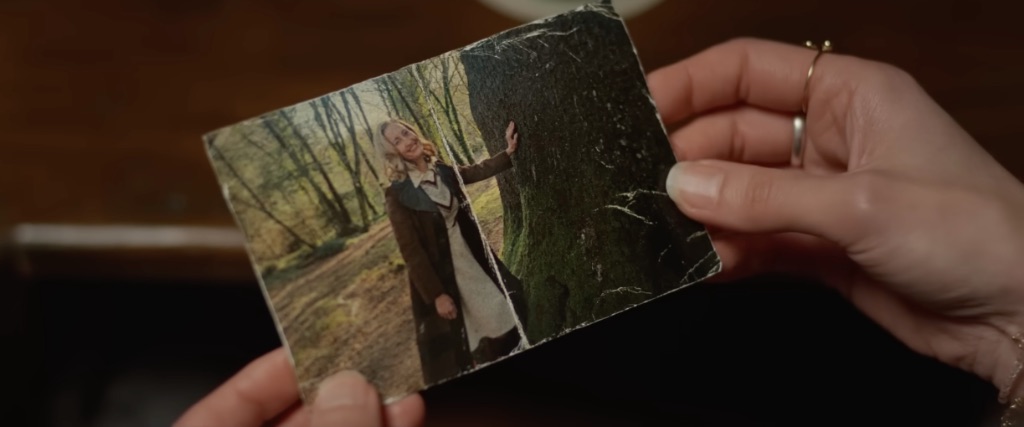
There’s one scene in particular that made me suspect that Hokum had more going on than I’d appreciated on my first watch. It’s when Bauman is telling the bartender Fiona that he’s here to scatter the ashes of his parents at a place that had been significant to them, a big tree in the forest near the hotel where they’d come for their honeymoon.
He shows Fiona a photograph of his mother at the tree. She says, “she looks happy.” He replies, “My dad took that.”
In the moment, I thought it was a really clever double-entendre. He hadn’t just taken the picture; he’d taken his mother’s happiness. We’d already seen that Bauman had a lot of resentment of his father; at the tree, he was thoughtful and considerate about spreading his mother’s ashes, and then unceremoniously dumped out the canister with his father’s remains. Clearly there was even more intrigue to the story, and we’d be uncovering more details later.
And we do by the end of the movie, but it reveals that Bauman was being misleading. His mother’s death was an accident, not a murder. And we don’t get any indication that their relationship was troubled before the accident. Instead, he didn’t give his son any outlet to process his grief, and it festered into a lifetime of resentment, blame, guilt, and self-loathing. Which makes the line no longer work as a double entendre.
I figured that these movies don’t really deal with wordplay anyway — the “do I look stupid?” exchange from Oddity notwithstanding — so I must have been over-thinking it, as usual. You can (and I do) retro-actively reinterpret it to suggest “my dad took away my memories of my mom being happy,” but at that point, you’re doing a lot of heavy lifting, and the line doesn’t have the same impact.
The thing that’s interesting about that to me is how I seem to treat the script and dialogue of a movie as functioning on a different level from everything else. A movie means what it means at the ending, and every exchange or idea up to that point is for the purpose of building to that ending, or else it doesn’t fit.
But back up to the scene at the tree. It came after we’d seen the hotel owner Cob terrifying a couple of children with stories about a witch in the woods who shackled her victims and dragged them down to tell, ripping parts of their bodies off as trophies (taking particular delight in suggesting that she rips off the dicks of little boys). As he tells it, we see close-ups of a diorama with little white figurines of terrified children, being dragged underneath a grassy barrow. And when we see the tree, there’s sinister music and close-up shots of a dark hollow at the base of the tree.
At the time, it’s pretty clear that this tree is going to turn out to be the source of all evil, and Bauman performing an emotionally significant ritual at it will somehow unlock the dark forces hidden beneath. Probably not yet, but this is the scene where we’re most likely going to see our first hint of the witch living out in the woods.
But none of that happens. The evil doesn’t live in the tree or even in the woods; it’s all contained inside and underneath the hotel. The scene at the tree is taking full advantage of all the potential energy of the beginning of a scary story, where we’re still in the process of establishing what’s happening, and we’re primed to look for dangers everywhere. I didn’t have any problem with that, and I didn’t consider it a “cop-out” or anything because it didn’t explicitly resolve into anything by the movie’s end. It’s just effective build-up of suspense.
When I realized that I was perfectly capable of appreciating how misdirects work in terms of visuals, but not in terms of revealing details of the story, it was yet another reminder to just slow down and watch the movie. Pay attention to what’s happening in the moment, instead of treating it all as incidental until the ending, when it tells you what it was all about. Bauman’s story about his parents is foreshadowing the fact that we’ll find out more about them later, and it’s key to understanding what’s wrong with his character.
The Unnecessary Desert
One of my biggest gripes after my first viewing of Hokum was the framing sequence at the beginning and end of the movie, showing us two versions of the epilogue of Bauman’s book.
I had it stuck in my mind that Hokum was Mc Carthy’s “big budget breakthrough,” and it gave me the impression that more money had drained some of the charm out his earlier movies Caveat and Oddity, charm that came from creative people working within constraints. What clearer example of that unnecessary excess could there be, than a film set in Ireland having short sequences requiring a completely separate shoot in Abu Dhabi?
It’s an assumption I could’ve dispelled if I’d done even the smallest bit of research. Image Nation Abu Dhabi is listed as a primary production company financing the movie, so for all I know, it’s entirely possible that the shots filmed there were a prerequisite for getting it made, not a needless extravagance. And what’s more, the “big budget” is estimated at 5 million dollars, which is small by Hollywood standards.
But I was primed not to like those desert shots, and I went away disappointed that they felt like a clumsy and contrived attempt to get across ideas that could’ve been expressed more subtly and simply.
The opening was absurdly contrived and constructed to have a pointlessly nihilistic conclusion that just didn’t make sense — it was made explicitly clear that Bauman was shooting for a “bleak ending,” but this just made him seem like a hack writer.
And the final version of the epilogue seemed to undermine itself by giving it a too easy and maudlin change-up: the greatest treasure of them all is a hug when you need it most. It retroactively made the movie’s climax seem more maudlin, because it had Bauman unable to forgive himself until his ghost mom appeared and gave him a hug.
After a rewatch, I think it’s clear that I completely missed the point. I took the shallowest possible interpretation, and then faulted the movie for being shallow, assuming it would have been better if it had just concentrated on being scary.
Not Shallow Enough
Which was due to my wanting Hokum to work like Oddity and Caveat, which both seemed to be content to work as well-told scary stories. They were intensely scary, beautifully shot, with impeccable art direction and editing, and a complete lack of pretentiousness.
They felt like a refreshing change from the “A24 Era,” where horror movies have this obligation to be about something more than just horror storytelling. It’s not a bad thing in itself. I enjoyed It Follows as a story about the loss of innocence, 28 Years Later and The Bone Temple as commentary on British history, and of course, Sinners is an absolute masterpiece. The problem isn’t the depth, but the obligation.
Even Weapons, one of the rare horror movies to get mainstream respect and attention, had people eager to treat it as a commentary on school shootings. I thought the genius of it was that it was simply a cleverly-told story.
And some of my other recent favorites, like Malignant, Barbarian, and Orphan: First Kill, seemed to have an embedded sense that they were playing with the genre as much as simply executing on it. As if they were somehow unwilling to quite commit to just working as earnest horror.
Needing everything to be a symbol has already started to backfire. I’ve now seen so many horror movies that make their ghosts or monsters or cursed ceramic hands metaphors for grief, that the once-profound idea feels trite. They’ve become better at suggesting depth than really making you feel it at a gut level, which is one of the most potent abilities of horror movies. Making everything cerebral undermines the power of horror to bypass intellect and hit you right in the gut.
There’s this pernicious idea that horror movies are the lowest of genre pictures, having little merit until a real filmmaker like Stanley Kubrick or Jonathan Demme decides to dabble in it and class up the joint. It implies that there’s no artistry to effective horror storytelling itself.
Caveat and Oddity both showed the inherent artistry in delivering a good, old-fashioned, scary story. They can have a sense of humor and be fun without undermining their scariness.
The Balancing Act
So I split Hokum into its constituent parts and thought of them as playing out in parallel, instead of being interconnected. There’s the haunted hotel story, the murder mystery, the Irish folklore story, the story of a broken man learning to forgive himself, and the theme of belief and being open-minded to the existence of things beyond our understanding. After my first watch, I felt like Bauman’s psychological journey didn’t connect as well as the good old-fashioned scary story did.
On a rewatch, I’ve got a better appreciation for how all of those constituent parts weren’t playing out in parallel, actually, but were all feeding into and playing off of each other as expressions of a core, universal idea. The idea of being open in a more general sense, not just to the existence of the supernatural, but open to each other as human beings.
Any scene that has a character saying the title of the movie has to be significant, right? In Hokum, it’s that same scene in the bar, after Alby has recounted his story of seeing the witch inside the Honeymoon Suite. Bauman dismisses the story as hokum, but it’s not at all coincidental that it’s happening in the same scene in which he had been telling Fiona about the epilogue to his upcoming novel.
I believe it’s the only moment in the entire movie where he cracks a smile. He’s so pleased with himself for having devised the perfect, bleakest ending possible. That’s why the opening scene is so absurdly contrived; it’s an author who’s become so focused on nihilism and hopelessness that it’s subsumed everything else, even common sense or plausibility. But he’s convinced that he’s come up with something so powerful that no one will be able to deny the truth of it. Except Fiona doesn’t seem to be having any of it, asking “why would you write that?” and saying that she won’t be reading it, if it has that ending.
Bauman replies that some of his books have been made into bad movies, so she can watch that instead. And it’s exactly the kind of line delivery that Adam Scott excels at — sardonic with a hint of self-deprecation — so I just took it as part of their banter. She’s the one person at the hotel he gets along with, because she matches his energy, doesn’t put up with his bullshit, but doesn’t shut him out, either. I hadn’t picked up on the condescension in that comment, though. He’s saying that if the book is too raw and real and challenging for her, maybe the safer and dumber Hollywood version, with its happy ending, will be easier to digest. Bleak endings are truth, everything else is hokum.
His suicide is presented as such a sudden and loud jump scare, that it hadn’t even occurred to me that it was anything other than sudden. But we can infer that it was all premeditated. He’d come here to wrap up final business with his parents, and now that he’d come up with the most perfectly bleak ending for the end of his book series, there was nothing left for him to do. He’d figured it all out.
Mushrooms, Chalk Circles, and Tape Recorders
But he’s given a second chance, thanks to Fiona’s intuition, the first of two times a character’s intuition and selflessness will save him. That idea of people being stubborn and closed off, vs open and kind, shows up again and again.
When Bauman is stuck inside the honeymoon suite and discovers his tape recorder, we hear the recordings that Fiona had made, gradually revealing more and more exposition. But the recordings also seemingly play unprompted, at the most opportune times. Right after Bauman is about to climb into the dumbwaiter, we suddenly hear Fiona’s voice, describing her panic at being trapped in the cellar because the dumbwaiter controls are broken. Someone’s ghost is warning him, trying to help.
When the witch is making her way back up into the room, Bauman uses the piece of chalk to draw a protective circle around the room. Earlier, in that same conversation in the bar, he’d dismissively said something to the effect of if he ever found himself being chased by a witch, he’d need therapy, not chalk. Clearly, he needs both. But men would rather confront a witch than go to therapy and process deep-rooted childhood trauma, I guess.
Down in the cellar, after he’s completely given up, he’s been shackled by the witch, and he’s sitting in an uncompleted chalk circle, that’s when the ghost of his mother visited him. A significant detail is that she puts his hand on his heart when she says “You can’t stay here,” making it another line with a double meaning. He can’t stay trapped in his feelings of guilt and self-hatred.
We see the witch casually able to walk through the broken chalk circle, but it’s also a pretty clear symbol that Bauman is now open and vulnerable, instead of closing himself off. And that’s when the kind version of his mother’s ghost appears, instead of the sinister version that had been haunting him since the beginning of the movie. It’s left a bit ambiguous as to whether she’s been trying to make contact with him for years, but he’s been too frightened, full of guilt, and closed off to see anything other than horrific flashes.
After the climax, when Bauman’s crawling out of the elevator and collapses due to smoke inhalation, there’s no reasonable way he would’ve survived. Except we hear a woman’s voice call out “Fergal,” drawing his attention to find Bauman and drag him to safety. He’d had no idea that Bauman was even there, and little reason to suspect anyone would be near the Honeymoon Suite.
Finally, there’s the scene in the hospital, where we learn that Alby had spiked Bauman’s flask with the magic mushroom powder. I’d completely misread this on my first viewing; I’d taken it to be a last stab at ambiguity, like a B-movie slapping on a final “THE END?” Did these supernatural events actually occur, or were they nothing more than a hallucinogenic trip?
But the movie pretty clearly confirms that it was all real. We get a quick flashback to Jerry insisting that the mushrooms don’t make people imagine the supernatural, but they let people see the supernatural that exists all around them. Bauman sees the marks of the shackles on his wrists, and he has to acknowledge that everything he’d dismissed as hokum was actually real.
And that means everything, including the happy ending. He was saved, multiple times over, by people going out of their way to show him kindness and help him. We’ve been taught that the world is a dark and cruel place, so we’re inclined to believe that darkness and cruelty are ultimately the only things that are real or true. Kindness, selflessness, and openness are too simple and easy; they feel naive and false. Ultimately, Hokum suggests that in a world where genuine evil exists, kindness is the only true thing, because it’s the only chance we have of making it through the darkness.
After my first viewing, I was a little disappointed that the kindest characters are killed off, after helping the jerk of a protagonist survive to the end. But after rewatching, I had a sense that Fiona and Jerry were the characters who had nothing left to prove. Bauman still has to make good on his new life, and work to bring some light into the world for a change. I realize that there’s a strong implication that Fiona was dragged to hell by the witch, but her ghost was still sticking around, at least. If this is a movie all about earning your happy ending, I think she earned hers.
A New Cinematic Universe
There were other great details that I picked up on a second viewing. I hadn’t noticed that the bell at the front desk is the same bell that featured in Oddity. And I love seeing these cursed objects carry over from one Damian Mc Carthy movie to the next, like the rabbit from Caveat on the shelf of the oddities shop.
And I should probably address the Jackass in the room: I don’t really like Jack the Donkey. Visually, he’s brilliant. Immediately, intensely creepy, even without any context. Plus there’s the visual connection to Fiona’s body, and to the rabbit from Caveat. But I have a peculiar pet peeve about “children’s character that is actually scary and evil.” Doubly so if they ever utter the phrase “hey, kids!”2Honestly, every time I see the popularity of Five Nights at Freddy’s, it makes me sad. I can’t help but think of all the potential of that premise, if they’d just had the creativity to do more than “they’re the Chuck E Cheese animatronics but you see, they kill people.” In Hokum it works thematically, and it’s an iconic representation of how Bauman’s entire childhood had been completely corrupted by that one traumatic accident. But I still don’t love it.
I’m hoping the Honeymoon Suite clock is the cursed artifact that makes its way into the next movie. That little guy was an MVP.