I spent the weekend with my husband at LFG Con, a board game and tabletop RPG convention which was started in 2025 by three friendly-local-game-store owners. It was hosted at a hotel across from the Burbank airport, but we made a staycation of it even though we live in the San Fernando Valley.
Probably due to its being new, and being scheduled right after GEN Con, it was fairly small by convention standards. But as somebody who gets anxious even seeing photos of the crowds at GEN Con, I thought it was almost perfect.
When we lived in the Bay Area, we went to KublaCon for several years, and I felt like I got spoiled by its accessibility, layout, and overall vibe. We both knew several people from the area into board games, so there were always familiar faces. And the layout of the hotel was ideal for it, in my opinion, with a large central atrium with lots of tables for casual or spontaneous games. You could choose a game, pick a table, and put up a flag indicating you were looking for people to play with. It felt very social and low pressure, although over the years it became more and more difficult to get into scheduled games before they filled up.
In Los Angeles, the three Strategicon conventions were the closest alternative, but I have to say I haven’t been extremely impressed the times I went. Most of that is because of the venue (a hotel near LAX), because while I’m sure it’s probably fine as a hotel, it’s pretty inhospitable for a game convention. Parking was a nightmare, and it seemed that every room for the convention itself was spread across multiple floors and hidden away at the end of dimly-lit cramped passages. Spontaneously picking a game and finding strangers to play with was all but impossible for me, and all of the scheduled events filled up long before I had the chance to get involved.
That might simply be an inevitable side effect of size and my not knowing a ton of other board gamers in the area. Whatever the reason, it was enough to get me mostly out of the hobby, even with an excellent local game store nearby.
Just a few days at LFG Con had me feeling back into it. There was a big open gaming area at the hotel, so it was pretty easy to find games in progress, or to sit down at a table and invite strangers to come join. They also put a lot of effort into an online scheduling system, so you could announce that you were starting a game and looking for players, and everyone at the con would be able to see it easily. (It was integrated with their Discord server as well). It was all a lot more slick and professional than I would’ve expected from a two-year-old local convention.
As a sign of how much I liked the vibe of the convention, I really enjoyed it even though I didn’t actually end up playing that much. Pretty much everybody I interacted with was friendly — which is unfortunately rare, since board game conventions tend to have a high number of grown adults throwing tantrums — and seemed to be there to play, not just to win.
I’m really hoping the convention takes off and manages to grow enough to be sustainable, but maybe not so much that it loses the charm of the early years.
What I Played
Moon Colony Bloodbath
This is a game by Donald X Vaccarino, designer of Dominion and Kingdom Builder, that got a lot of buzz last year but with the tariffs has been very difficult to find. (Big thanks to my husband for picking me up a copy!)
It’s an ingenious engine-builder/engine-destroyer that works like a co-op game and deck builder, except everyone is building a shared deck. The premise is that you’re a scientist building a colony on the moon, trying to build up a big but sustainable population, all before the inevitable collapse. Cards for disastrous events and killer robot attacks get introduced into the deck, killing off your colonists and eventually destroying your buildings. And because it’s a deck builder, the disasters keep happening over and over again, every time the deck is reshuffled.
I had a ton of fun with it, and I’m looking forward to getting to play it again. (There’s a solo variant included, as well). It’s one of those games where the clever mechanics are always completely visible, so you can appreciate it as a meticulously-designed and -playtested machine, but the theme still comes through.
Jaws
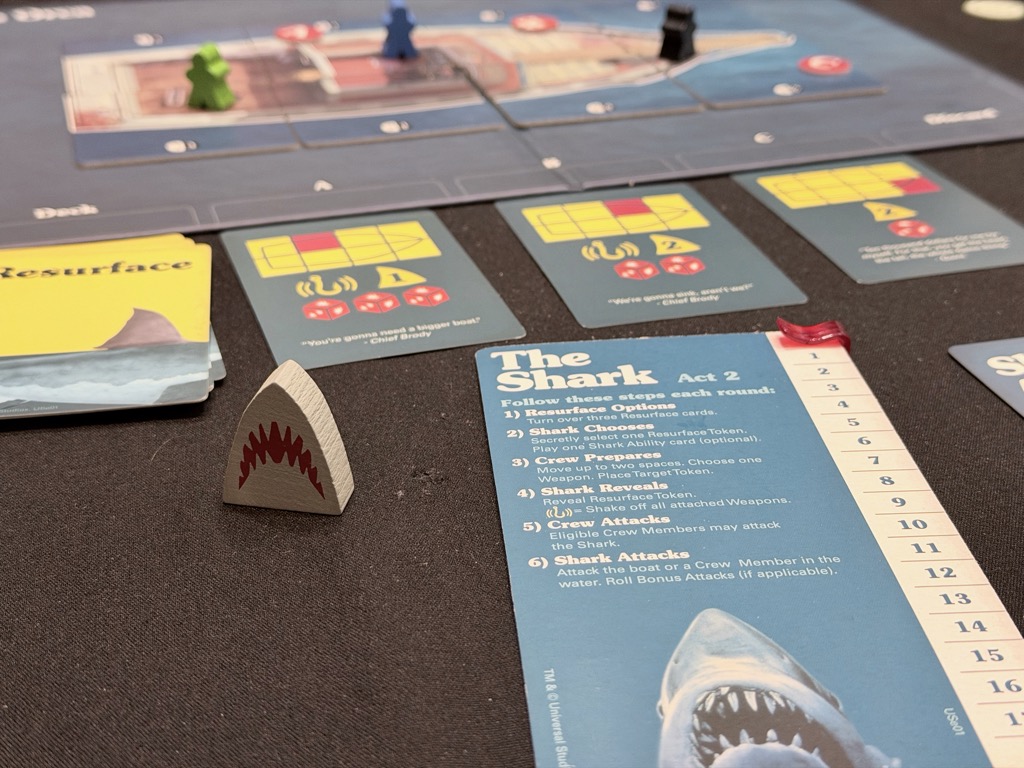
This is one of the licensed games from Prospero Hall, the design studio that were1I can’t find anything definitive saying whether the studio still exists. I’d heard they were dismantled in 2024, and just exist as a brand these days. masters at making licensed games that are far, far better than a licensed game needs to be. I became a huge fan of the studio after Godzilla: Tokyo Clash, and would buy just about everything they put out, regardless of whether I liked the license. I got Jaws several years ago, but never had the opportunity to play it until last weekend.
Jaws is such a quietly clever adaptation for two reasons: first, its game design is modern, but the presentation in terms of graphic design, typography, and component design all looks like it could’ve been a Jaws-branded game from the 1970s. The Orca and Hooper’s speedboat are depicted as big, chunky wooden pieces that the meeples stand in.
Second, the game is divided into two distinct halves, just like the movie. The first is a hidden-movement game where one player is the shark, and the other player(s) are Brody, Quint, and Hooper. The shark is trying to swim around the island and eat swimmers while avoiding detection; the more swimmers it eats, the more advantages it has in the second act. The humans are trying to figure out where the shark will attack next, rescue swimmers out of the water, and launch motion-detecting barrels at the shark.
The second act takes place on the Orca, and has the shark deciding where it’ll surface next, with the humans ready to defend against it. The shark is trying to destroy the boat or eat the three crew members. The crew is trying to kill the shark.
How much you like the game probably depends a lot on how much you like hidden-movement games, even more than how much you like Jaws. I thought it was a lot of fun (even though as it turns out, I’m not a great white shark) and an extremely clever and thematic adaptation.
Camp Grizzly
I love this game, and since I found out that a second edition is now available for pre-order, I’ve really been wanting to play it again.
It’s a co-op game where you’re all playing as camp counselors being stalked and attacked by a bear mask-wielding maniac named Otis. My best description of it is that the goal of the game isn’t necessarily to win; it’s to make the best possible early-1980s slasher movie.
The game at the convention was delayed because someone very excitedly came up to the table and said she’d been dying to play the game forever, and would I mind waiting until they finished the game they were currently in? We ended up having to do a lighter and quicker session, and I think the game benefits from players who are more into vibes than game mechanics. But I still appreciated getting a chance to play a game that I love but almost never actually get to play.
Daggerheart
Daggerheart is an RPG system published by Darrington Press, who were a major sponsor of the convention. They ran hourly sessions introducing first-time players to the game and its mechanic, and my husband, who’s already played it several times, sat in on a short beginners’ game with me.
I’ve tried at various points to get into tabletop RPGs, and it just never takes, for various reasons. But I enjoyed my 45 minutes with the game enough to want to try it again for at least one full session. Part of that is because we had a great GM (Erika Elder Martin), whose enthusiasm for the game and the philosophy behind it really came through. And the rest was that philosophy behind it: it tries to strike a balance between game mechanics like D&D, and cinematic, collaborative storytelling. I liked it, and if there were the same system in a non-fantasy setting, I’d probably like it even more.
Thunder Road: Vendetta
My husband got a copy of this Mad Max-style racing game after playing the RPG version, and we tried it out a couple of times, once with just the two of us, and another time with four players.
It’s a lot of fun! Very chaotic, designed to maximize cars slamming into each other, tripping mines, smashing into walls or into wrecks and exploding, being taken out by airstrikes from helicopters, and so on.
There’s a mechanic where going off the right end of the track will cause the left end of the track to disappear, destroying every car on it. One of the players boosted his car over the line, wiping out all three of my husband’s cars in the process. It’s the kind of lightweight, raucous game where that can happen and instead of being angry, you say, “that was pretty bad-ass.”
Heat
Someone brought a giant playmat for Heat: Pedal to the Metal and ran sessions using Hot Wheels as the vehicles. I still like the game a lot, but that wasn’t an ideal way to play it.
Pirate Borg
Pirate Borg is an RPG set in a dark fantasy version of the Caribbean, with magic, vampires, zombies, eldritch monsters, and lots of pirates. A darker and even more fantastic version of On Stranger Tides. I got a copy of the core book with no intention of ever playing the game, just because I liked the setting and the design of the book itself so much.
It picks up the alt-punk magazine aesthetic of Mörk Borg, which is full of double-page spreads giving emphasis to bold artwork and weird, distressed typography, and almost all of the pages giving as much emphasis to the art as to the text itself.
As our last game of the last night of the convention, we played a one shot run by another great GM (Jason D’Alberti, who was there as part of OSR-LA), going through the process of rolling characters and then playing through an around 3 hour story about pirates boarding and raiding a ship full of vampires.
Pirate Borg describes itself as “rules light,” which makes it ideal for people more invested in the role-playing and storytelling aspect of TTRPGs than the tactical combat, but leaves players like me with uncomfortable pauses as I try to decide what to do next out of a billion different options.2Someday I’m going to write a blog post trying to figure out exactly what my problem with RPGs is. I definitely enjoyed the scenario we played, and it was a highlight of the convention for me, but I don’t think I’d be compelled to play more than the occasional one shot story. I need the structure and the mechanics to fall back on, and was actually feeling low-grade anxiety over not coming up with good story ideas in the moment.
It was a really good way to end the convention, having gotten to see a combination of board games and role-playing games, all with people really enthusiastic about their hobby.
I also went to a panel of independent game publishers who had surprisingly practical info and advice (since you rarely get specifics from convention panels) about trying to do everything yourself. It actually made me leave inspired to try to make a physical game, even if only to say that I’ve done it. The convention really exceeded my expectations for what I’d initially thought was going to be at most a single day’s worth of stuff to do, at most, and it rekindled my interest in board games as a hobby.