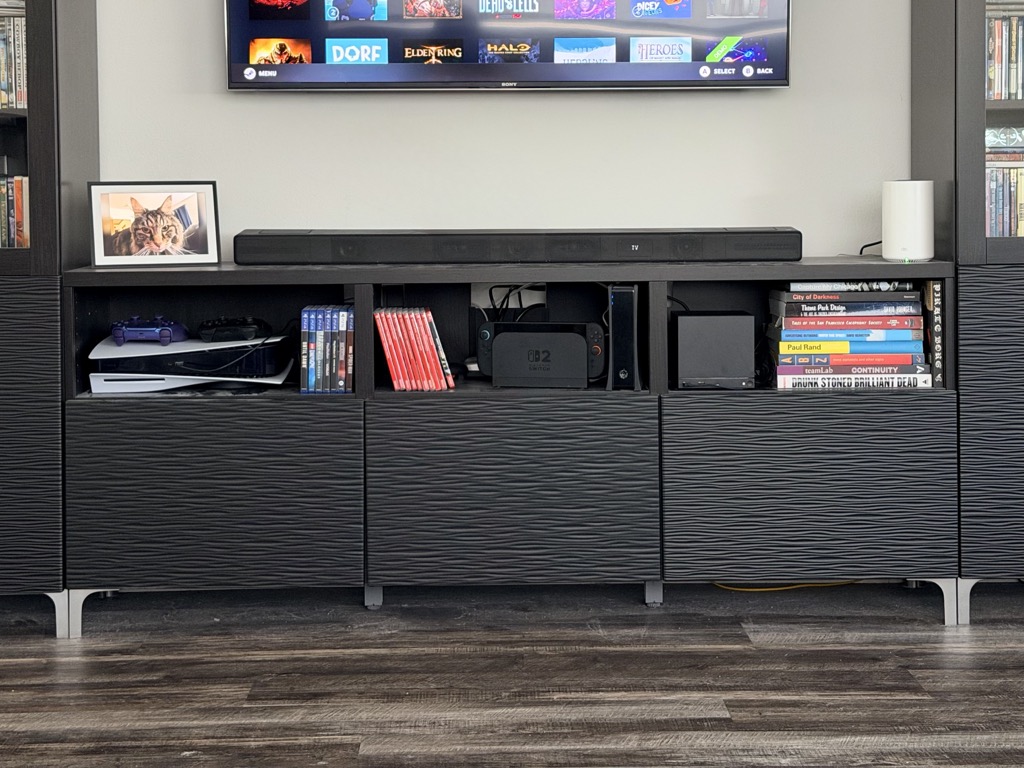
It’s almost like all that time I spent evangelizing Steam hardware was for nothing. I’d come to terms with the cost, more or less, since that’s just how much computing components cost now, since crypto-bros and then AI-bros have made everything worse for everyone. I submitted my Request For Purchase to Valve the second the option became available.
And then Valve’s randomizer had the audacity to put me — me! — on a wait list. Not even waiting to pre-order one, but waiting to be moved onto the list that would eventually be allowed to pre-order one.
Based on everything I’d heard, I was prepared for the idea that I wouldn’t even have my number come up until 2027 at the earliest. And since the Steam Machine is an unnecessary luxury by any definition, I made peace with that and moved on. I can just use that money on a bunch of different, much cheaper things, I figured. And I did.
(To be clear: I didn’t spend anywhere near the cost of a Steam Machine on fountain pens and stationery. I’m not a madman. But it did put me in the overall mindset that the imaginary money I’d set aside for the computer, being an unemployed person, could now be spent on things I wouldn’t have otherwise).
But then, over a month later, while leaving a movie, I saw two back-to-back emails from Steam, telling me I’d been moved from the waiting list to the “reservation queue,” and that my spot in the “reservation queue” had come up.
Was it a glitch, an email sent in error? Did I have somebody at Valve quietly pulling strings for me? Had the demand for these things dramatically fallen off after that initial burst of interest? Did I even still want one? I ignored all of these questions and ordered one anyway. It arrived a shockingly short time later.
You can see it in the photo attached to this post, sitting in its rightful place in our entertainment center, next to two other machines designed for the important task of playing video games on a TV screen. Just from a photo of the three devices side by side, you can immediately tell the big difference: only one of them is still used regularly.
To me, that one picture says so much more than the obvious fact that we need to be better about dusting. Just the fact that it’s so unobtrusive, drawing even less attention to itself than a WiFi router, shows how thoroughly my needs have diverged from the people making all the gadget blogs and videos I keep reading and watching. Almost everything that makes it appealing to me is pretty much the opposite of what makes for an exciting tech review.
Small And Quiet
Even after watching a few of the unboxing videos for the Steam Machine, I still didn’t appreciate just how small it is in person. Even compared to a Switch 2 in its dock, it’s still tiny. All the photos of the Steam Machine next to a banana didn’t give me a clear impression of its actual size. I guess I need to spend more time around bananas.
The PlayStation 5 is famously huge, unwieldy, and cursed with a terribly impractical design, so it doesn’t say anything interesting to compare the two. In terms of the design of a device that’s supposed to be part of a “normal adult’s” home entertainment system, the Steam Machine is probably closest to the current Xbox generation, which I skipped due to extreme lack of interest. Apparently, it’s about half the size of an Xbox Series X. That makes me wonder why I never saw a ton of YouTube videos from people showing how to build your own Xbox alternative.
Because there are certainly no shortage of those for the Steam Machine. Every day YouTube serves up another three or eight videos from people claiming that “I can’t believe I beat Valve!” by building a “Cheaper, Better Steam Machine!” with the exact same components that you could be using, if you just had the right attitude, a little can-do spirit, and as much common sense as all that money you seem to be so eager to waste. Every one of those videos I’ve watched has ranged from misguided, to misleading, to outright deceptive. Only mentioning partway through the video that they bought a special one-left-only bundle of out-of-warranty components. Or that they had to 3D print their entire case, and still couldn’t come up with one that was as small.
Or even just building a straightforward mini-ITX PC, which is cheaper, sure, and technically more capable, but which still has every single problem with PCs in the living room, problems which the Steam Machine was specifically designed to address.
I’ve seen so many of these takes that I’ve started to think that maybe they’re not being deliberately deceptive, after all. Maybe people genuinely are unable to comprehend the idea of someone who really does value “small and quiet” above everything else.
I can sympathize, somewhat, because it’s never been a priority for tech journalists, and marketing teams (apart from Apple’s) never emphasize size and noise over processing power, GPU benchmarks, and storage. All of the coverage is designed to be self-perpetuating, after all, to cover the latest and greatest chipset or the groundbreaking new product model. It’s not aimed at people like me, who can’t even remember what GPU is in their PC.1Turns out it’s an RTX 3080, if anyone was wondering. I’ve never had to care because it’s always run everything I wanted it to.
Years in the Making
It’s likely that the Steam Machine will find some audience of people using it on their desktop as their primary computer, even though I imagine that market all but disappeared as soon as the price was announced. But realistically, it’s a living room PC.
Maybe it’d work well as a small, gaming-focused second PC on a desktop, but it definitely seems that all of the advantages of the Steam Machine reveal themselves the farther away you get from the screen. And, realistically, the closer you get to having middle-aged eyesight.
As an aside as an Older Person: It’s funny that for most of my time using computers, people were always dismissing Macs as “toys” and insisting that real work was done on PCs. Ever since I left my last job in traditional game development, both my work and my home setups had a Mac as my main computer, with a PC I’d keep around for playing games. And it’s hardly a representative sample, but most of the people I know have a similar setup. It’s not a completely irrelevant tangent, since it’s an indication of how much assumptions haven’t managed to keep up with reality. And more relevant: how increasingly common it is for people to have multiple, special-purpose computers.
But as someone who plans to use the Steam Machine with my ass comfortably seated on a couch 20 or so feet away from the television, the goal of getting 4K at 60fps couldn’t possibly be any less relevant. I saw several reviews that dismissively called it “a 1440p machine,” and as far as I’m concerned, that’s a sufficient number of ps. Even with a 4K television, that extra resolution is going to be completely lost on me for anything other than text-heavy UI screens.
What’s more important is the HDMI-CEC support built in, meaning I can pick up the controller, press a button, and it will turn on the television and switch to the correct input.
That one convenience is something that I have literally been trying to get for 20 years now. Or at least as long as I’ve primarily bought games through Steam, and wished that I didn’t have to keep getting Xboxes or PlayStations just for the pick-up-a-controller-and-start-playing experience.
The HDMI cable that shipped with the Steam Machine wasn’t long enough to run through the wall to the TV, so I had to dig through all of the old storage boxes to find a longer one. And it was a vivid reminder of just how long I’ve been trying to get a decent living room PC setup going. There was a surprising number of cables, dongles converting DVI to HDMI, dongles for remote controllers, wireless keyboards with touchpads, bluetooth keyboards, bluetooth mice. All going back through one standard after another. All failing to do the job for one reason or another, and ending up with my just giving up and resigning myself to getting the next generation of console. Until eventually losing interest in video games in general.
The Effusive Praise of “It’s Unremarkable”
So I’ve had the Steam Machine set up for a few weeks now, and it’s time for the hard-hitting, no punches pulled, honest review. What is it like to actually use this expensive computer that Valve expects us to believe is a new era in gaming?
It’s fine.
It was trivially easy to set it up and didn’t require me to use a mouse or keyboard even once. It took an SD card loaded with games from my Steam Deck, and we had at least 20 games loaded and ready to go within minutes. We downloaded a few more in hardly any time at all. We even added a couple of special startup videos.
My husband and I actually did something that we haven’t done since the release of Mario Kart World on the Switch 2: we actually played a game together while sitting on the couch. It was the Teenage Mutant Ninja Turtles game Shredder’s Revenge, which I bought when it was released, but was never much fun with only one player. With two, it’s a lot of fun, and super nostalgic even for somebody like me, who has no affection for the turtles or their video games.
I did try playing Star Wars: Zero Company on it, and it didn’t perform very well, even at reduced settings. (Trying it on my desktop PC with Bazzite also performed badly until locking up entirely; I’ve only gotten any stability out of it by holding my nose and rebooting into Windows). I was inclined not to play it in the living room anyway, since it’s a little too text-heavy for a living room setting.
Which gets to the aspect of the Steam Machine that really is groundbreaking, even though it’s the one that rarely gets talked about at length, because it’s so obvious. It’s the line that’s repeated in all of Valve’s marketing, and which is printed on the sides of all their boxes. All some variation on “your games, how you want them.”
Of course, they’re still not really your games, since getting it on Steam just gets you a digital license. Which is an increasingly relevant sticking point for video game fans, but isn’t much of a practical issue at the moment. Because if I get a game intending to play it on the Steam Machine, I can also play it on three other computers I have at the moment, on four different operating systems.2My PC dual boots between Bazzite and, only when necessary, Windows.
Theoretically, I could play a mouse-and-keyboard dependent game sitting on the couch, using the trackpads on the Steam Controller, but more realistically, I’ll just play it upstairs at my desk. And I’ll probably always gravitate towards the sims and city builders that work best that way. But there’s been a surprising number of games that work well whether I’m at the desktop, using the Steam Deck handheld3Or using the Steam Deck docked to my desktop monitor, which is I guess a fifth way to play stuff?, or now, sitting in the living room with a bigger TV and a pretty nice sound system.
That’s a lot more flexibility than the Switch offers, and of course it’s miles ahead of what I can do with the PS5.4I have to say that I still can’t believe that anyone took the “Playstation Portal” seriously. No offense to anyone who found a use case, I guess, but $250 for a screen that’s still bound to your home console is extravagant even for somebody as in the thrall of convenience and unnecessary gadgetry as I am. And it just drives home the real cost of console exclusives and lock-in, and why Valve wasn’t willing to subsidize the cost of their hardware, even though they’re making obscene amounts of money on Steam.
Being able to play the game you’ve bought on whatever hardware you bought sure feels like the way it should have always worked, but we’ve spent decades being trained to accept that enjoying video games needs to be really expensive, inconvenient, and consumer-hostile. And that console manufacturers providing backwards compatibility was this rare gift that we should be thankful for. Which is ludicrous, because the rare gift we should be thankful for is obviously the ability to play games in multiplayer, with people who don’t use the same hardware. Can you even imagine being able to do that without paying a monthly subscription fee?
Most of the stuff I’ve thrown at the Steam Machine has worked well. The most consistent issue I’ve run into has nothing to do with the processor or the GPU, but how PC games are almost never designed to be run on a TV that’s several feet away. Few games that weren’t designed to be simultaneous console releases support fully scalable UI, so the text is all but illegible unless you lower the resolution to something that makes everything else look ugly. I’m hoping it becomes more common practice to support bigger text, if living room PCs become a bigger market.
But overall, my early impression of the Steam Machine is that it simply works, exactly the way that I’d hoped it would. And the way that I’ve wanted it to work, for as long as I can remember, for as long as I’ve been playing games on a television screen. The idea that I’ve finally got that, in a tiny box with a giant heat sink sitting quietly and unobtrusively in my entertainment center, feels pretty revolutionary.
Comments
One response to “The Steam Machine: Now You’re Playing With… Convenience”
A tangent on the licenses versus ownership thing that’s my personal rabbit hole is the idea of digital estate planning. If I want to will my Steam account to my nephews it is technically illegal per Steam terms and Steam could terminate the account rather than allow the transfer. In practice password sharing “under the table” works just fine and is relatively common. But with so much of our estates “digital” now it feels worth establishing actual rights. I need to write a full blog post on the subject.