On the day I’m writing this, BlizzCon is going on, which means a lot of teasers, previews, and announcements for games that make me say, “Wait, are people really still playing that after all these years?” Yesterday morning, one of the first things I saw online was a post about the teaser for the new Starcraft, the successor to Blizzard’s seminal but long-dormant sci-fi real-time strategy series.
The post simply had a few screenshots from the teaser trailer, with close-ups of a grim space marine, giant landing ships on an alien planet, and an impressive mech suit. The text said: “StarCraft announced (open world shooter) – Coming 2030”.
I assumed it had to be a parody of whatever Blizzard had actually announced. Can you even imagine a company with the definitive real-time strategy franchise releasing a new entry and choosing to make it just another open world shooter? And announcing a game that won’t come out until 2030 has to be a gag, right?
Four years is not a particularly long development time; I’ve regret to say that I’ve taken even longer than that to make fairly simply games for a 1-bit handheld platform. But it’s like how you always list a price as $999 to avoid the psychological barrier. 2030 feels like it should be so far away! The bigger problem, though, is that Starcraft is such a well-known and fiercely beloved franchise, so why would anyone want to release a successor that makes audiences ask, “How is that not just another Destiny or Halo?”
I swear that all of this is relevant to a tribute to Battlezone, released in 1998.
It was also an attempt to make a new update for a seminal game that was almost 20 years old at that point. The original was a classic vector-based tank game that was almost certainly the first first-person game that most people had ever seen. The developers also were tasked with being faithful to the original, but making something that fit in better with the trends at the time.
And the trends at the time were, well, the first StarCraft. Or more accurately, the Command and Conquer series, which had already been out for a few years. Real-time strategy games were huge. To the point that it’s still weird to me whenever I realize that they’re just not a thing anymore. Just about every month since I’ve started working in video games, I’ll see another video or essay about the Death of Adventure Games, but it’s actually more surprising to me that the RTS genre seems to have so thoroughly disappeared, considering how ubiquitous it was.
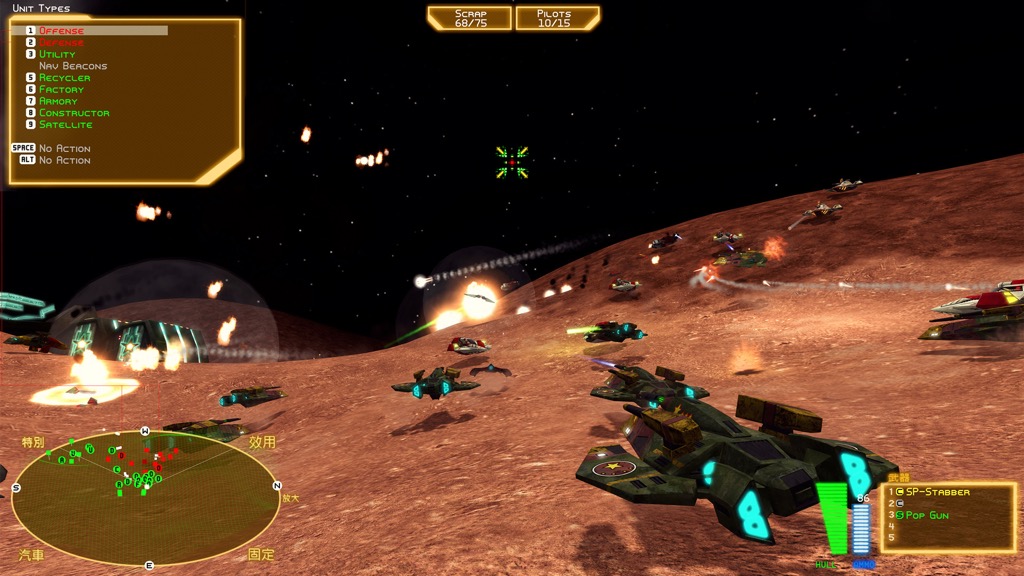
Battlezone took the first-person tank combat of the original and not only updated everything to contemporary 3D instead of wire frames, but added two more layers: a first-person shooter, and an RTS base-building and unit-management game. You could jump in and out of different vehicles and drive them around, or try (usually unsuccessfully) to take them out on foot. You could also order construction of new buildings and new units, and give them automated instructions.
It seems like it shouldn’t have worked, since there would be too much to deal with all at once. But it worked beautifully. You were constantly having to switch between the immediate, immersive concerns of a shooter; the tactical concerns of a skirmish; and then the overall strategy of where you choose to build and how you choose to advance on the enemy.
And because you could never remain completely in the realm of unseen commander hovering over the battle, sending faceless units to their doom, there was a near-constant shift in drama and immersiveness as well. You —or at least I, as a person who’s generally bad at video games — could find yourself outside of your tank and super-vulnerable on foot, deciding whether you want to be reckless and try and take on the enemy with no defenses, or scramble and try to stay out of sight while you desperately search for, or construct, another vehicle.
On top of that, there was a story campaign dealing with an alternate-history Cold War, with the US and USSR fighting for dominance of the solar system. That made it feel similar to a less-fantastic version of Command and Conquer, which to me was far more interesting than Blizzard’s pastiche of every sci-fi movie or book they’d ever seen, plastered on top of a meticulously-balanced strategy game.
And you could play through the campaign, or play in multiplayer matches against real opponents. The existence of the latter is why I never did the former, and why I never actually played much of Battlezone no matter how much I liked it. When I worked at LucasArts, we would play in LAN matches after hours against members of the QA teams, and it was always a humiliating spectacle. Like playing against the Harlem Globetrotters levels of being so thoroughly outmatched by professionals. Even more than Counter-Strike, it was that experience that made me realize that I’m just shit at most action games, and even though I don’t care that much about winning, I still hate losing so completely and profoundly as we did in those matches.
But it’s stood out in my mind ever since as one of the most ingenious game designs I’ve ever played. The perfect example of taking on what should’ve been too much, and still managing to pull it off.
One of the most common ideas when you’re a younger fan of video games is that of the “Everything Game.” You can kind of tell how long someone has been playing games and thinking about how they’re designed, simply by how much they try to put into it. Starting out, it seems like a natural progression: if I’m having this time running around and shooting, wouldn’t it be even better if there were a ton of lore and world-building? And I could talk to every NPC? And if there were a higher-level strategy layer on top? And lots of mini-games? It’s easy to think that not being as maximalist as possible with a game design is nothing more than a failure of ambition.
Most people eventually come to the realization that that’s why we have different video games. When you have a game that tries to do everything, it’s never a “oh boy! Two cakes!” situation, even when the individual parts are done well. The elements fight with each other, often ruining the pacing, often detracting from the impact of each other, and often feeling exhausting. It’s why whenever I see a game that tries to be everything to everyone, I immediately think of it as a case of unchecked ego and out-of-control scope.
But there are significant exceptions, the games that take on more and actually pull it off. Subnautica was a recent surprise. But Battlezone makes me more intensely nostalgic, because I didn’t fully appreciate at the time how optimistic it was. There was still a belief in “let’s try it and see if it works!” Even as it was trying to do more, it incorporated all of its layers into the design; it wasn’t an open-world game simply because publishers think you have to be an open-world game to be viable with a business that’s pouring hundreds of millions of dollars into a release.
And its story and setting weren’t the most original thing, but were very clever, and they showed that the developers still believed that the storytelling mattered. Even in a game that was all about the action and strategy. It reminds me a little bit of the Electronic Arts album cover days, selling a clever and self-contained idea with a novel story and design that work together. Nothing like a bloated games-as-a-service behemoth that it would be today.
The screenshot attached to this post is from Battlezone 98 Redux, which was a remaster of the game that was a modern reinvention of the original classic. And now, even that remaster is 10 years old. And I wish I lived in the alternate universe in which this game set off a trend that would define the next 20+ years.
Leave a Reply