I’m still not sure what exactly I was thinking when I decided The Autopsy of Jane Doe would be fun Spooktober viewing for somebody like me, who’s so easily triggered. I guess I heard the idea of “father and son coroners trapped in a funeral home with a vengeful corpse” and concentrated on the ghost story part, and not on the fact that the autopsy mentioned in the title would play such a big part.
So I was already watching much of it through my fingers, and that was before they put a cat in harm’s way. For other sensitive animal lovers: skip everything between 34 and 37 minutes.
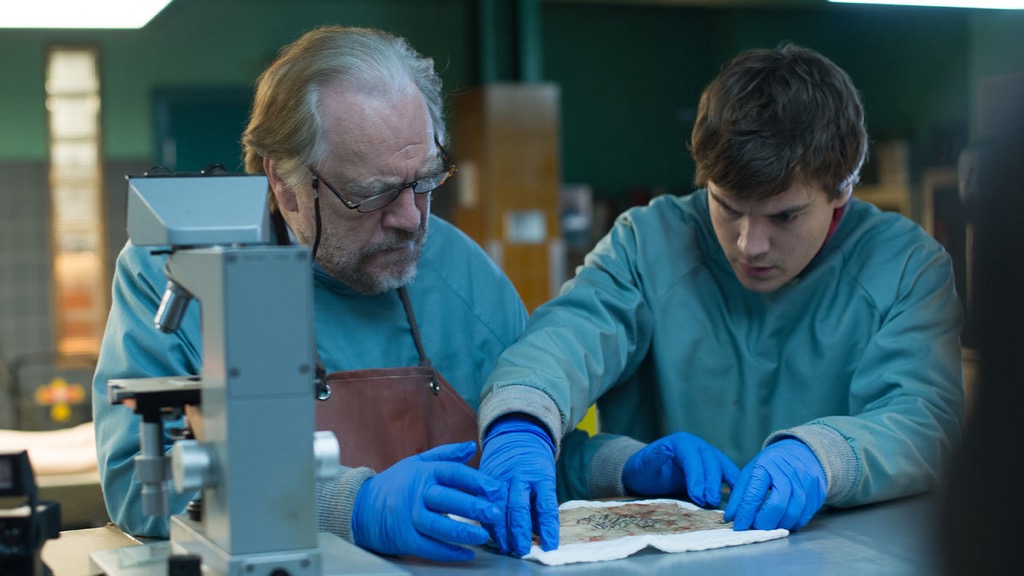
The premise is that police in a small town in Virginia are investigating a triple homicide when they find the nude body of a young woman buried in the basement. Knowing that there will be a lot of press attention, the sheriff takes the body to the local coroner for a rush job, to determine a cause of death by the morning. The coroner, played by Brian Cox, runs a family-owned mortuary with the help of his son, played by Emile Hirsch.
Everything in the first half of The Autopsy of Jane Doe is handled like a slick and moody police procedural, feeling like a Prestige TV series take on Silence of the Lambs. It does feel a little too self-consciously artsy, but it’s all solid and anchored by good performances all around, from Cox and Hirsch in particular.
They’re set up as extremely familiar stereotypes. He’s gruff and no-nonsense, an expert not just from having seen it all, but from having exceptional powers of observation. He’s demanding in his training of his son, who secretly has no plans of carrying on the family business. They perform an autopsy on a burn victim while listening to rock music on the radio, and the dad tests his son by asking him for the cause of death. When he offers the more obvious conclusion, dad corrects him by pointing out the detail that he’d overlooked. It’s all exactly the kind of scene you’d see in at least a dozen different series on CBS over the past couple of decades.
But the movie lets a genuine sense of affection show through. They really do love each other. And there’s a scene where Cox’s character shows some warmth and humor by encouraging Hirsch’s girlfriend to look at one of the corpses, if she’s so curious about them. He explains that a bell is tied around the ankle of one of the corpses as part of an old coroner’s tradition, and he’s a traditionalist: back when it was difficult to distinguish a dead body from someone in a coma, they used the bell to allow the person to signal that they were still alive. His dark sense of humor is evident in that he put it on the body of a man whose head had been blown off by a shotgun.
Once the autopsy of the title character starts in earnest, though, it soon becomes clear that this isn’t a character study. It’s not going to be using horror to explore any deeper themes, either. It’s all about showing the gruesome parts of poking around a body, cutting it open, spreading it apart, breaking it apart, scooping stuff out. There are a lot of close-ups of blood and organs and various parts of the inside of a body, and descriptions of horrific things. The only time the camera seems to stay a discreet distance away is when they’re checking for sexual assault.
The combination of the slick production, the strong performances, and all the gore is enough to trick you into thinking this is a much smarter and deeper movie than it actually is. The examination starts to uncover all of these seemingly impossible horrors, and it is all genuinely intriguing, but it’s punctuated by lots of jump scares and digressions to check out strange noises. It seems superfluous to keep going for the cheap scares when they’ve got plenty of horrific stuff going on in the examination room. It almost feels like some of it was put in out of a sense of obligation; this is how horror movies are supposed to work. Or maybe there wasn’t enough confidence that the things learned over the course of the examination would be scary enough on their own.
To its credit, the movie doesn’t waste much time having its characters not believe that they’re in a horror movie. It only takes a couple of inexplicable occurrences for them to start treating it like the supernatural event it so clearly is.
But the moment that things take a turn for the supernatural is the moment when The Autopsy of Jane Doe breaks whatever spell it’s been able to cast, convincing you that it’s deeper than it actually is. You soon realize that its creepy and evocative setting, and its unflinching gore, are making promises in the first two acts that the last act isn’t able to keep. None of the jump scares worked for me at all, because they all seemed so telegraphed.1There’s a scene where Hirsch’s character is startled by what he sees in a microscope, and then he asks Cox to take a look, and I would not have been at all surprised if the microscope slide had suddenly revealed a demon face. (Fortunately, the movie doesn’t go that far). And the horrors of the last act are mostly glimpsed, shrouded in shadow, instead of seen full-on, which would be an excellent show of creepy restraint in a different movie, but just seems anticlimactic in one that’s already spent so much time giving you close-ups of the outsides and insides of dead bodies.
And the most dramatic and horrific plot development is something that seems like a strong idea in theory, but just lands with a dull thud here because it doesn’t fit with everything else we’ve seen. Instead of being hit with the full impact of it, you’re just wondering how it even makes sense, considering our characters are trapped in a cellar in the middle of the storm of the century and a power outage. The movie does retroactively suggest a kind of explanation at the end — basically, it’s doing Oculus, but without doing all of the build-up that that movie does, establishing that incessant dread of uncertainty.
So the end result is that The Autopsy of Jane Doe has all the elements of a good old-fashioned horror story in an extremely evocative setting; good performances of likeable and believable characters; and the willingness to go for an intensity you might not expect from a movie that would seem to rely mostly on mood and suggestion. It just undermines itself when it has to actually deliver on all of the creeps and horrors it spent so much time suggesting.
Leave a Reply